





 Portuguese
  English
  Spanish
  4 min of reading
  0 comments


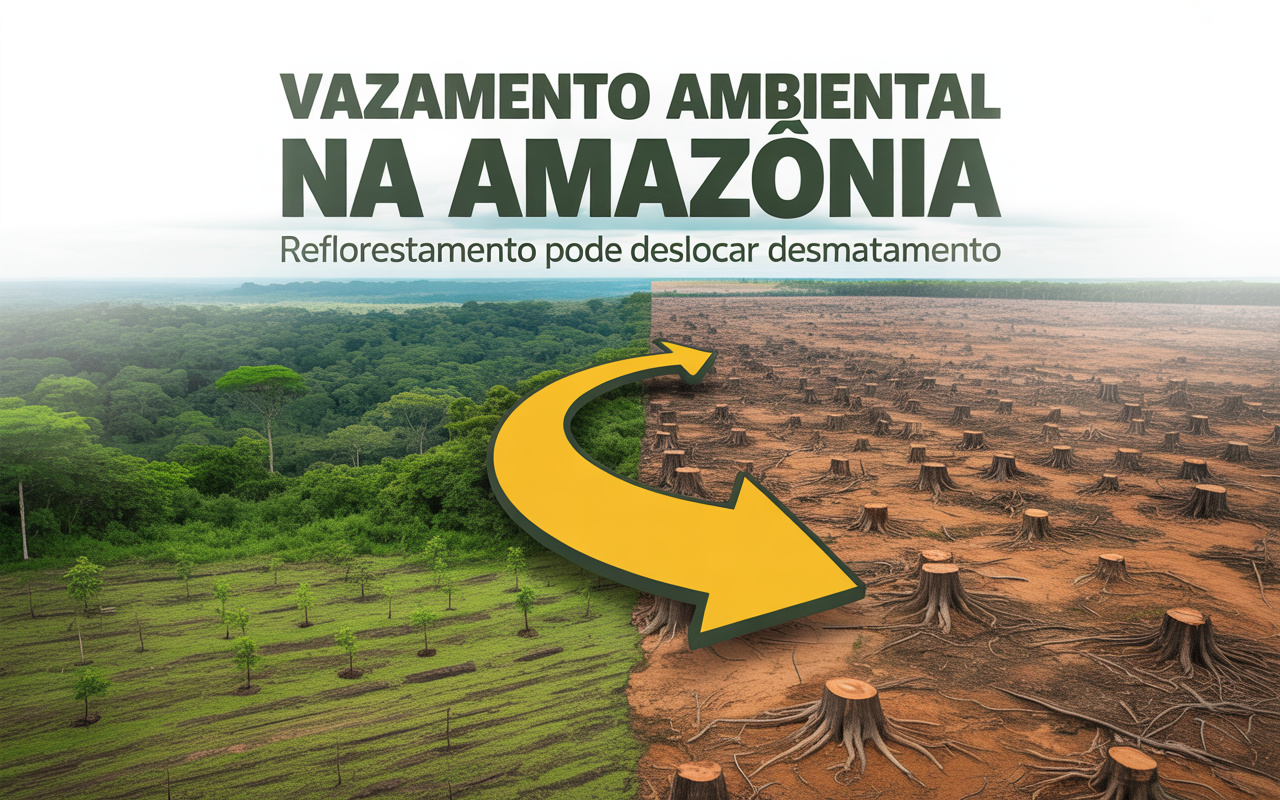
Study Published in Land (MDPI) Shows That Reforestation in the Amazon Can Shift Up to 12% of Deforestation to Neighboring Municipalities, Generating an Unexpected Indirect Effect.
For years, reforestation has been treated as one of the most direct solutions to curb the advance of deforestation in the Amazon and mitigate climate change. Planting trees, recovering degraded areas, and restoring forests seems, at first glance, an environmentally unequivocal strategy.
However, a recent study published in 2025 in the scientific journal Land, by MDPI, brings an important alert: reforestation efforts can provoke an indirect effect known as “deforestation leakage,” shifting agricultural and livestock activities to neighboring municipalities and generating new deforestation hotspots.
What the Scientific Study Says
The article, titled Leakage Effects from Reforestation: Estimating the Impact of Agricultural Displacement for Carbon Markets, was conducted by researchers Daniel S. Silva and Samia Nunes.
-
Motorola launched the Signature with a gold seal from DxOMark, tying with the iPhone 17 Pro in camera performance, Snapdragon 8 Gen 5 that surpassed 3 million in benchmarks, and a zoom that impresses even at night.

-
Satellites reveal beneath the Sahara a giant river buried for thousands of kilometers: study shows that the largest hot desert on the planet was once traversed by a river system comparable to the largest on Earth.

-
Scientists have captured something never seen in space: newly born stars are creating gigantic rings of light a thousand times larger than the distance between the Earth and the Sun, and this changes everything we knew about stellar birth.

-
Geologists find traces of a continent that disappeared 155 million years ago after separating from Australia and reveal that it did not sink, but broke into fragments scattered across Southeast Asia.

The research analyzed municipal data from the Brazilian Amazon from 2000 to 2023, using spatial econometric models to understand how changes in land use in one municipality affect nearby areas.

The main finding was clear: When areas are designated for reforestation, part of the productive activities—especially livestock and agriculture—does not disappear. Instead, they may migrate to neighboring municipalities.
This displacement was statistically significant and represented, on average, about 12% of the reforested area converted into additional deforestation pressure in nearby regions.
How “Deforestation Leakage” Works
The mechanism is relatively simple, but its implications are complex. When a municipality enhances reforestation policies or restricts land use for productive activities, producers who depend on these areas may seek new available lands. In regions like the Amazon, where extensive areas are still subject to conversion, this migration can lead to the opening of new fronts for deforestation.
The study identified that the leakage effect tends to occur within a radius of approximately 150 kilometers and usually manifests within up to two years after reforestation begins. In other words, environmental policy in one area can generate indirect impacts in another, altering the regional land-use dynamics.
Implications for Carbon Markets
One of the most sensitive points of the study relates to carbon markets. Reforestation projects often generate carbon credits based on estimations of avoided emissions or sequestered carbon. However, if part of the agricultural activity simply migrates to another area and causes new deforestation, the net climate benefit may be lower than estimated.
According to the authors, certification systems and international programs—such as those used by private initiatives and REDD+ mechanisms—may underestimate this spatial effect if they do not incorporate models that capture regional displacements.
This means that although reforestation remains an important tool, it needs to be accompanied by integrated policies that prevent the simple transfer of environmental pressure to another territory.
The Territorial Complexity of the Amazon
The Brazilian Amazon is marked by strong economic and territorial interconnectedness. Productive chains of livestock, soy, and other agricultural activities operate on a regional scale.
In this context, changes in land use in one municipality are unlikely to remain confined to its administrative borders. The study shows that isolated policies can generate adaptive market responses, especially when there is continuous demand for agricultural production.

This does not mean that reforestation is ineffective. On the contrary: it remains essential for restoring ecosystems, protecting biodiversity, and sequestering carbon. The central point is that effectiveness depends on integration with broader territorial planning.
The Challenge of Environmental Policies
The results reinforce a growing discussion in the field of environmental economics: local policies need to consider indirect effects. Without regional or national coordination, well-intentioned actions can yield partial results. Deforestation may not decrease overall if it simply changes location. This highlights the need for:
- Integrated territorial planning policies
- Increased oversight in adjacent regions
- Sustainable economic incentives for producers
- Alignment between reforestation and productive chains
The research suggests that considering only local indicators may lead to overly optimistic assessments of the environmental impacts of restoration projects.
What Changes in the Environmental Debate
The study published in Land does not invalidate reforestation but complicates the debate. It shows that environmental solutions require a systemic view. In a continental region like the Amazon, decisions made in one municipality can reverberate for hundreds of kilometers.
The unavoidable question arises: are environmental policies being designed with sufficient territorial reach to prevent the problem from merely changing addresses?
In a scenario of increasing global climate pressure and the expansion of carbon markets, understanding these indirect effects can be decisive in transforming good intentions into effective environmental results.








-

Uma pessoa reagiu a isso.