





 Portuguese
  English
  Spanish
  6 min of reading
  0 comments


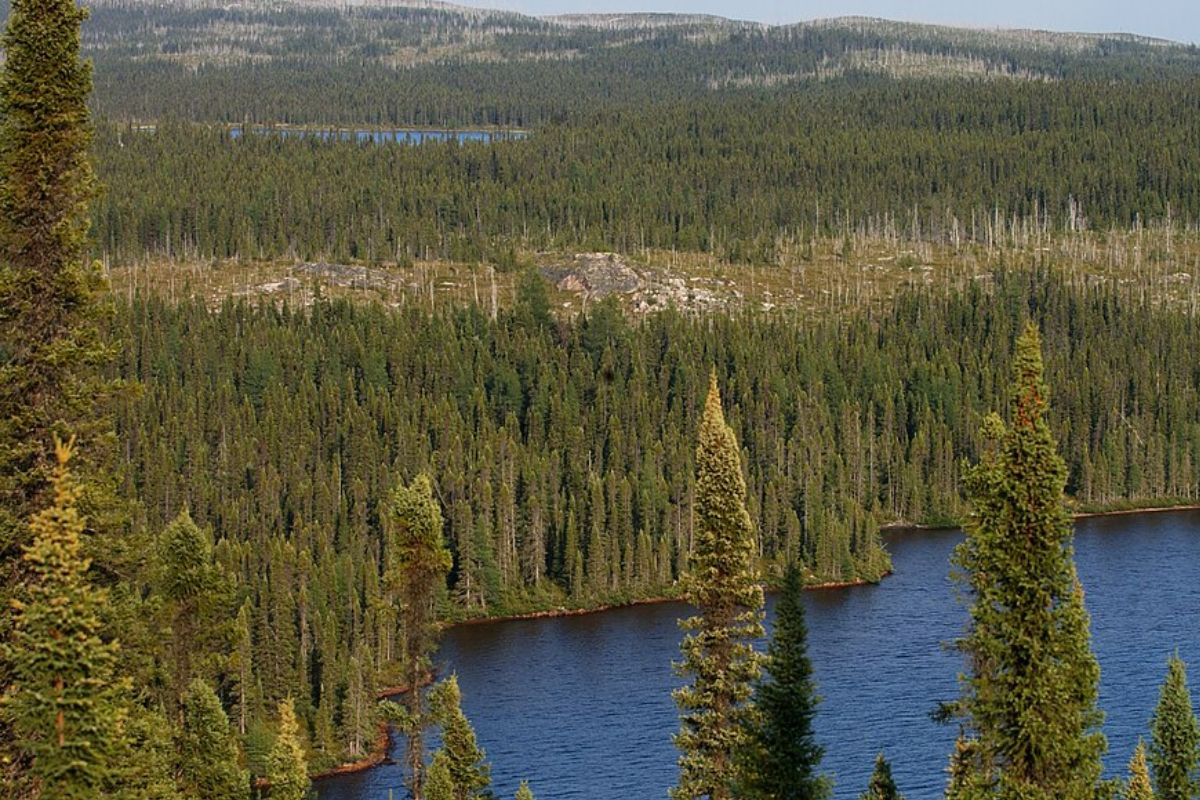
Reforesting the Boreal Edge of Canada Seems to Be a Powerful Solution for the Climate, With the Potential to Capture Up to 19.4 Gt of CO₂, But Fire, Permafrost, Albedo, and Early-Dying Seedlings Could Reverse the Balance
Reforestation has become a magic word in climate debate, but on the boreal edge of Canada, it comes with a huge asterisk. A new study estimates that reforesting up to 32 million hectares in the north of the country could capture up to 19.4 gigatons of CO₂ by 2100, equivalent to five times Canada’s current annual emissions. It’s a scale that transforms the boreal taiga into a candidate for a central mitigation tool.
At the same time, the authors make it clear that reforesting is not just pressing a green button. Fire regimes, early seedling mortality, temperature and precipitation changes, effects on permafrost and albedo can turn an ambitious plan into a mediocre or even problematic outcome. Reforesting can be part of the solution or become a fragile promise, depending on where, how, and with what care it is planted.
Why Reforesting the Boreal Edge Seems So Tempting
The climatic context weighs heavily. Warming at high latitudes is accelerating and does not behave like the rest of the planet. In the Arctic and its periphery, longer seasons, more frequent extreme events, and stress on slowly evolving ecosystems are already a reality.
-
Motorola launched the Signature with a gold seal from DxOMark, tying with the iPhone 17 Pro in camera performance, Snapdragon 8 Gen 5 that surpassed 3 million in benchmarks, and a zoom that impresses even at night.

-
Satellites reveal beneath the Sahara a giant river buried for thousands of kilometers: study shows that the largest hot desert on the planet was once traversed by a river system comparable to the largest on Earth.

-
Scientists have captured something never seen in space: newly born stars are creating gigantic rings of light a thousand times larger than the distance between the Earth and the Sun, and this changes everything we knew about stellar birth.

-
Geologists find traces of a continent that disappeared 155 million years ago after separating from Australia and reveal that it did not sink, but broke into fragments scattered across Southeast Asia.

Within this scenario, Canada has committed to formal emissions reduction targets by 2030 and net-zero emissions by 2050. This requires both decarbonizing the economy and creating robust and verifiable carbon sinks.
This is where reforesting the boreal edge catches the eye: the boreal forest already stores huge carbon reserves, much of it in the soil and organic matter, not just in the trunks.
The temptation is to see the biome as a giant carbon sponge, and reforesting farther north would, in theory, expand this reservoir.
How Much Carbon Reforestation Could Remove by 2100

The study works with scenarios of reforestation and afforestation on a giant scale in the boreal taiga, ranging from 6.4 to 32 million hectares along the northern edge. Instead of a single number, the researchers simulate ranges of outcomes.
By reforesting within this range of area, the estimated net removal goes from 3.88 to 19.4 gigatons of CO₂ equivalent over 75 years.
Even the most conservative scenario is described as a substantial contribution to Canada’s climate neutrality targets.
The ecozone of the Western Taiga Shield appears as the most promising in terms of total ecosystem carbon. But the central message is different: reforesting on this scale only makes sense if the permanence of that carbon is credible.
How the Study Calculates Reforestation Potential More Realistically
The novelty is not just in asking if reforestation is worthwhile, but in how to do the calculations. Aggregate models tend to smooth the landscape, as if each hectare behaved the same. Here, a different choice was made.
The authors use a spatially explicit carbon budget model, the GCBM, capable of working with the five compartments required by the IPCC approach: aboveground biomass, belowground biomass, litter, dead wood, and soil organic carbon.
Instead of an average, the model tracks carbon fragment by fragment, including periods of decline.
Additionally, Monte Carlo simulations are used, with thousands of runs that vary prior coverage, initial mortality, climate, and wildfire probability. Reforesting stops being a single number and becomes a map of risks and opportunities.
Fire as a Variable That Can Change Everything
Among all the uncertainties, the return interval of fire appears as a master variable. With long intervals between fires, carbon can accumulate for decades.
With short intervals, the gain drops drastically, and in some scenarios, maintaining a high net capture becomes difficult.
This aligns with recent reality. The record-breaking fire season in Canada in 2023 has become a mandatory reference when discussing carbon permanence: when the forest burns, it’s not just biomass that is lost; it’s the carbon balance and public health that come into play.
When reforesting in regions with a high fire risk, the project begins to depend on active risk management. Without it, years of capture can return to the atmosphere in a single bad season.
Reforesting Is Not the Same as Afforestation
The study reinforces a distinction often confused in headlines. Reforesting means recovering land that was historically forested, which already has soil and microclimate compatible with the forest. In these cases, the chance of success is greater, and the focus tends to be on restoration.
Afforestation of historically non-forested areas is riskier. It can work in some contexts, but it is much more sensitive to local limitations, plant mortality, and disturbances. In simple terms, reforesting where there has been forest is usually less risky than forcing forest where it has never existed.
Early Seedling Mortality: The Blind Spot of Many Reforestation Projects
Another central warning is early mortality. If many seedlings die in the first years, the capture potential plummets. In the model, high mortality in the first five years jeopardizes the outcome.
In practice, this is not a technical detail. The northern region is hostile: cold, with complex soils and expensive logistics. Serious reforestation requires selecting adapted species, appropriate establishment techniques, and real monitoring, not just the planting photo. If only a small fraction survives, the promised carbon becomes just an intention.
In a scenario with carbon markets and public targets, promising and failing to deliver becomes a reputational risk.
When Reforesting Runs Into Permafrost and Albedo
Two side effects emerge as natural complicators of the idea of reforesting everything possible.
Permafrost: forest cover can act as a thermal insulator, protecting part of the carbon in the soil. But the outcome depends on vegetation type, snow, moisture, and local dynamics. Not every reforestation project automatically improves permafrost stability.
Albedo: at high latitudes, more trees can darken the surface, especially over snow, causing the system to absorb more radiation. This reduces reflectivity and can offset part of the carbon sequestration benefit if the locations are poorly chosen.
Therefore, reforesting is not “the more area, the better,” but “where the net benefit is truly positive.”
Biodiversity and Land Use: Not Every Open Area Is a Candidate for Reforesting
The so-called “free” planting maps often show areas that are, in reality, wetlands, shrublands, pastures, or peatlands with essential ecological functions.
Converting these environments into forests can mean habitat loss, alteration of hydrological cycles, and impoverishment of the landscape.
The study suggests that, instead of a race to plant the maximum number of hectares, the more coherent strategy is a mosaic of solutions: prioritizing degraded areas or those with recent loss of forest cover, avoiding valuable wetlands, and diversifying plantings so that a single fire does not erase a generation’s work.
Governance, Fire, and Indigenous Leadership in Reforesting the North
In northern Canada, discussing reforesting without addressing governance and local knowledge is incomplete. The country has been revaluing Indigenous practices of controlled burning and land management as tools to reduce wildfire risk and strengthen biodiversity.
It’s not about romanticizing, but about adaptive management based on accumulated experience, with clear objectives: reducing available fuel, breaking landscape continuity, and protecting communities. Reforesting without integrating this type of management increases the chance of seeing planted carbon turn to smoke.
What Reforestation Really Means in the Boreal Edge

In the end, the study does not sell reforestation as a magic formula. The message is more mature: reforestation and afforestation in the boreal edge have substantial carbon removal capacity, but function like an obstacle course.
Between the potential of 3.88 to 19.4 Gt of CO₂e and the real outcome lie wildfires, dying seedlings, sensitive soils, permafrost, albedo, biodiversity, and political decisions.
Reforesting can be a powerful tool if done with criteria, a clear target, and respect for the territory.
In your opinion, does it make more sense to prioritize reforesting degraded areas that are already forested or to invest in afforestation of new areas in the boreal edge to tackle the climate crisis?







-

-

2 pessoas reagiram a isso.