





 Portuguese
  English
  Spanish
  3 min of reading
  0 comments


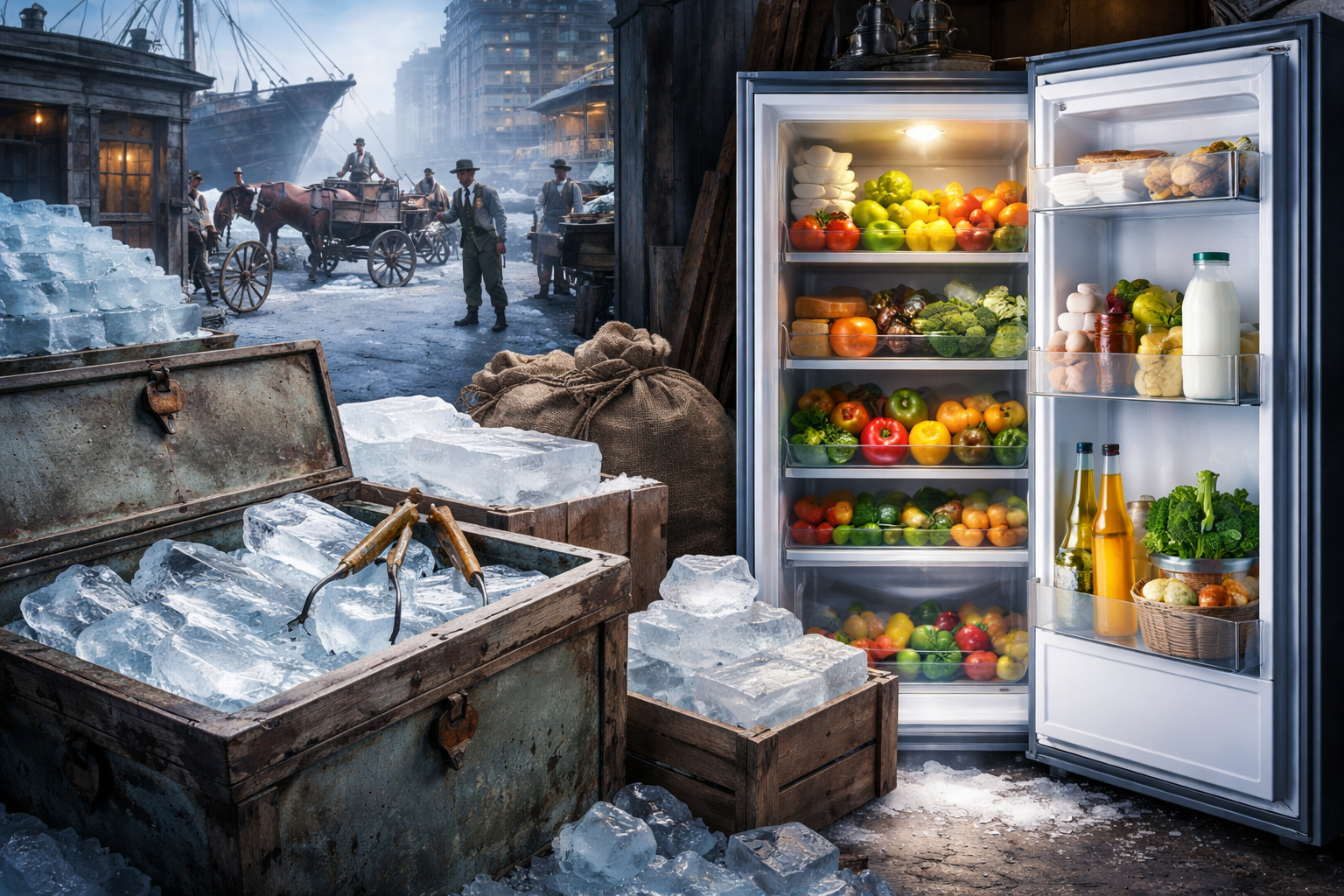
From Yellow Fever to Scientific Advancement, Understand How Natural Ice Became an Empire, Faced Sanitary Crises, and Was Surpassed by Technology
A global technological transformation began in the early 19th century and gradually redefined trade, cities, and science.
Initially, in 1806, the Boston merchant Frederick Tudor sent over 80 tons of ice to the Caribbean, according to the Boston Gazette from February 13 of that year.
Although half of the cargo survived, the project faced disbelief and losses.
Still, over the following decades, Tudor expanded routes to Cuba, Jamaica, India, Brazil, Singapore, Hong Kong, and Australia, consolidating an empire that, by 1856, reached 132,000 tons annually.
For this reason, he became known as the “Ice King”, dominating the international trade of natural ice.
-
Motorola launched the Signature with a gold seal from DxOMark, tying with the iPhone 17 Pro in camera performance, Snapdragon 8 Gen 5 that surpassed 3 million in benchmarks, and a zoom that impresses even at night.

-
Satellites reveal beneath the Sahara a giant river buried for thousands of kilometers: study shows that the largest hot desert on the planet was once traversed by a river system comparable to the largest on Earth.

-
Scientists have captured something never seen in space: newly born stars are creating gigantic rings of light a thousand times larger than the distance between the Earth and the Sun, and this changes everything we knew about stellar birth.

-
Geologists find traces of a continent that disappeared 155 million years ago after separating from Australia and reveal that it did not sink, but broke into fragments scattered across Southeast Asia.

Natural Refrigeration Sustains Empire and Reorganizes Cities
Initially, ice was manually harvested from frozen lakes in the northern United States, in dangerous operations.
Later, Tudor reduced costs by using sawdust as insulation and horse-drawn plows, making the process more efficient.
In the 1860s, home iceboxes emerged, increasing urban consumption.
In New York, the average consumption exceeded 600 kilograms per person per year.
Moreover, the expansion of refrigerated railcars reorganized the supply chain.
Between 1882 and 1886, shipments of beef to New York skyrocketed from 2,400 to 63,000 tons.
Consequently, Chicago grew from 30,000 inhabitants in 1850 to 1.7 million in 1900, establishing itself as the national meat processing center.
Sanitary Crisis Undermines Confidence in Natural Ice
However, during the Industrial Revolution, factories were dumping waste into rivers and lakes.
Thus, natural ice began to carry invisible impurities.
Historical accounts mention cases of cholera associated with the consumption of contaminated ice.
Therefore, gradually, public trust diminished and opened space for more controlled alternatives.
John Gorrie and the Origin of Artificial Refrigeration
Meanwhile, in 1841, in Florida, physician John Gorrie was facing outbreaks of yellow fever.
In the face of ice shortages, he developed experiments based on air compression and expansion.
In 1851, according to records from the United States Patent Office, Gorrie patented his artificial ice machine.
However, he faced strong resistance and public criticism, as well as financial difficulties.
Later, in the 1850s, Scottish engineer James Harrison, working in Australia, refined the system.
He utilized evaporation and condensation cycles of volatile fluids, making the process commercially viable.
According to historical accounts, Harrison was able to produce up to 3,000 kilograms of ice per day.
Thus, artificial refrigeration began to replace natural ice.
The Popularization of the Refrigerator and the Consolidation of the Cold Chain
Later, in 1927, affordable home models emerged.
According to historical data from the period, less than 1% of households had refrigerators in the 1920s.
However, by 1944, about 85% of homes in the United States were already using the appliance.
Consequently, the refrigerator became one of the fastest adopted technologies of the 20th century.
In addition, it definitively consolidated the cold chain, essential for food, medicines, and scientific research.
Scientific and Technological Impact of Refrigeration
In addition to food, refrigeration began to enable vaccines, insulin, blood donations, and magnetic resonance imaging.
Subsequently, similar principles allowed cooling advanced scientific equipment, such as particle accelerators and space telescopes.
Indeed, laboratory techniques such as PCR relied on thermal preservation to enable modern discoveries.
Thus, what started as the trade of natural ice evolved into a global technological system.
While Tudor’s empire marked the 19th century, it was artificial refrigeration that definitively redefined the urban, industrial, and scientific structure of the modern world.
In light of this historical transformation, what current innovation might be quietly preparing for the next great structural change in society?








-

-

-

6 pessoas reagiram a isso.