





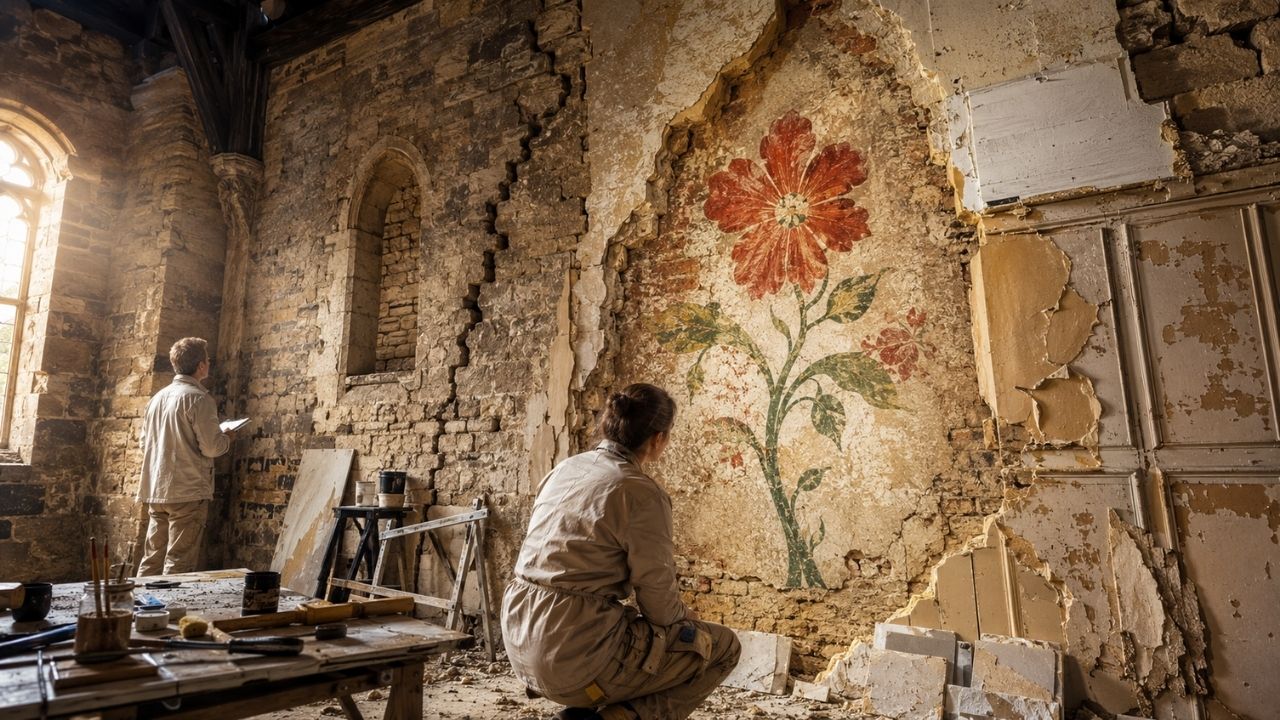

Hidden for centuries in Durham Castle, the medieval mural painting features a masonry pattern, red flower, and green stem; the restoration also revealed windows closed in the 16th century, an oyster shell, and signs of structural sinking linked to transformations carried out by the powerful English medieval bishops in the historic fortification.
A medieval mural painting estimated to be between 700 and 750 years old was found during renovations at Durham Castle, in northeast England. Archaeologists, historians, students, and conservation professionals revealed the work hidden under layers of plaster and panels installed in the 1950s, along with other marks of the building’s transformation.
The discovery was announced by Durham University on March 18, 2026 and detailed by the magazine Current Archaeology on April 1. The investigations took place in the area currently known as the Senate Suite, within the castle founded in 1072 and part of the UNESCO World Heritage Site.
Painting remained hidden for hundreds of years
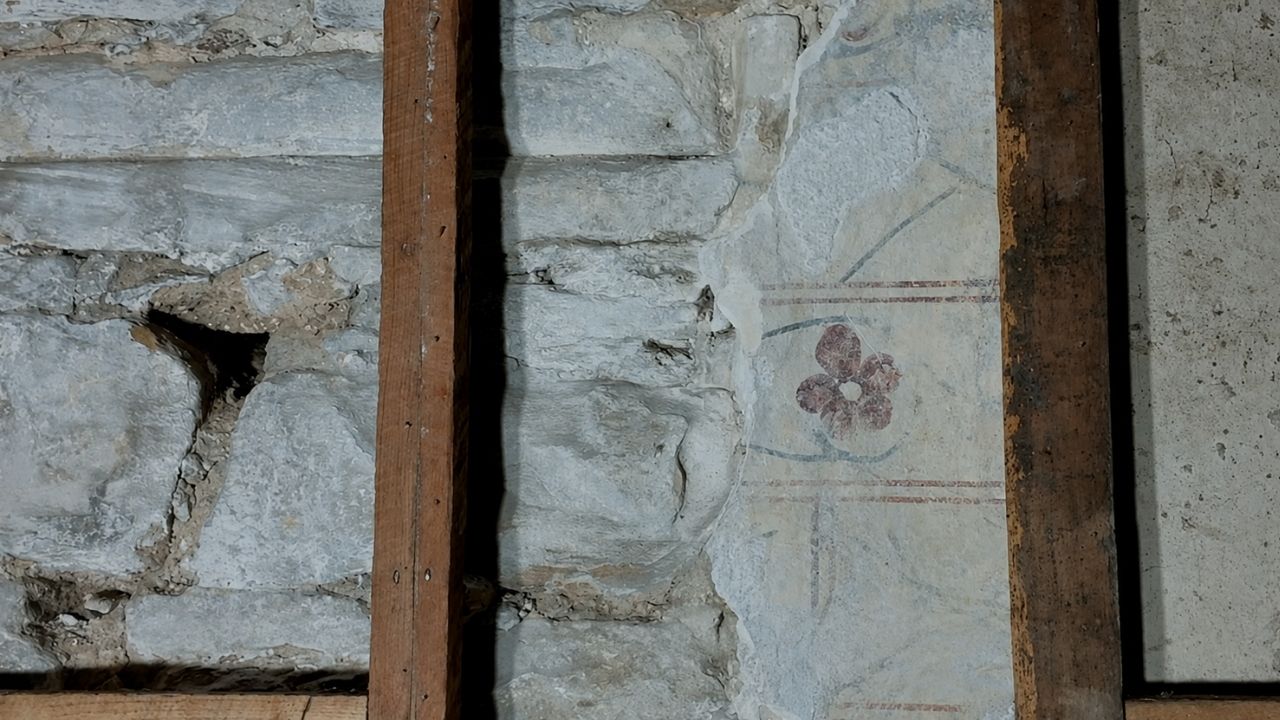
The preserved section of the medieval mural painting was covered by interventions carried out at different times in the castle’s history. First, the surface received new layers of plaster; later, it was concealed by wall panels placed in the mid-20th century.
-
Ultralight electric bike launched with Turbo 3.1 S-Works motor, carbon frame, premium wheels, adjustable suspension, 111 Nm of torque, and a battery of up to 840 Wh; meet the S-Works Turbo Levo R Ultralight LTD

-
Deer Moon arrives on July 29, 2026, and can be seen with the naked eye after sunset, appearing larger and more orange near the horizon, creating a remarkable opportunity for observation and photography under the open sky in different regions of Brazil.
-
Orange juice residues contain hesperidin, limonene, valencene, and other substances that can become a source of valuable compounds for the pharmaceutical and cosmetic industries.
-
Xiaomi launches smart range hood that detects gas leaks, monitors air quality, and sends real-time alerts to the phone.


Removing these materials exposed a decoration that had not been seen for centuries. The sequence of coverings ended up protecting part of the painting, allowing colors and shapes to survive the successive adaptations made to the environment.
Red flower and green stem appear at the center of the composition
The fragment features lines that mimic masonry blocks, a decorative technique used to impart visual order and sophistication to walls. In the center, researchers identified a red flower connected to a green stem.
The combination indicates that the room did not have a merely functional wall. The decorative treatment suggests a prestigious environment, designed to demonstrate wealth, authority, and aesthetic care during the medieval period.
Work may be up to 750 years old
Experts place the creation of the painting between the late 13th century and the early 14th century. This means the fragment may have been produced approximately 700 to 750 years ago.
The estimate considers the position of the work, its characteristics, and the different construction phases identified in the building. New tests on samples of plaster and mortar may help to more precisely define the chronology of the interventions.
Decoration reveals the elevated status of Durham Castle
For the team involved, the medieval mural painting reinforces that that part of the castle was reserved for activities or occupants of high status. An elaborate decoration required materials, specialized labor, and planning.
The find also broadens the understanding of the internal appearance of the fortification. Although castles are often associated with exposed stone walls, many important medieval spaces were covered, painted, and intensely decorated.
Prince-bishops concentrated religious and political power
Durham Castle was founded in 1072 and became the seat of the prince-bishops of the region. These authorities exercised religious functions but also accumulated political and administrative roles in a strategic area of England.
The painting helps to materialize this power within the residence. The prestige of the bishops was demonstrated not only by documents or ceremonies but also by the architecture and decoration of the spaces they occupied.
Windows were blocked during renovations in the 16th century
Investigations identified several closed openings in the south wall. Two of them were originally rectangular windows and are believed to have been blocked around the 1540s.
The alteration is associated with the works promoted by Bishop Cuthbert Tunstall, who transformed the room located on the other side of the wall into a chapel. The closing of the windows shows how the internal organization of the castle changed to accommodate new functions.
Oyster shell may have been left by a worker

Among the materials used to fill one of the structures, researchers found an oyster shell. The hypothesis presented by the team is that it was discarded by a worker during the 16th-century works.
Although small, the piece adds a daily dimension to the investigation. The shell may represent the trace of a meal consumed by someone working on the renovation, bringing archaeology closer to the routine of people involved in the construction.
Zigzag crack exposes ancient structural problem
Another element revealed was a zigzag crack in the masonry. For archaeologists, the fissure records an episode of movement or subsidence that occurred in the early centuries of the castle’s existence.
The north wall would have started to separate from the rest of the structure, creating a risk of displacement towards the nearby slope. The irregular shape of the crack preserved in the wall itself the memory of an ancient structural problem.
Buttress was built to support the wall
The team relates the movement of the masonry to the installation of an inclined buttress on the outside of the north wall. The reinforcement structure would have been added during the 13th or 14th centuries.
This element indicates that medieval builders noticed the instability and sought to prevent the problem from advancing. The castle did not remain intact over the centuries, but was continuously repaired, reinforced, and adapted.
Renovations opened a rare opportunity for archaeology
As Durham Castle remains occupied and in use, deep interventions in its walls do not happen frequently. The restoration allowed specialists to investigate areas normally inaccessible without causing unnecessary dismantling.
Before and during the works, teams of Archaeology, History, heritage conservation, and maintenance monitored the space. The integration between research and renovation reduced the risk of important evidence being covered again or removed without documentation.
Samples of Plaster and Mortar Will Be Examined
Researchers collected materials related to different phases of construction. Among the planned methods is luminescence dating, used to investigate when certain components were produced or used.
The results may help separate medieval interventions, 16th-century alterations, and later renovations. The medieval mural painting is the most visible element of the discovery, but the surrounding materials may reveal an even more detailed historical sequence.
Castle Now Houses University Students


Currently, the building is home to University College, affiliated with Durham University, and continues to function as a space for residence and learning. This use keeps the castle integrated into the contemporary life of the city.
The discovery, therefore, occurred in a heritage site that does not function solely as a historical monument. Students live in a building whose structure encompasses nearly a thousand years of expansions, repairs, changes of function, and successive occupations.
Discovery Changes the Interpretation of a Known Space
The revelation of the painting, windows, and crack allows for the reconstruction of different moments in the same environment. The decorated wall records medieval prestige; the closed openings show the creation of a chapel; the fissure preserves evidence of the challenges faced by the builders.
Together, these elements demonstrate that a historic castle is not the result of a single era, but of accumulated decisions by generations that altered its appearance, stability, and purpose.
Medieval Mural Painting Restores Colors to Durham’s Past
The medieval mural painting found in the Durham Castle shows that the fortification was once more colorful and ornate than its current walls suggested. Hidden for centuries, the red flower with a green stem has become concrete evidence of the power wielded by the ancient prince-bishops.
At the same time, blocked windows, a forgotten shell, and a zigzag crack reveal religious, everyday, and structural aspects of the construction. Which of these findings caught your attention the most: the painting up to 750 years old, the trace left by a mason, or the ancient flaw in the wall? Tell us in the comments.


