





 Portuguese
  English
  Spanish
 3 min of reading


Ariel Project and USIS Enable the Integration of an Offshore Submarine Robot and an Air Vehicle in an
Unmanned Vessel
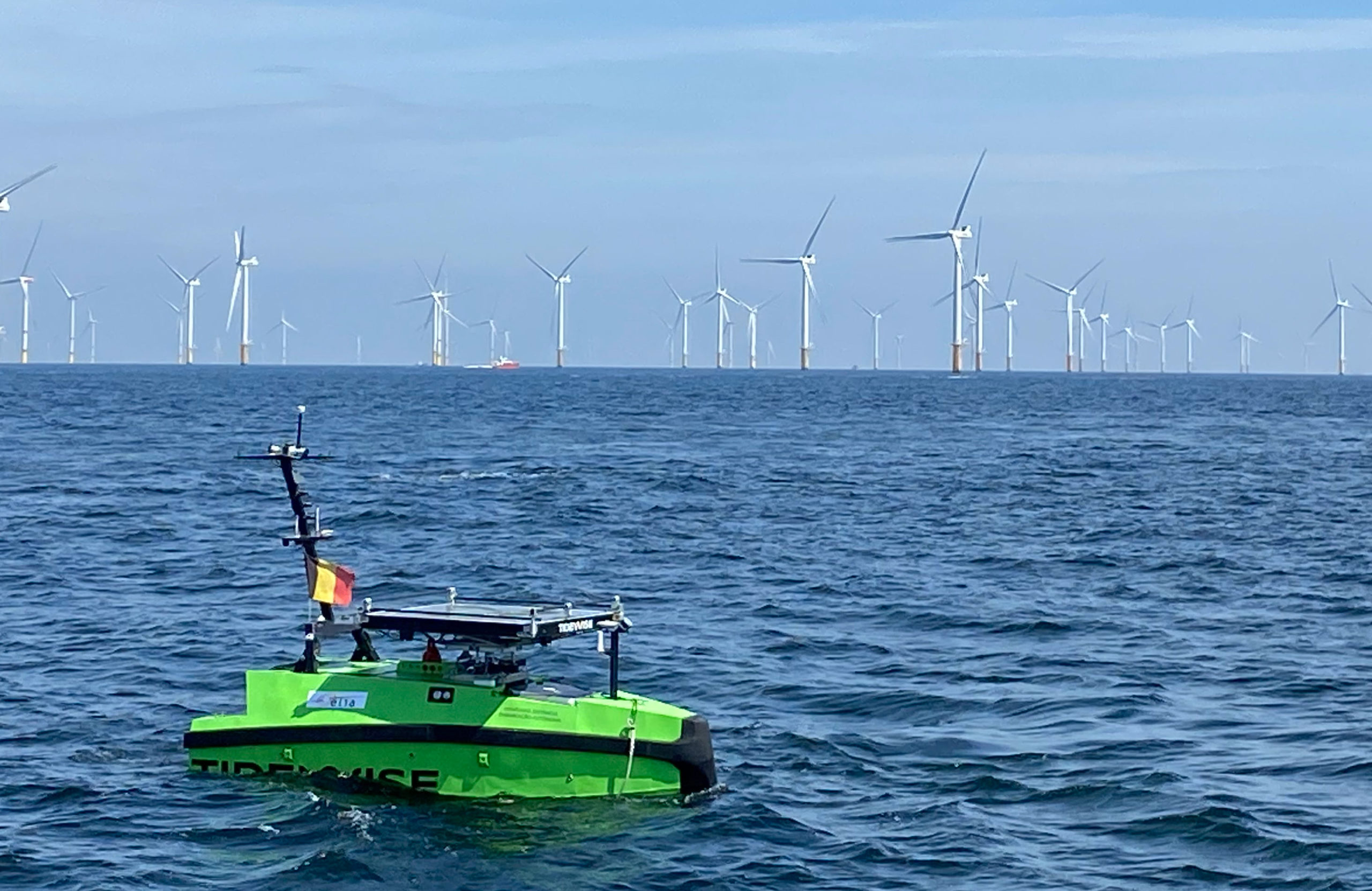
Repsol Sinopec Brasil, one of the largest oil and gas producers in the country, and TideWise, a Brazilian company providing services using autonomous vessels, developed the ARIEL project (Autonomous Robot for Identification of Emulsified Liquids) and the USIS Project (Uncrewed Subsea Inspection System), both aimed at creating automated offshore maritime inspection systems in a more efficient, economical, and safe manner.
The ARIEL Project, which won the ANP Innovation Award in 2020, involves the development of a
robotic system composed of an autonomous vessel, the USV Tupan, developed by TideWise, a UAV (Unmanned Aerial Vehicle), a water sampling system, and a package of metoceanographic sensors.
Learn More About This System in Offshore Submarine Application


Currently in its second phase, the project’s delivery is an uncrewed system for the inspection and monitoring of the presence of oil in the sea. During the Rio Oil & Gas 2022, the companies will demonstrate the autonomous Ariel system in Guanabara Bay, with live broadcasts at RSB’s booths.
-
Motorola launched the Signature with a gold seal from DxOMark, tying with the iPhone 17 Pro in camera performance, Snapdragon 8 Gen 5 that surpassed 3 million in benchmarks, and a zoom that impresses even at night.

-
Satellites reveal beneath the Sahara a giant river buried for thousands of kilometers: study shows that the largest hot desert on the planet was once traversed by a river system comparable to the largest on Earth.

-
Scientists have captured something never seen in space: newly born stars are creating gigantic rings of light a thousand times larger than the distance between the Earth and the Sun, and this changes everything we knew about stellar birth.

-
Geologists find traces of a continent that disappeared 155 million years ago after separating from Australia and reveal that it did not sink, but broke into fragments scattered across Southeast Asia.

If there is a suspicion of oil at a specific point, Ariel, which has a range of up to 1100 kilometers, navigates to the indicated position. At the location, the drone takes off, conducting a scan to identify the possible oil slick. If the drone does not identify the slick, a message is sent to remote operators indicating a potential “false positive.”
If identified, the drone returns to the USV and sends a signal for it to navigate to the indicated coordinates. Upon arrival, a fluorometer checks for the presence of oil in the water, and the sampling system is activated, collecting a sufficient amount of water and oil for laboratory analysis, enabling the development of an oil slick dispersion model.
Following the success of the ARIEL Project, TideWise and Repsol Sinopec Brasil initiated the USIS Project. The main objective of the project is to integrate an ROV, a remotely operated underwater vehicle, with the USV Tupan.
Both vehicles will be equipped with sensors, LiDAR on the USV and optical cameras on the ROV, to create an uncrewed system for the inspection of offshore assets. This technology will allow remote operators to monitor mooring cables, subsea pipelines and gas pipelines, FPSO hulls, submerged structures of offshore wind farms, and shore approaches of subsea pipes or cables, as well as enable cleaning of biofouling on submerged surfaces.
“Ariel and USIS are strategic initiatives within the RSB Research and Development portfolio, aligned with the sustainability themes of the Repsol Group, focusing on safety, environment, and innovation and technology. Besides detecting oil in the sea, the integration of these projects will allow us to advance new features, such as satellite communication and offshore wind potential measurement,” emphasizes Marcelo Andreotti, Research Manager in Production Facilities and Operations.
“This system will reduce operational costs by up to 70% and fuel consumption by up to 95%, increasing the safety of operations and improving the quality of the data collected. The USIS project will enable the Brazilian maritime industry to position itself at the forefront of developing fully autonomous ROV support vessels, further highlighting our pioneering role in integrating complex robotic systems,” says CEO Rafael Coelho.
About Repsol Sinopec Brasil
Present in Brazil since 1997, Repsol Sinopec is a pioneer in opening the E&P market and in exploration in the Brazilian pre-salt. Today, it is the fourth largest oil and gas producer in the country, with a daily production average of around 80 thousand barrels per day, sourced from the Sapinhoá, Lapa, and Albacora Leste fields.
RSB is also responsible for discovering the BM-C-33 field, an asset that could be one of the
main sources of natural gas supply in the country. Since 2010, the company forms a joint venture
between the Spanish Group Repsol (60%) and the Chinese Group Sinopec (40%). Thus, it is a controlled company
that adopts the operational standards of the Repsol Group, which operates across the entire energy value chain.
Learn More At: repsolsinopec.com.br | Via Approach Comunicação








Seja o primeiro a reagir!