





 Portuguese
  English
  Spanish
  4 min of reading
  0 comments



A 110,000-year-old bone fragment found in the Denisova Cave in Siberia revealed that Neanderthals separated by 10,000 years belonged to closely related lineages, in addition to reinforcing evidence of extreme isolation, reduced populations, and strong genetic differentiation among Eurasian groups
The Neanderthals that occupied the Denisova Cave in the Altai Mountains of Siberia have returned to the center of a new discovery from a 110,000-year-old bone fragment. The analysis revealed that two individuals found at the same archaeological site, but separated by 10,000 years, belonged to closely related lineages and had a common ancestor.
The small bone also allowed for the retrieval of the fourth complete genome of a Neanderthal sequenced so far. From this comparison, researchers expanded their understanding of the reduced size and isolation of these populations long before the disappearance of Neanderthals, which occurred about 40,000 years ago.
The Denisova Cave was intermittently inhabited by Neanderthals and Denisovans for nearly 300,000 years. In this context, the genome of the 110,000-year-old individual, named D17, was compared to three other complete Neanderthal genomes to investigate how these populations were organized.
-
Navios dump 40 tons of shells and concrete blocks into the sea off the UK, reversing 200 years of destruction, bringing oyster reefs back, cleaning the water, and testing if the ocean floor can regenerate on a large scale.

-
Scientists released one-ton giant bison in the mountains of Romania, and the result surprised even zoologists: the vegetation in the region increased by 30%, and the soil began to capture ten times more carbon than before.

-
In 2016, a plane equipped with billions of laser pulses scanned 2,100 km² of jungle in Guatemala and revealed, beneath the tree canopies, a Maya megacity with 61,480 unknown structures, elevated roads spanning dozens of kilometers, industrial-scale irrigation systems, and a population of up to 15 million, three times more than any previous estimate.

-
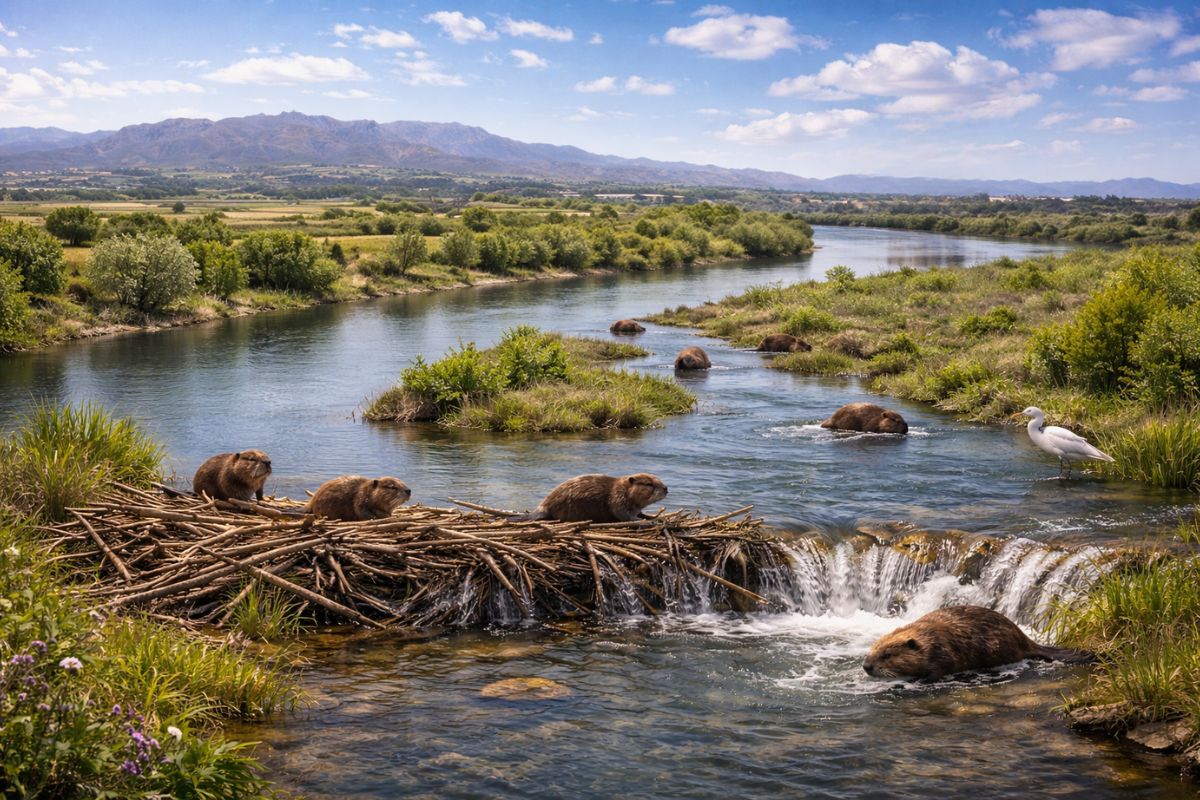
Someone released 18 beavers in the upper Ebro River; it seemed like an isolated case, but no one knows who did it or how to stop their expansion, and now they have already reached Catalonia. And there’s a detail that changes the game: they can help restore rivers and even capture carbon.

Distant kinship in the same cave
In the genetic comparison, researchers analyzed D17 alongside a Neanderthal named D5, dated to 120,000 years ago and found in the same cave. The result showed that D5 was not a direct ancestor of D17, but that the two belonged to very close lineages, linked by a common ancestor.
This distant biological relationship indicates a prolonged presence of Neanderthals in the Altai region. At the same time, the picture suggests that the cave was part of a broader landscape, repeatedly used by these populations over time, and not by a single continuous group settled there without interruptions.
The discovery reinforces the importance of the Denisova Cave as one of the main points for understanding the history of Neanderthals in Eurasia. The fact that two individuals with a 10,000-year gap show a connection between their lineages broadens the perception of the continued use of the region by related groups.
Small and highly isolated populations
The genetic analysis also showed that the Neanderthals of Altai lived in very small and highly isolated populations, with 50 individuals or fewer. The genetic markers indicated strong signs of inbreeding, with large segments of identical DNA in the examined individuals.
These segments indicate that the parents of these Neanderthals were very closely related, at a degree comparable to that of first cousins. The finding adds new details to the portrait of reduced communities, poorly connected to each other and marked by close biological relationships.
The results complement previous research that had already pointed to smaller and more isolated groups among Neanderthals than among modern humans. A 2022 study indicated that a Neanderthal community in Altai had about 20 individuals, while another found evidence of an isolated group for approximately 50,000 years.
For a long time, isolation and inbreeding have been pointed out by many researchers as factors linked to the disappearance of Neanderthals. However, the latest data indicate that these populations also managed to survive for long periods even under extreme conditions of isolation and with a reduced number of members.
Genetic differences between east and west Eurasia
Another point highlighted by the research is that the Neanderthals of Altai were very different from later European Neanderthals. In the genetic analysis, D17 was found to be closer to D5 than to any of them in relation to Neanderthals from Europe or to later populations from the Altai region itself.
This pattern suggests that Neanderthal populations in eastern and western Eurasia became genetically different from each other in a relatively short period. The separation would also have occurred within a geographic area considered quite small.
The comparison drew attention to the speed with which these differences may have accumulated. The individuals with analyzed genomes were separated, on average, by about 50,000 years, but reached levels of difference comparable to those observed today between some of the most distinct human populations, such as peoples from Central Africa and Papua New Guinea, whose separation dates back about 300,000 years.
According to the interpretation presented by the researchers, the reduced size and isolation of these groups may have accelerated this process. In small and isolated populations, genetic drift can cause random changes to become more frequent over time.
More complex population structure
The results reinforce the idea that Neanderthals did not form a single homogeneous population spread across Eurasia.
Instead, they were composed of a mosaic of groups shaped by complex demographic processes, including divergence, migration, local extinctions, and replacements.
The study also highlights the high degree of genetic separation between these groups. This level of differentiation may have limited the Neanderthals’ ability to respond to environmental changes by reducing genetic circulation between distinct populations.
The increase in the number of available genomes has also been pointed out as an important advance for this type of investigation. The presence of two sequenced Neanderthals in such a geographically close location offers a more detailed view of the population structure of this human group.
With the inclusion of the genome of D17, the research adds a new piece to the reconstruction of Neanderthal history in Altai.
The fragment of bone from 110,000 years ago indicates that these populations maintained a prolonged presence in the region, lived in small and isolated groups, and yet developed profound genetic differences among themselves over time.








Seja o primeiro a reagir!