





 Portuguese
  English
  Spanish
  4 min of reading
  0 comments


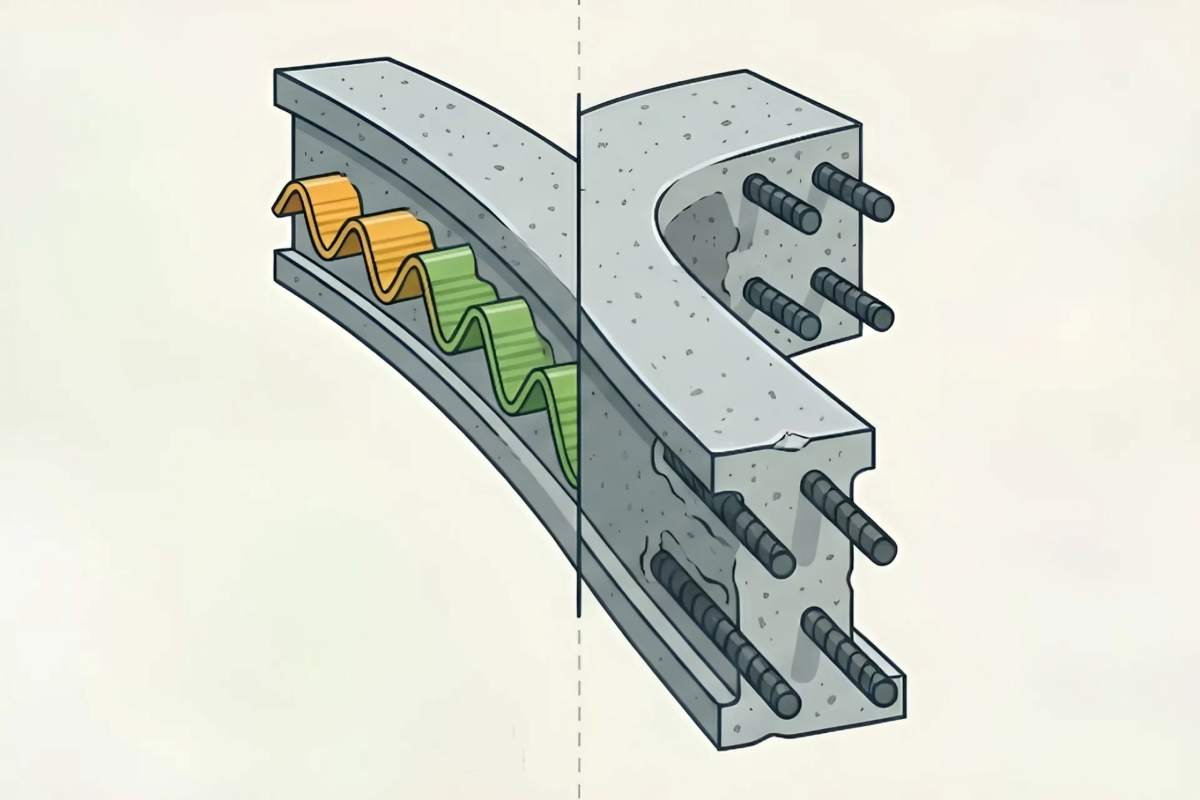
Researchers in Dubai developed 3D printed plastic reinforcements for concrete that reached up to 80% of steel strength in flexural tests, matched ductility in some configurations, and also increased energy absorption by up to five times.
Researchers at the University of Sharjah developed 3D printed plastic reinforcements that enhanced the load-bearing capacity of concrete and achieved up to 80% of the strength obtained with steel reinforcements in flexural tests. The tests also indicated ductility comparable to that of steel in some configurations and energy absorption up to five times greater than that observed in traditional bars of the same material.
The proposal stems from a review of one of the most established elements of civil construction: the geometry of the reinforcement. Instead of conventional cylindrical bars, the team produced pieces of polylactic acid, PLA, with flat, wavy, triangular shapes, and irregular surfaces to improve stress transfer within the structure.
Different geometries enhance performance
The work focused on the behavior of the reinforcement within the concrete, not only on the material but also on how it acts in the structure. The team evaluated unconventional designs created by 3D printing to verify if specific geometries could elevate structural efficiency.
-
The mysterious giant blue sphere in the middle of the Amazon that went viral on the internet is the Planetarium of Médio Solimões, an impressive project that is revolutionizing access to astronomy in Brazil.

-
Earth is “pulling” water from the oceans into the core at nearly 3,000 km deep, and scientists finally explain how this slow and invisible process may be completely transforming the planet from the inside over billions of years.

-
Japan shocks the world by announcing a billion-dollar plan to build a chip factory on the Moon with the support of Toyota, Sony, and the government, aiming for 2-nanometer technology and global dominance.

-
Scientists in the U.S. transform plastic waste into gasoline and diesel with nearly 60% efficiency using molten salts and less than 200 °C, in a process that could cost less and challenge traditional methods that reach 500 °C.
The wavy, triangular, and serrated shapes were designed to increase adhesion to the concrete and better redistribute stresses. This geometric adjustment allowed for increased load capacity and improved structural resistance, with more gradual responses before failure.
In some tests, the PLA plates absorbed up to five times more energy than traditional bars made of the same material. This result indicates a less abrupt failure and a greater capacity to dissipate stresses before collapse, an aspect associated with safer structural behavior.
PLA comes close to steel in concrete tests
PLA is already used in packaging, home 3D printing, and medical applications, but the tests at the University of Sharjah have placed it on a new level within reinforced concrete. Certain configurations, especially the wavy triangular plates, achieved up to 80% of the flexural strength observed in steel-reinforced beams.
In terms of ductility, the performance was also comparable to that of steel in some samples. The study does not treat PLA as a direct and immediate substitute but points to the possibility of use in specific applications where lightness, corrosion resistance, and customization may be more decisive than extreme strength.
Among the cited scenarios are prefabricated elements, temporary structures, modular construction, and areas with high exposure to corrosion. In these cases, the lighter weight of the material can simplify transportation, reduce the need for heavy machinery, and decrease energy consumption throughout the construction process.
Climatic pressure and corrosion expand search for alternatives
The advancement gains relevance in a sector that faces strong environmental pressure. Steel production involves ore extraction, melting, processing, and transportation, stages associated with a significant share of global CO₂ emissions.
In the presented context, the construction sector accounts for nearly 40% of global energy-related emissions, including building materials and operation. In this scenario, any improvement in the components used to reinforce concrete can have a direct effect on the sector’s impact.
Beyond the climatic weight, steel suffers degradation over time due to corrosion, especially in humid and marine environments. This requires costly maintenance or oversized structures, while polymeric materials like PLA eliminate this corrosion problem.
3D printing opens the way for custom production
3D printing appears as a central part of the proposal because it allows for the manufacture of complex geometries with low waste. Instead of adopting standardized mass-produced parts, the system opens the possibility of designing specific reinforcements for each structural element, using only the necessary volume of material.
This model connects to trends already present in civil construction, such as industrialization, advanced prefabrication, and digital construction. The logic is to reduce waste, optimize materials, and increase precision in the execution of pieces intended for concrete.
European companies are already experimenting with 3D printing of concrete, and the incorporation of customized reinforcements appears as a natural step within this process. The technology is not yet presented as a total solution to replace steel, but as a gradual advancement with the potential for transformation in specific niches.
Among the future possibilities are secondary infrastructure, non-critical elements, modular constructions, and projects linked to the circular economy, including the use of recycled PLA or next-generation bioplastics.
The study also points to the chance of hybrid systems, with steel only where it is indispensable and optimized polymers occupying the rest, in search of greater efficiency in reinforcing concrete.










Seja o primeiro a reagir!