





 Português
  Inglês
  Espanhol
  4 min de leitura
  0 comentários


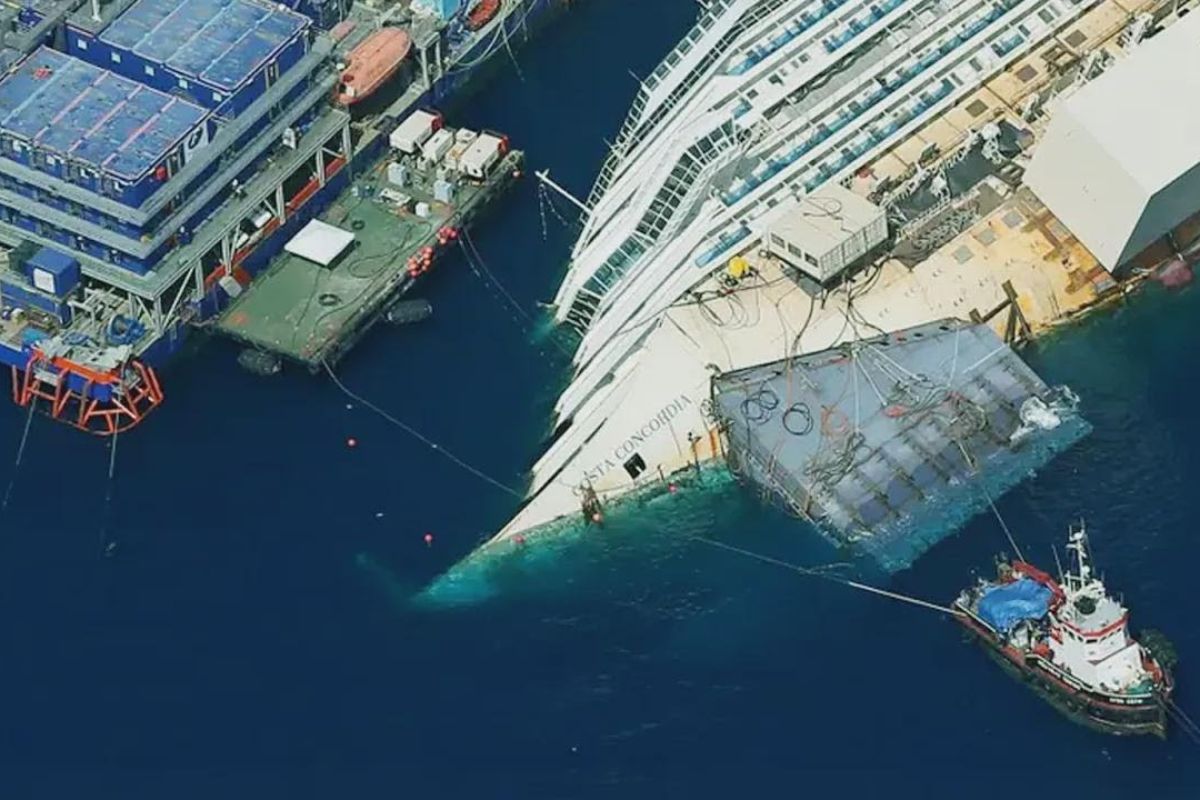
Costa Concordia: Rescue With Hydraulic Jacks And Floats Saved Marine Sanctuary After 19 Months And Became Historical Case
The Costa Concordia collided with rocks near the island of Giglio, Italy, and tilted in a sensitive area of the Mediterranean, within a national park and marine sanctuary. The shipwreck created a race against time, uniting heavy engineering, technical diving, and pollution control. The rescue plan aimed to remove the ship in one piece, upright, refloat, and tow it, minimizing environmental risk.
For 19 months, the Costa Concordia was stabilized, received submerged platforms, and had its oil removed. The critical phase used hydraulic jacks and large floats in millimeter maneuvers. The goal was clear: protect the marine sanctuary and prevent leaks, while multinational teams executed the operation with centimeter tolerances.
How Engineering Stabilized The Hull

The priority was to prevent the Costa Concordia from sliding down the slope. The team installed anchoring blocks, towers, and chains beneath the hull, creating retention at multiple points.
-
With more than 635,000 doctors, Brazil sees competition increasing in large cities, and recent graduates are competing for shifts at an accelerated pace while the countryside still faces shortages.

-
The world’s first octopus farm wants to open in the Canary Islands and is already provoking an international reaction: the plan aims to produce 3,000 tons per year.

-
Drought may be creating stronger superbugs in the soil and helping antibiotic resistance reach hospitals, warns a study highlighting a problem that could grow alongside extreme weather.

-
The biggest scam in history: Napoleon’s France deceived the United States by selling them a territory that was Spanish.


An artificial base was then built with sandbags and steel platforms to bear the weight when the ship was lifted from the rocks.
This foundation allowed the installation of the rotation system. Hydraulic jacks with cables were positioned on top of the hull and connected to structural chains.
Without this anchoring, any pulling could break the anchors and jeopardize the rescue, especially with the hull resting on uneven outcrops.
Hydraulic Jacks And Floats, The Pair That Uprighted The Ship

As the operation transitioned to the more delicate rescue phase, 36 hydraulic jacks applied thousands of tons of force to initiate the turnaround of the Costa Concordia.
When the ship began to respond, the team started flooding the upper side floats to add controlled weight and accelerate the rotation.
The process required continuous adjustment of ballast via computer.
Any excess would cause the hull to rotate beyond what was necessary, so filling the floats and the pulling of the hydraulic jacks were synchronized degree by degree.
This is how the ship reached a vertical position without environmental damage, a key step to preserve the marine sanctuary.
Why The Marine Sanctuary Required Zero Tolerance For Leaks

The hull contained fuel oil and diesel, as well as debris. Before the rescue, divers installed valves and heated the thick oil to pump it out safely.
Containment through floating barriers and collection boats remained active at all times, reducing the risk of contamination.
After the uprighting, biologists monitored the area and relocated sensitive organisms during the works.
Protecting the marine sanctuary meant combining engineering and biology, synchronizing diving, drilling, and sediment cleaning schedules.
From Vertical To Refloating, The Step That Liberated Giglio
With the Costa Concordia in a vertical position, the floats from the damaged side and reinforcing beams came in to distribute loads on the hull.
The ballast control expelled water from the tanks, slowly lifting the ship a few meters above the platforms.
Tugs then moved the hull to deeper waters.
The rescue exceeded US$ 800 million, the timeline was extended and each advance depended on the stability of the assembly, as storms had tested the anchoring and structures.
Finally, the hull was towed for dismantling, with recycling of metals and waste protocols, ending the pressure on the marine sanctuary.
The Technical And Environmental Legacy Of The Greatest Rescue In History
The Costa Concordia case consolidated a methodology that associates hydraulic jacks, floats managed by ballast systems, and modular underwater platforms.
The combination of structural control, smart ballast, and operational discipline raised the industry standard, especially in sensitive areas.
For tourist coastal regions, the lessons are direct. Environmental planning from the very first hour, transparency with the community, and phased execution are essential.
The rescue proved that it is possible to remove a giant hull, preserve a marine sanctuary, and avoid an ecological disaster.
If you had to prioritize one factor in operations like that of the Costa Concordia, would you choose mechanical redundancy in the hydraulic jacks, an increase in the number of floats, or even stricter protocols for the marine sanctuary throughout the whole rescue?








-

-

-

10 pessoas reagiram a isso.