





 Portuguese
  English
  Spanish
  6 min of reading
  0 comments


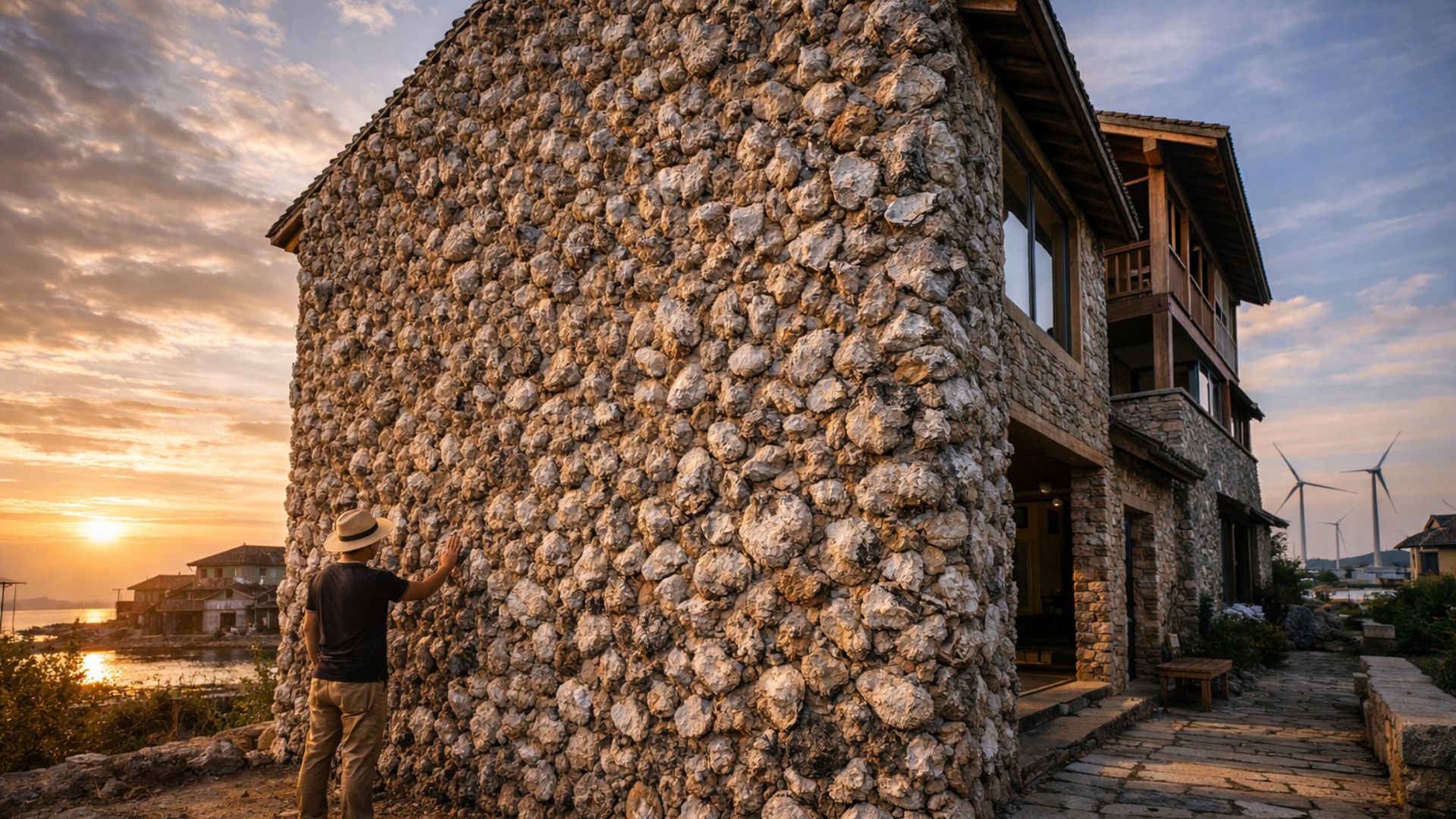
Coastal construction mixes oyster shells, local memory, and contemporary architecture in a 320 m² house in China, uniting fishing village tradition with modern solutions without resorting to flamboyant forms or breaking with the natural surroundings.
A house built on the coast of Qidong, in the Chinese province of Jiangsu, has drawn attention for incorporating oyster shells mixed with washed stone in the external walls, in a solution that repurposes a material linked to maritime daily life and transforms it into a central element of the construction.
Named East Courtyard, the residence was designed by the Benzhe Design office, has 320 square meters, and was completed in 2025, combining contemporary language, local references, and a program designed for the routine of a family from the countryside and the sea.
The proposal does not treat the shells as an ornament applied after the work nor as an isolated detail of the facade.
-
Italian researchers have detected what appears to be a second Sphinx buried under the sands of Egypt, and satellite scans reveal a gigantic underground megastructure hidden beneath the Giza Plateau for over 3,000 years.

-
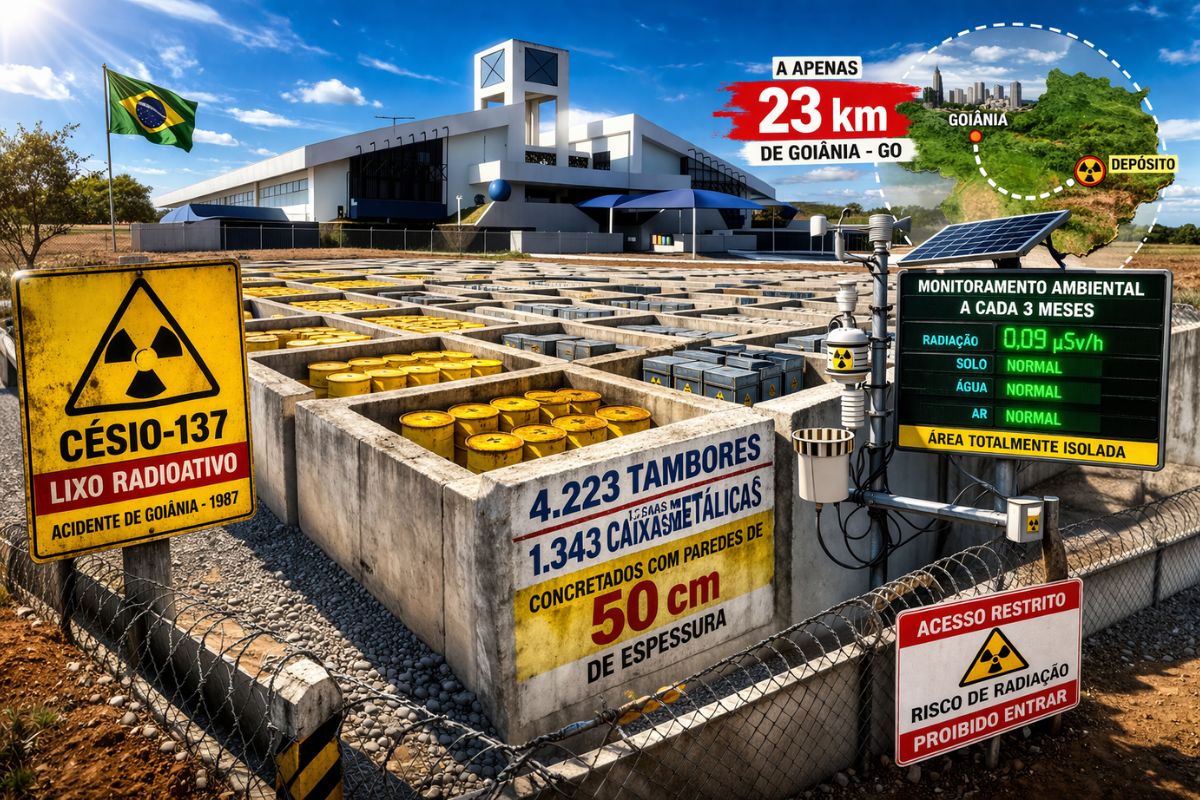
There are 4,223 drums and 1,343 metal boxes concreted with 50-centimeter walls that store the radioactive waste from Cesium-137 in the worst radiological accident in Brazil, just 23 kilometers from Goiânia, with environmental monitoring every three months.
-
Giant Roman treasure found at the bottom of Lake Neuchâtel in Switzerland reveals an advanced trade system, circulation of goods, and armed escort in the Roman Empire about two thousand years ago.

-
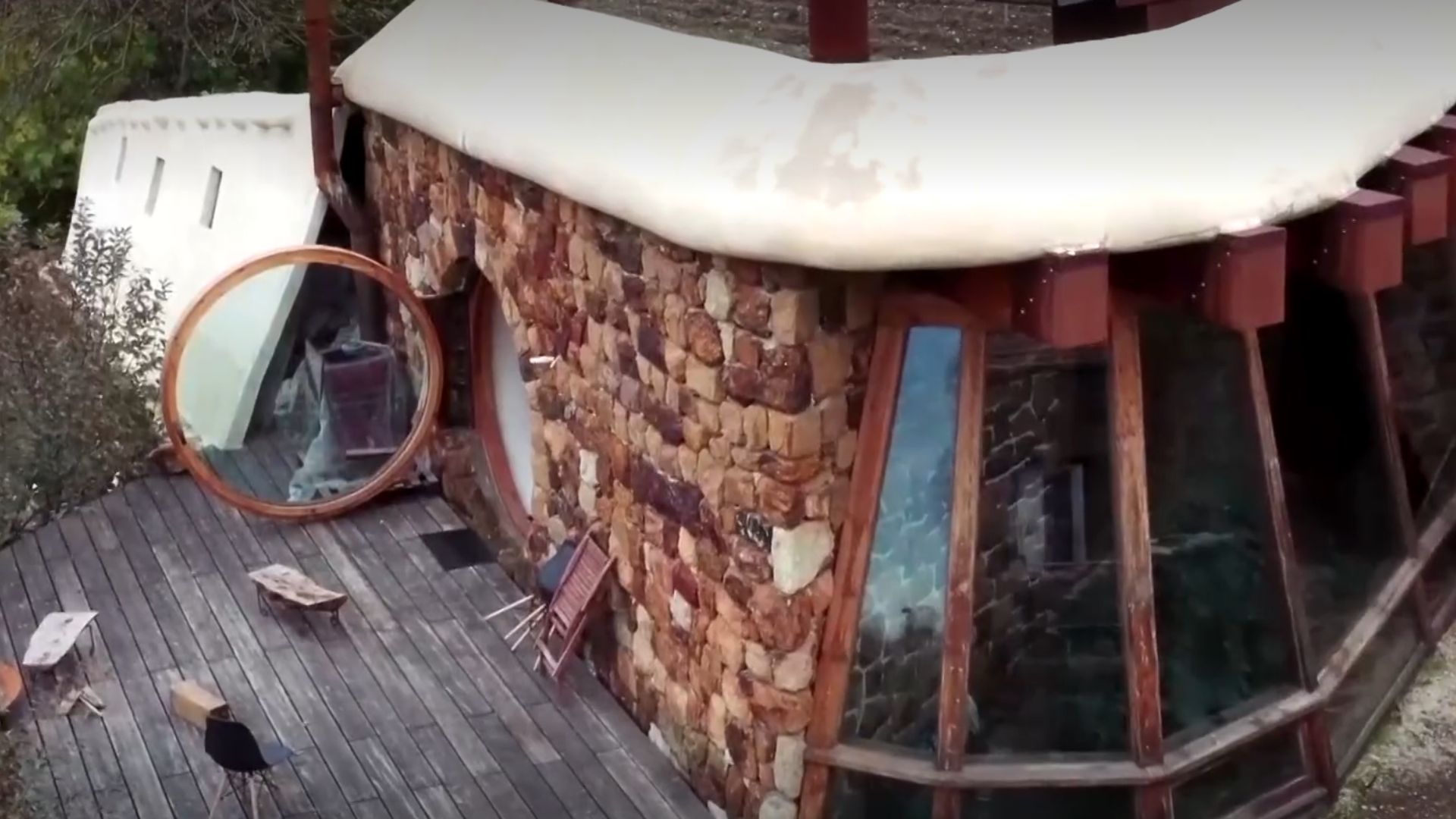
He buried 1,200 old tires in the walls to build his own self-sufficient house in the mountains with glass bottles, rainwater, and an integrated greenhouse.

They appear integrated into the very skin of the building, producing a rough, irregular surface directly associated with the coastal landscape.
The result breaks with the more standardized appearance of houses covered by uniform plaster and, at the same time, preserves a visible relationship with the material culture of the village where the residence was built.
Traditional technique with shells resurfaces in contemporary architecture
According to the project description, the use of shells revives an ancient practice in the region, where fishermen pressed this material into the walls.

The work revisits this repertoire in a contemporary way, without literally reproducing methods from the past, but maintaining the link with local construction memory.
Instead of presenting the house as an autonomous object or imported from another context, the architects sought a construction that seemed to arise from the territory itself and the marks left by life by the sea.
This choice helps explain why the project arouses curiosity without relying on flamboyant forms or futuristic solutions.
The unusual aspect lies less in the geometry and more in how waste and references from the coast have been converted into architectural material.
By exposing the texture created by the mixture of shells and stone, the house reinforces a reading in which technique, landscape, and memory coexist on the same surface.
The land is located in an old fishing village situated at the confluence of the Yangtze River and the East China Sea.
In this flat environment, marked by tides and the presence of wind turbines, the implantation sought to respect the scale of the surroundings.
The residence was organized into three floors, but without imposing visually on the neighboring houses, repeating proportions common to the old rural homes of the region and softening the transition between domestic space and open landscape.
Project prioritizes family routine and adaptation to the coast
The project arose from a very concrete family demand.
The children of the residents, who spend much of the year away from home, commissioned the reconstruction of the residence for their parents, both over 60 years old.


This fact alters the reading of the work, as it distances the idea of a formal experiment made only for display and repositions the house in the realm of daily necessity.
This is a dwelling designed to accommodate existing habits, improve the daily use of spaces, and preserve emotional ties to the place.
In this sense, the house combines a unique appearance with discreet solutions for permanence and coexistence.
The project avoids high walls and heavy closures, preferring low walls and trees to define the perimeter of the courtyard.
This choice ensures privacy without creating a total break with the village, maintaining a more continuous relationship between interior, backyard, and rural landscape.
Even though the work has its own presence, it does not present itself as a foreign body in front of the neighboring constructions.
The volumetry was also designed to reduce the feeling of excessive mass.
Visual corridors, softer boundaries, and the opening of the courtyard help to dilute the volume of three floors.
Thus, the ensemble preserves the domestic scale and avoids the image of a monumental house inserted into a fabric of small dwellings.
The strategy reinforces the intention to adapt the project to the coast and community life, rather than turning it into an isolated piece of architectural spectacle.
Natural light and integration of internal spaces
Inside, the distribution of the environments follows the same logic of containment and clarity.
Although the residence has three levels, the program includes six main rooms, leaving a significant portion of the area designated for living, circulation, and resting spaces.
A central skylight organizes the ensemble, while living rooms and areas of permanence articulate vertically to enhance the perception of continuity between the floors.
On the lower floor, the washed stone covering extends from the external area into the house, weakening the separation between courtyard and interior.
On the intermediate level, windows and stairs direct the gaze towards the agricultural surroundings, bringing the residents closer to the seasonal landscape.
At the top, the zenith opening brings light to the tea area and creates a quieter atmosphere, marked by shadow, texture, and natural variation throughout the day.
Natural light thus functions as a decisive part of the spatial experience.
The project uses openings of different sizes to establish specific relationships with the exterior.
In some places, the openings are wide and bring the house closer to the backyard.
In others, horizontal windows frame trees, trunks, and sections of the landscape.
On the stairs, a vertical opening concentrates the incidence of sunlight into a narrow band of light.
This resource serves not only to illuminate but also to mark time and give density to the daily life of the residence.
Reuse of shells redefines materials in construction
Another aspect that brings the work closer to the residents’ routine is the preservation of a garden in a corner of the courtyard.
The area was maintained for the cultivation of flowers and food, a practice associated with rural life that continued integrated into the new design.
This decision reinforces that the house was not conceived as an isolated showcase of contemporary architecture, but as an effective dwelling for a family that remains connected to the land, the neighborhood, and coastal culture.
It is at this intersection of daily use, local context, and materiality that East Courtyard stands out.
The oyster shells, generally treated as waste or remnants of the marine environment, begin to serve a legible function in the construction and alter the more widespread image of a house made only of concrete, brick, and homogeneous finishing.
The external surface exposes a different logic, in which the memory of the place and the texture of the materials gain the same weight as the residential function.
Even when observed only in photographs, the residence immediately communicates this combination of discretion and strangeness.
The volume follows the village, the courtyard opens to the landscape, and the facade carries signs of the sea without transforming the project into a caricatured piece.
At a time when architecture has sought to reconcile local identity, material reuse, and solutions more linked to the territory, the house in Qidong emerges as an example of how an unlikely element can be incorporated into construction in a coherent, habitable way that is directly connected to the place where it was built.









Seja o primeiro a reagir!