





 Portuguese
  English
  Spanish
  4 min of reading
  0 comments


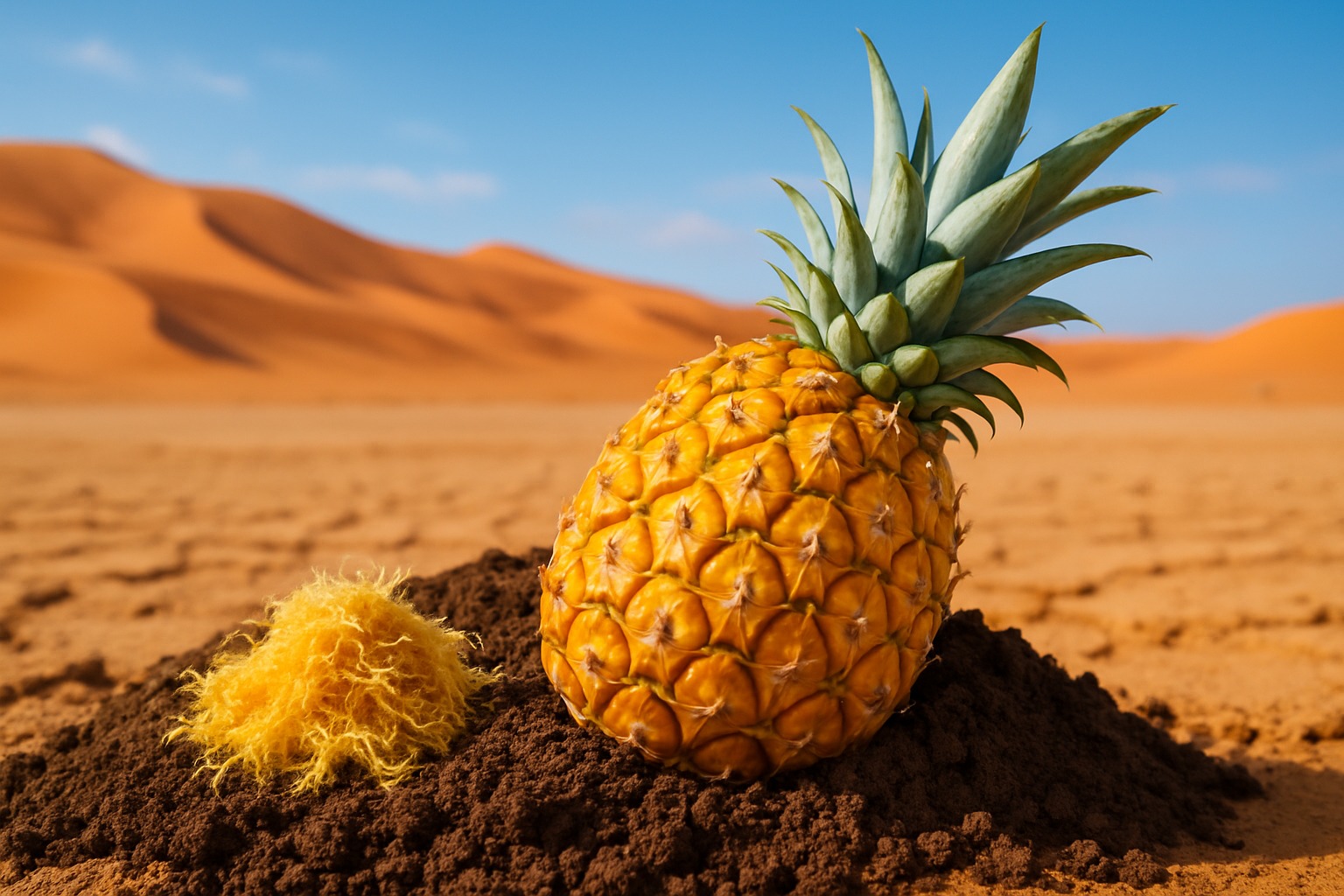
Study Converts Pineapple Peels into Nanocellulose, Increases Water Retention in Desert Soils, Reduces Evaporation and Improves Stability, Allowing Cherry Tomato Cultivation in Arid Sands of the United Arab Emirates
Researchers converted pineapple waste into nanocellulose capable of increasing water retention by 32.7% and halving evaporation in desert soils of the United Arab Emirates, enabling experimental cultivation of cherry tomatoes under arid conditions.
The processing of pineapple waste into nanofibers demonstrated direct potential to stabilize sandy soils, increase fertility and reduce pressure on water resources in desert regions, providing a practical alternative for agriculture in arid zones.
Conversion of Food Waste into Functional Nanocellulose
The study showed that pineapple peels, typically discarded by juice and hospitality industries, can be transformed into nanocellulose with properties capable of altering the physical and chemical behavior of extremely dry sandy soils.
-
While the world looks at oil, the war with Iran is already disrupting helium supply from Qatar, affecting car and iPhone chips, threatening AI expansion, and putting pressure on aluminum packaging at the highest value in four years.

-
Global warming will expose a treasure hidden under the ice of Antarctica and may spark an international dispute over gold and valuable minerals.

-
A street vendor from Praia Grande built a robot made of scrap from scooters and washing machines that pulls his popcorn cart on the beach, emits sounds, and interacts with customers, becoming an attraction on the coast of São Paulo.

-
The specifications of the Xiaomi 18 Pro Max have been leaked, and the highlight is a dual 200 MP camera with a new 22-nanometer technology that promises to consume less energy and capture details in shadows and bright areas using LOFIC HDR.


The research was conducted by an international team of scientists who applied successive mechano-chemical treatments, including grinding, alkaline processing, bleaching, and ball milling, until fibers were obtained from macro to nano scale.
The fibers produced from food waste were incorporated into typical desert soils of the United Arab Emirates, allowing for controlled evaluation of their effects on water dynamics, soil stability, and nutrient retention.
Tests on Three Types of Desert Sand
The experiments involved three common classes of desert sand from the region: lithic sands, quartz-rich sands, and calcareous sands, each with distinct characteristics of porosity, cohesion, and water retention capacity.
The application of the fibers allowed for consistent changes in the behavior of these soils, regardless of the predominant mineral composition, indicating that the effect of nanocellulose is not limited to a single type of sandy substrate.
The results indicated that the addition of the fibers promoted greater structural stability, reducing the mobility of sand particles in environments subject to constant wind action and rapid moisture loss.
Significant Gains in Water Retention and Stability
The soils treated with pineapple nanofibers exhibited an increase of up to 32.7% in water retention capacity, a significant gain in surfaces where moisture typically dissipates within hours.
The soil permeability was reduced by 58%, slowing down runoff and excessive water infiltration, which helps maintain available moisture for longer periods after irrigation.
Surface evaporation was also reduced by 50%, while soil cohesion quadrupled, a critical factor in desert areas where sand instability hinders any agricultural cultivation attempts.
Nutrient Retention Nearly Doubles with Nanofibers
In addition to water gains, the tests showed that nutrient retention, especially phosphorus, nearly doubled in soils treated with pineapple-derived fibers, reducing losses due to leaching or volatilization.
This increase is significant in arid regions, where fertilizers applied to the soil are often quickly lost due to the low retention capacity of sandy substrates and the scarcity of organic matter.
With greater nutrient availability in the root zone, the treated soil provided more favorable conditions for plant development, even under severe water restrictions.
Experiments with Cherry Tomato Seedlings
Growth trials conducted with cherry tomato seedlings confirmed the effects observed in the physical-chemical analyses of the soils, demonstrating a direct impact on plant survival and development.
At moderate concentrations, between 0.25% and 1% fiber by weight, the seedlings showed higher survival rates, a greater number of leaves, and healthier growth compared to controls.
When the concentration was raised to 3%, there was a decrease in the survival of the plants, indicating that excessive application of the fibers may compromise plant performance and requires precise adjustment of the levels used.
Behavior of Fibers Over Time
The study also evaluated the biodegradation of the fibers in different environments, noting that in organic matter-rich soils, decomposition occurs more rapidly over time.
In very poor sands typical of deserts, the fibers maintained their structure for longer periods, preserving the positive effects on water retention and soil stability for more than one season.
This structural persistence is considered advantageous, as it prevents the benefits from disappearing quickly, reducing the need for frequent reapplications of the material in agricultural management.
Alignment with Circular Bioeconomy
The conversion of pineapple waste into nanocellulose applied to the soil aligns with the principles of the circular bioeconomy, in which organic waste returns to the productive system as valuable inputs.
Regions such as the Middle East and North Africa, which import a large portion of the food consumed and face increasing water scarcity, seek solutions that reduce dependence on external resources.
In these contexts, an abundant and often discarded waste can become a strategic material to support agriculture in arid zones and mitigate the effects of desertification.
Integration with Other Initiatives in Degraded Soils
The research fits into a broader set of initiatives exploring biomaterials to recover degraded soils, utilizing local resources and processes with lower environmental impact.
In Saudi Arabia, natural polymers derived from algae have been tested to combat desertification, while in Morocco, agricultural cooperatives experiment with biochar produced from pruning waste.
Pineapple nanocellulose complements these approaches, reinforcing the use of simple and locally available materials to generate direct effects on water retention and agricultural productivity.
Implications for Soil Restoration and Food Security
By relating the structure of the fibers to soil mechanics, water dynamics, and interactions between plants and microorganisms, the research offers a technical roadmap for restoring desert soils.
The authors indicate that future studies should refine water retention models and explore the integration of other agricultural by-products into the process, expanding the possibilities for applying the technology.
The proposal paves the way to reduce water stress, improve food security, and increase climate resilience in areas where desertification progresses faster than local adaptation capacity, even with small technical adjustments throughout the process.









-

Uma pessoa reagiu a isso.