





 Portuguese
  English
  Spanish
  4 min of reading
  0 comments


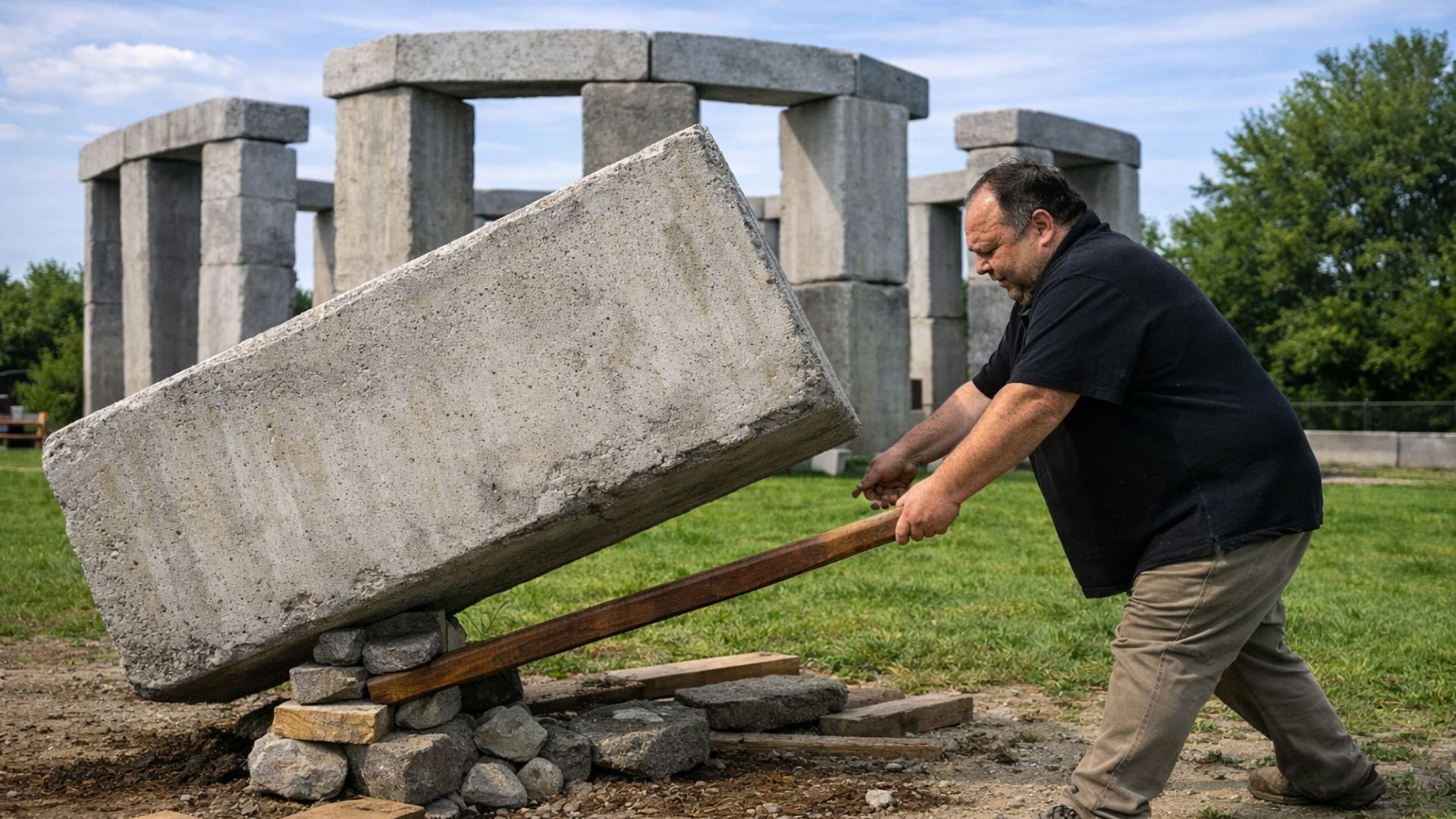
Home experiment transforms backyard into practical engineering laboratory and reignites debate about the construction of ancient monuments by demonstrating how simple principles of physics allow moving tons with precision and control, without modern machines or intensive collective force.
In the backyard of his home in Michigan, retired construction worker W.T. “Wally” Wallington transformed several tons of concrete blocks into public demonstrations of practical mechanics by building a structure inspired by Stonehenge and moving it without cranes, motors, or hydraulic systems.
Instead of resorting to brute force, he uses wooden levers, small stone supports, improvised fulcrums, and controlled changes in the center of gravity to rotate, shift, and lift pieces that, at a quick glance, would seem impossible for a single person to handle.
Lever and gravity method explains the movement of giant blocks
The case gained attention because Wallington did not limit himself to defending an abstract hypothesis about ancient works, but built a full-scale replica on his own property to demonstrate, step by step, how to transport, align, and lift large blocks using basic resources.
-
Measuring almost 15 meters in length, with 29 watchmen and space for 6 men for 6 weeks, the Ben Franklin spent 30 days drifting in the Gulf Stream without surfacing on a mission so unusual that NASA treated it as a trial for a space station.

-
China debuted a new platform at its first commercial spaceport, a structure 83 meters tall designed to launch rockets at a high cadence, divert flames without an underground trench, and dump 500 tons of water in 15 seconds.

-
Brazilian family transforms old boathouse in Paraty and creates a refuge with glass walls, private beach, and three suites in a property that combines Atlantic Forest, exclusivity, and sophistication.

-
A crane with a reach of 69.5 meters and a lift of 53 meters unloads the largest container ships on the planet and accelerates the invisible machinery of global trade.


According to ASME, the American Society of Mechanical Engineers, the method includes wooden cables and minimal support points to make the mass “walk” in short movements, always exploring balance, rotation, and mechanical advantage instead of industrial power.
In one of the most cited demonstrations, he shows that simply positioning a small stone under the base of the block balances it and allows controlled rotation; with levers, the whole assembly begins to move sideways with each half rotation.
A HISTORY reports that, by Wallington’s calculations, one man could transport a one-ton concrete block at about 300 feet per hour, while larger groups could accelerate the movement of even heavier masses.
Stonehenge and the challenge of moving stones weighing up to 25 tons
The immediate interest in the experience is explained by the size of the challenge associated with the British monument, whose sarsen stones weigh on average 25 tons, while the so-called bluestones vary between 2 and 5 tons, according to English Heritage.

The same institution reports that the sarsens came from the West Woods area in southern England, and that the construction required extraction, shaping, transportation, and lifting of monumental stones, as well as sophisticated joints typically associated with carpentry.
These details help explain why any functional low-tech method sparks immediate interest among archaeologists, engineers, and curious onlookers: when a single man moves tons in his backyard, the discussion about what ancient peoples were capable of doing changes scale.
Demonstrations include moving a barn and blocks weighing nearly 9 tons
A HISTORY reports that Wallington had already moved an entire barn by himself using the same logic of levers and progressive support, as well as applying reasoning to swing and lift heavy pillars to a vertical position.
ASME details that the method was applied to a block weighing 19,200 pounds, approximately the weight of a slab associated with Stonehenge, lifted with limited assistance only in the final positioning stage.
Another element that increased curiosity around the project was the so-called “round road,” a wavy wooden path created to use the block’s own weight and the continuity of movement as part of the transport over the ground.
Experiment reignites debate about the engineering of ancient civilizations

Although the images are impressive, Wallington’s experiment does not alone resolve the history of Stonehenge, because the archaeological site involves long distances, varied terrain, collective organization, and successive stages of excavation, finishing, fitting, and assembly.
English Heritage describes that, to raise the stones, sloped cavities were opened, reinforced with wooden stakes, while plant fiber ropes, support structures, and possibly auxiliary weights would help tilt the blocks into their final position.
For this reason, Wallington’s contribution entered the debate as a demonstration of mechanical viability, not as definitive proof about the past, as archaeology continues to test different scenarios for the transportation and elevation of the monoliths.
The central point of his experience is different: to show that operations often treated as impossible can be reinterpreted when they are no longer seen merely as a matter of strength and are analyzed as basic engineering.
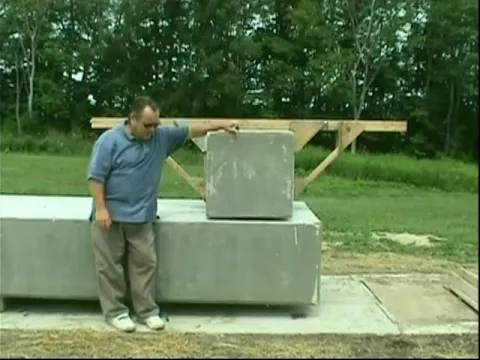

Common backyard becomes a showcase of applied physics and intuitive engineering
Part of the narrative strength of the case lies in the contrast between the domestic setting and the size of the pieces, as simple beams, small stones, and improvised supports replace heavy machinery in a residential environment transformed into a visible experimentation laboratory.
This visual aspect helps explain the recurring circulation of the theme in reports and videos, because the scene of a retiree moving tons alone concentrates, in a single image, historical curiosity, physical intuition, and a technical challenge understandable to any observer.
Without closing the archaeological debate, Wallington has brought to light an old and persistent hypothesis: societies without modern machines may have relied less on massive force than on ingenious solutions based on levers, balance, repetition, and precise control of movement.





Seja o primeiro a reagir!