





 Portuguese
  English
  Spanish
  4 min of reading
  0 comments



The Google Sycamore Quantum Computer Chip Is Ready to Surpass the Fastest Supercomputers in the World, According to a New Study
Recently, a study published in the journal Nature revealed that the Sycamore quantum computer chip, developed by Google, may surpass the fastest supercomputers in extremely specific calculations.
The research, led by Alexis Morvan and his team from Google Quantum AI, represents a significant advancement in the field of quantum computing, suggesting that we are increasingly close to practical applications for this emerging technology.
The Computationally Complex Phase
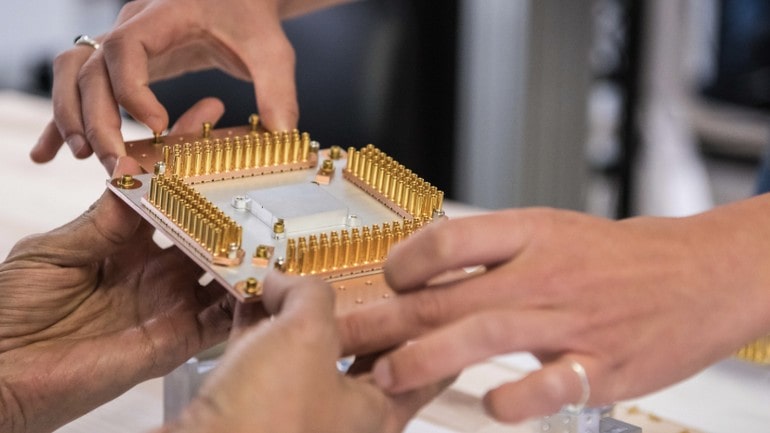
Google researchers discovered a new “computationally complex and stable phase”, which can be achieved using existing quantum processing units (QPUs).
-
China has created a mass-produced hypersonic missile that costs the same as a Tesla, and this is changing everything in modern warfare because the United States cannot defend itself without spending millions.

-
100% Brazilian technology transforms agricultural waste into a meat-scented ingredient using fungi from the Amazon rainforest. The process does not use excessive water or chemicals, and it also increases the nutritional value of the final product.

-
Psychology reveals that adults who avoid conflicts at all costs are not balanced individuals, but rather children who learned in the worst way that expressing emotions brought punishment and now live paralyzed by the fear of expressing themselves.

-
Goodbye pet hair on clothes: a washer with an internal filter promises to remove up to 5 times more hair than regular machines and uses an XL trap dryer system to capture what remains.


This phase, called the “weak noise phase”, allows quantum computers to perform complex calculations at a speed that exceeds the fastest supercomputers available today.
Upon reaching this phase, the Sycamore chip demonstrated its ability to execute calculations that classical supercomputers would take thousands of years to complete.
The outcome of the study is a significant milestone in the development of quantum computing, but challenges remain. According to Google experts, quantum error correction is necessary to effectively increase the number of qubits and ensure that these calculations remain accurate on a larger scale.
Qubits and Their Complexities
Quantum computers operate using qubits, which rely on the principles of quantum mechanics to process data in parallel.
This contrasts with classical computing bits, which operate sequentially. The main advantage of qubits is that as their number increases in a QPU, the processing power of the machine grows exponentially. For this reason, calculations that would take ages for a classical computer can be completed by a quantum computer in a matter of seconds.
However, qubits have a significant limitation: they are extremely sensitive to disturbances. This sensitivity, known as “noise”, causes frequent failures in qubits, making them more unstable compared to the bits of a classical computer.
For example, about 1 in every 100 qubits fails, while the failure rate in classical bits is approximately 1 in 1 billion. This is exacerbated by environmental factors such as temperature variations, magnetic fields, and even cosmic radiation, which can interfere with the operation of qubits.
The Barrier of Quantum Supremacy

For quantum computers to achieve “quantum supremacy”—that is, the ability to solve problems that a classical computer cannot—advanced error correction solutions are necessary. However, these technologies are still under development.
Additionally, a quantum machine would need millions of qubits to operate at scale, but most current QPUs contain around 1,000 qubits. Therefore, scaling these machines remains a challenge.
Despite this, Google scientists have demonstrated that quantum computers can outperform supercomputers in specific calculations, even with current noise levels.
They used a method called random circuit sampling (RCS) to test the performance of a 2D grid of superconducting qubits. These qubits, made of superconducting metal and kept at temperatures close to absolute zero, are one of the most common types used today.
The Future of Quantum Computing
The experiments revealed that qubits can transition between two distinct phases: an initial phase and the “weak noise” phase, in which quantum calculations become complex enough to surpass classical computers.
During testing, scientists artificially adjusted the noise or slowed down the propagation of quantum correlations to reach this phase. The demonstration was conducted on the 67-qubit Sycamore chip, showing that the advancement is real and promising.
Representatives from Google Quantum AI stated that this is an important step towards developing quantum applications for the real world. “If you can’t win on the RCS benchmark, you can’t win at anything else”, said the experts, referring to the performance test used to measure the efficiency of quantum computers compared to classical supercomputers.
This advancement marks a turning point in the journey to achieve quantum supremacy and indicates that the potential of quantum computers is getting closer to being realized. The next challenge for scientists is to demonstrate “beyond classical” commercial applications that have a direct impact on the real world.
As new error correction technologies are developed and more qubits are added, quantum computers will be able to revolutionize the way we process information and solve complex problems.







-

Uma pessoa reagiu a isso.