





 Portuguese
  English
  Spanish
  3 min of reading
  1 comment


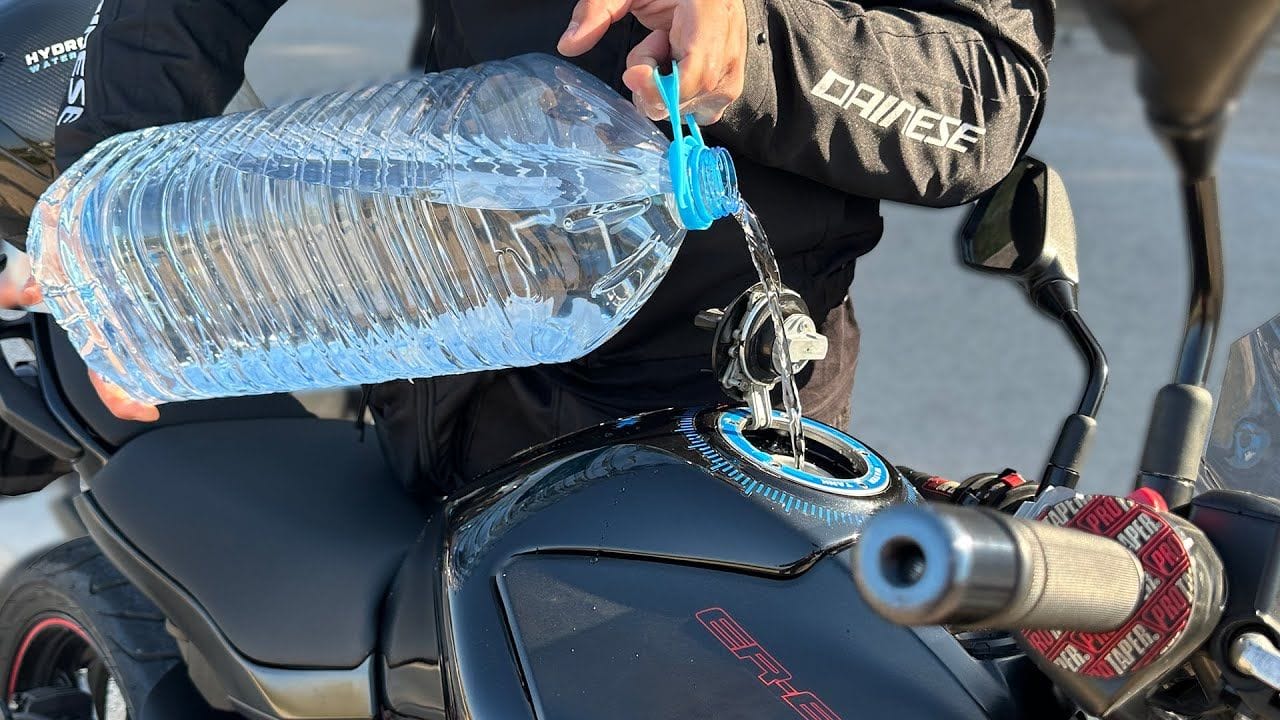

A Surprising Innovation in the Transportation Sector: A Motorcycle That Works Exclusively with Water, ‘Promises’ to Be Able to Travel More Than 1,000 Km on a Single Tank.
The promise of this innovative motorcycle reveals a technology capable of extracting hydrogen from water to use it as fuel, revolutionizing the concept of sustainable mobility.
According to reports, the highly efficient electrolysis equipment installed in this motorcycle is at the core of this innovation. It is supposed to extract the hydrogen contained in water, which is then used as fuel. This approach eliminates the need to store hydrogen in high-pressure tanks, as only the necessary hydrogen is extracted. Moreover, the motorcycle’s safety system deactivates the generation of hydrogen in case of accidents, avoiding the risk of explosions.

Consultation with Engineers and Specialists
The idea of a water-powered motorcycle, which supposedly would function as a self-sustainable energy source, is often discussed in the context of innovations in mobility. However, it is important to analyze this idea in light of the laws of physics and engineering.
-
OMODA & JAECOO grows in Europe in 2026 with an integrated strategy of sales, innovation, local production, and technological advancement in the United Kingdom, Italy, and Spain.
-
OMODA & JAECOO expands after-sales service in Brazil with competitive maintenance, a 7-year warranty, and high availability of parts for technological SUVs.
-
OMODA & JAECOO appoints Alessandra Souza as executive marketing director in Brazil and accelerates brand expansion with a focus on innovation, networking, and hybrid portfolio.

-
Jaecoo 7 with super hybrid SHS system exceeds 1,200 km of combined range with a 1.5 turbo engine, high-density battery, and intelligent energy management.

First, it is essential to understand that every machine needs an external energy source to operate. This energy is converted by the engine into useful work, but there are always losses in the process, primarily due to factors such as friction and heat. For example, in a traditional internal combustion engine, only about 25% of the energy from gasoline is effectively used to move the vehicle; the rest is lost mainly in the form of heat.
In the case of a motorcycle that supposedly works with water, the general idea would be that water could be decomposed into hydrogen and oxygen through electrolysis, and the hydrogen would then be used as fuel. However, electrolysis requires electrical energy, and this energy must come from some external source. It is not possible, according to the laws of thermodynamics, for the motorcycle to generate more energy than the energy it initially received to start electrolysis.
Therefore, the idea of a water-powered motorcycle that would produce enough hydrogen to self-propel and still generate surplus energy is scientifically unfeasible. Such a concept would violate the first and second laws of thermodynamics, particularly the principle that energy cannot be created or destroyed, only transformed, and that no system can be 100% efficient due to inherent losses, such as friction and heat dissipation.
Thus, a motorcycle that operates solely on water and is capable of producing its own energy continuously and sustainably, without the need for external fuel, is not viable with the current understanding of the laws of physics and engineering. Engines that use hydrogen as fuel are an area of research, but the hydrogen used in these cases still needs to be produced and stored in a traditional way, using energy from external sources.








Essa moto já existe, porém não se pode dizer que é só a água, pois tem um catalisador que neste caso é o alumínio. É um processo químico e elétrico; a moto funciona perfeitamente. Se viola as leis da física ou não, isso é o que menos importa.