





 Portuguese
  English
  Spanish
  3 min of reading
  2 comments


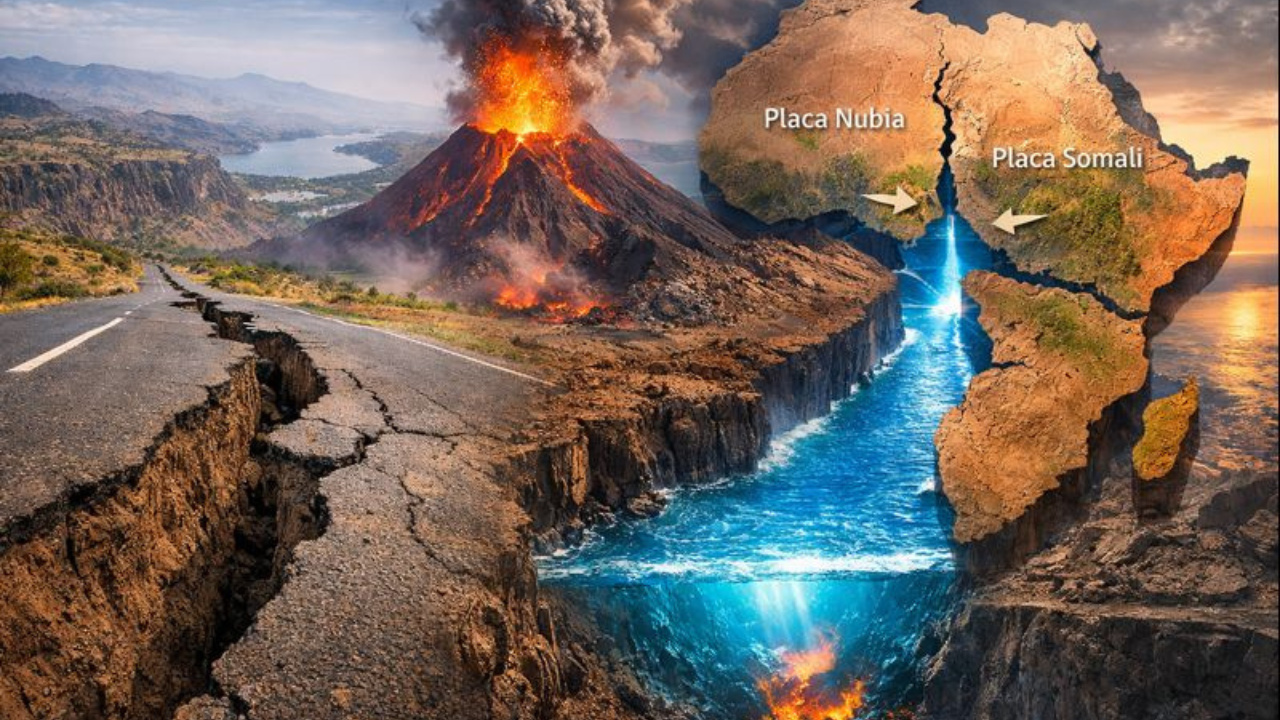


Tectonic Plates In Motion In The African Rift Accelerate Continental Separation And Indicate Possible Formation Of A New Ocean.
Africa is undergoing a large-scale geological transformation that could profoundly change the map of the planet.
The continent is slowly dividing due to the movement of tectonic plates, a process known as Continental Separation.
The phenomenon occurs in the African Rift, an extensive active geological zone that crosses the eastern part of the continent, and could ultimately lead, in millions of years, to the Formation of a New Ocean.
-
In a flooded well, archaeologists found a 1,700-year-old Roman egg that still contains clear and yolk intact inside the very thin shell.

-
Something is happening around the Earth: Inside the huge explosion of fireballs in 2026

-
A hot air bubble coming from Argentina expands over Brazil, causing thermometers to exceed 38 degrees with a thermal sensation of 40 degrees in late March, affecting 6 states at once.

-
The radish leaf that almost everyone throws away has more polyphenols, flavonoids, and fiber than the consumed root, and a 2025 study showed that the leaf contains compounds that protect the intestine, combat inflammation, and may inhibit the growth of cancer cells.

According to National Geographic, this division occurs due to the separation between the Somali and Nubian subplates, driven by intense Volcanic Activity and the movement of magma within the Earth.
Although it is a slow process, its effects are already being felt in some African countries, particularly in the form of cracks in the ground and geological instability.
What Is The African Rift And Why Is It So Important
The African Rift, also known as the East African Rift System (EARS), is one of the most tectonically active regions in the world.
It acts like a gigantic “scar” on the Earth’s crust, where the African continent is literally being stretched.
This system extends for thousands of kilometers and crosses countries such as Ethiopia, Kenya, Tanzania, Uganda, Rwanda, Burundi, the Democratic Republic of the Congo, Djibouti, Eritrea, Malawi, Mozambique, as well as parts of Somalia and Zambia.
Along this stretch, the tectonic plates are slowly moving apart, creating faults, deep valleys, and active volcanoes.
How Does Continental Separation Occur
The Continental Separation in the African Rift occurs because the Earth’s mantle releases heat and magma towards the surface.
This hot material pushes the crust upwards and sideways, thinning the ground and causing progressive fractures.
Over time, these fissures widen.
Meanwhile, Volcanic Activity contributes to accelerate the process, as magma fills the spaces created by the movement of the Somali and Nubian plates.
Thus, the African continent begins to split into two distinct large land masses.
Visible Impacts Already Registered
Although the Formation of a New Ocean is still far in geological time, some impacts are already noticeable.
In Kenya, for example, roads and infrastructure have been damaged by cracks that suddenly appeared in the ground.
Additionally, low to medium intensity earthquakes and frequent volcanic eruptions reinforce that the African Rift is an unstable area.
For local populations, the phenomenon represents both a risk and a challenge for urban, agricultural, and logistical planning.
Volcanic Activity: Risk And Natural Spectacle
The Volcanic Activity associated with the African Rift is one of the most impressive aspects of this geological process.
Active volcanoes and geothermal fields are common, especially in the Afar region, in northern Ethiopia, where the phenomenon began millions of years ago.
On the other hand, this same activity offers opportunities, such as geothermal energy generation, used by some countries in the region.
Thus, the phenomenon encompasses natural risks and economic potential, depending on how it is managed.
A New Ocean In The Future Of Africa
With the continuation of the Continental Separation, scientists believe that, in the distant future, water from the Indian Ocean could flood the African Rift.
This advance would result in the Formation of a New Ocean, definitively separating East Africa from the rest of the continent.
This kind of transformation is not unprecedented in the history of Earth.
A classic example is the separation between Africa and South America, which gave rise to the Atlantic Ocean.
The current process follows the same logic but on a timescale that exceeds human generations.
Slow But Inevitable Transformations
Although the changes are not noticeable on a day-to-day basis, the progress of the African Rift indicates that Africa is undergoing one of the most important geological reconfigurations on the planet.
The tectonic plates continue to move, Volcanic Activity remains intense, and Continental Separation continues its natural course.
Therefore, even though the Formation of a New Ocean will take millions of years to materialize, the current signs reinforce that the African continent is slowly transforming before our eyes.






La humanidad pesa en la gravedad terrestre esa primera razon nos demuestra que toleramos grandes incomodidades el exito humano recide en la comodidad donde existen planetas que nuestro peso por la gravedad es incinificante lograndose la longetividad y la extencion de la edad …a otro punto..este mundo no es para desarrollar vida y intalase …no!!!! es para desarrollar vida y expandirce…un ejemplo dos horas parados y nos canzamos rapido …nunca vuzcamos comodidad gravitacional…
Se llamara el Océano Africano