





 Portuguese
  English
  Spanish
  7 min of reading
  0 comments


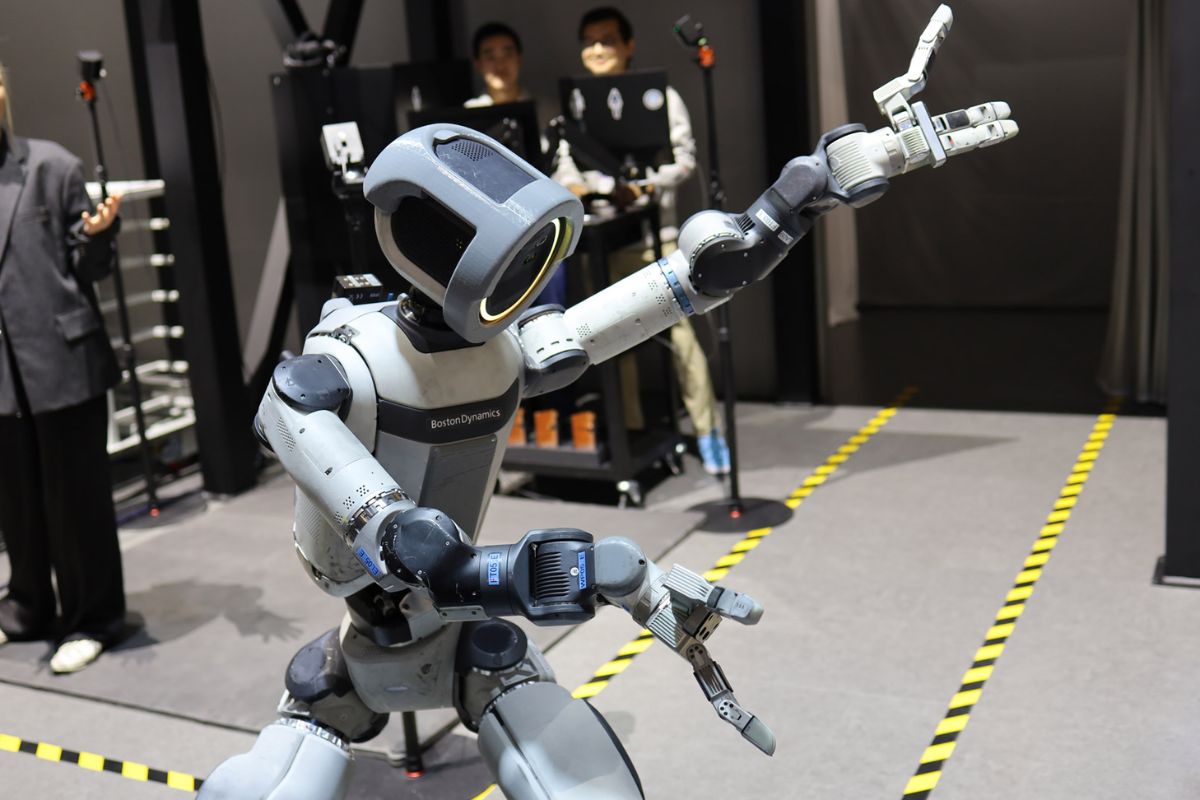
The Boston Dynamics Humanoid Robot Atlas Begins To Operate Autonomously At A Hyundai Factory In Georgia. Electric, With AI And Nvidia Microchips, It Rotates Its Torso, Learns By Demonstration And Repeats Tasks Without Breaks, Reigniting Discussions About Productivity, Safety And The Future Of Industrial Work.
The Boston Dynamics humanoid robot called Atlas has begun to operate autonomously in a Hyundai factory in Georgia, marking a turning point in the way automation is presented on the factory floor. The scene described is that of a humanoid standing 5’9″ and weighing 198 lbs, equipped with artificial intelligence and capable of performing movements that until recently were considered too ambitious for machines.
The arrival of the Boston Dynamics humanoid robot in the industrial environment has also sparked a contrast that runs through the whole discussion: the promise of continuous efficiency against the social discomfort of an operation that “does not take breaks” and can repeat tasks indefinitely. The technology appears as a technical leap, but its use is described as controversial, precisely because it touches on a question that no one likes to answer out loud: what happens when production no longer needs the human rhythm?
Atlas Leaves The Hydraulic Era And Appears As An Electric Body With An “AI Brain”

The current Atlas is presented as a humanoid created by Boston Dynamics, but with an important difference compared to the past: it is no longer described as that bulky hydraulic robot that ran and jumped.
-
While the world looks at oil, the war with Iran is already disrupting helium supply from Qatar, affecting car and iPhone chips, threatening AI expansion, and putting pressure on aluminum packaging at the highest value in four years.

-
Global warming will expose a treasure hidden under the ice of Antarctica and may spark an international dispute over gold and valuable minerals.

-
A street vendor from Praia Grande built a robot made of scrap from scooters and washing machines that pulls his popcorn cart on the beach, emits sounds, and interacts with customers, becoming an attraction on the coast of São Paulo.
-
The specifications of the Xiaomi 18 Pro Max have been leaked, and the highlight is a dual 200 MP camera with a new 22-nanometer technology that promises to consume less energy and capture details in shadows and bright areas using LOFIC HDR.

The narrative speaks of a “new generation” with a sophisticated fully electric body and an “AI brain”.
This leap is associated with two directly mentioned technical elements: artificial intelligence and advanced Nvidia microchips.
The central idea is that the hardware and software push Atlas to a level of autonomy where it can perform “hard-to-believe feats” without relying on the constant presence of engineers programming each step.
At this point, the Boston Dynamics humanoid robot is not presented as “an improved mechanical arm,” but as a platform capable of learning, adjusting, and repeating movements with stability, rather than merely executing a fixed sequence.
An Anatomy That Provokes Strangeness And, At The Same Time, Opens Possibilities

The description insists on a detail that changes how we think about movement: Atlas “rotates around its core.”
Instead of limiting the body to traditional amplitudes, it would be capable of continuously rotating joints, increasing the range of motion and reducing the idea of “joint limit”.
This feature is treated as an advantage: when a robot is not restricted to a short rotational arc, it can reposition its body in ways that seem human, or even beyond human.
It’s not just aesthetic.
In an industrial environment, range of motion becomes the ability to reach, tilt, reposition, and return to the work point with fewer “intermediate maneuvers”.
The result is a curious effect.
The Boston Dynamics humanoid robot is described with movements reminiscent of dark fantasy, and this matters because the strangeness, in itself, becomes part of the public debate about the acceptability of this automation.
From “Engineers’ Algorithms” To Learning Through Teaching And Demonstration
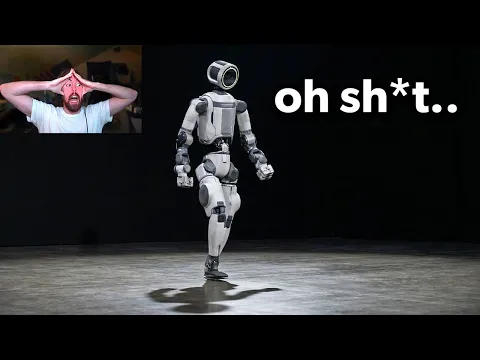

One of the most revealing passages of the material sent discusses how Atlas learns. Previously, Atlas relied on algorithms made by engineers.
Now, the described path is different: less manual programming and more teaching, demonstrations, and machine learning.
This alters the project’s center of gravity. Manual programming means anticipating every condition and every variation.
Learning through demonstration suggests that the system can observe, adjust, and internalize patterns, making it plausible that it performs tasks that were not “coded line by line”.
The Boston Dynamics humanoid robot is described as capable of “truly learning”, and the assertion comes with an efficiency argument: it would be one of the most effective ways to program robots of this type.
The industrial implication is direct: when the training method changes, the cost of expanding the repertoire of tasks also changes.
Theoretically, the adaptation curve becomes less dependent on rewriting routines and more on guiding, demonstrating, and validating.
Mobility That Becomes Spectacle And A Showcase Of What AI Is Buying
The material sent lists a set of feats that serve as a public showcase of progress: Atlas “jumps and runs with ease”, does “flips”, “even dances” and is mentioned as capable of “dancing the Macarena”. These examples are not just internet jokes. They communicate fine control of the body, balance, and coordination.
For a humanoid robot, mobility is not just displacement.
It is real-time stability, the ability to transfer load, react to small disturbances, and correct posture without falling.
The implicit message is that the Boston Dynamics humanoid robot has begun to master movements that, recently, would have been considered unfeasible outside the lab.
In the factory, this can mean something simple and brutal: if the robot moves well, it can navigate, reposition itself, reach different points, operate in spaces where only a human would have previously entered comfortably.
Mobility, then, ceases to be a “show” and becomes flexibility.
The Three-Finger Hand And The Explicit Choice For Functional Simplicity
The material draws attention to another technical point: the hand of Atlas has three fingers.
And the justification is pragmatic: robotic hands are an extremely complex engineering problem, and therefore the solution doesn’t try to perfectly imitate a human hand.
The crucial detail is the mentioned versatility: these three or one digit can rotate around itself and act as a thumb, with the possibility of switching between “modes”.
This suggests a design that seeks to reduce complexity without completely losing the ability to grasp, hold, and manipulate.
In factory terms, the message is that the Boston Dynamics humanoid robot does not need to be a perfect anatomical copy to be useful.
It needs to be repeatable, robust, and sufficient for the tasks that really matter in the industrial flow.
Operate Alone At Hyundai And The Symbolic Weight Of “Autonomously”
The starting point of the theme is clear: “Atlas, the humanoid robot from Boston Dynamics, now operates autonomously at the Hyundai factory in Georgia.”
The word “autonomously” here carries more weight than it seems.
Because autonomy, in everyday use, is often confused with “without anyone watching.”
In the described scenario, autonomy is presented as the ability to execute without depending on the constant intervention of a human operator for each micro-decision of movement.
This is what gives the case a sense of disruption.
The Boston Dynamics humanoid robot appears as a system that does not need to be puppeteered.
It prepares for work, executes, and moves with operational independence. And this is what fuels both enthusiasm and apprehension.
“He Does Not Take Breaks”: Infinite Productivity And The Shock With The Human Rhythm
The most controversial part of the material is not about the robot’s size, nor the chip, nor the dance. It is the direct comparison between person and machine:
“He does not take breaks. He works all day.”
The narrative also emphasizes that he will do “the same thing all the time” and that many people underestimate the difference between a human performing an action and a robot doing it indefinitely.
This point is central to understanding why the theme is described as controversial. The promise is not just productivity, but persistence.
Infinite repetition has a cumulative advantage. The material even uses an analogy with bots in video games: you turn on an autoclicker, come back later and find an “unfathomable level of resources.”
The logic behind it is the same: repetition without fatigue accumulates results.
When this enters a factory, the debate about the Boston Dynamics humanoid robot becomes a debate about scale: it is not just about replacing a worker in a shift, but about putting a routine into continuous operation, with potential impacts on cost, production time, and how work is organized.
The Future Of Industrial Work Becomes A Narrative Dispute Within The Technology Itself
The material also carries an explicit social tension. There are shocking phrases with language of “slavery” and “human batteries” that serve as a thermometer for the discomfort of part of the public toward humanoid automation.
Even without detailing policies, the text suggests that the public discussion will not be limited to engineering.
Because the technology described is not neutral in the eyes of those who observe it.
A humanoid that works without breaks holds a mirror up to human work: biological limitations, need for rest, rights, collective organization.
The material mentions that it “does not know what a union is” and “does not even know what Christmas is,” using this to emphasize the difference in regime between human work and machine work.
Thus, the Boston Dynamics humanoid robot becomes a symbol. Not just of mobility and AI, but of the type of factory that can exist when repetitive and persistent tasks no longer require the human body.
Atlas appears as the most recent case where a Boston Dynamics humanoid robot ceases to be a demonstration and enters the logic of industrial operation, with autonomy, electric body, Nvidia microchips, and learning through demonstration.
The controversy, however, follows the advancement: the promise of continuous repetition without breaks directly impacts the discussion about the future of industrial work.
Do you see the Boston Dynamics humanoid robot as a tool for safety and productivity or as a milestone that could accelerate the replacement of people in industrial tasks?









-

-

-

-

16 pessoas reagiram a isso.