





 Portuguese
  English
  Spanish
  4 min of reading
  12 comments


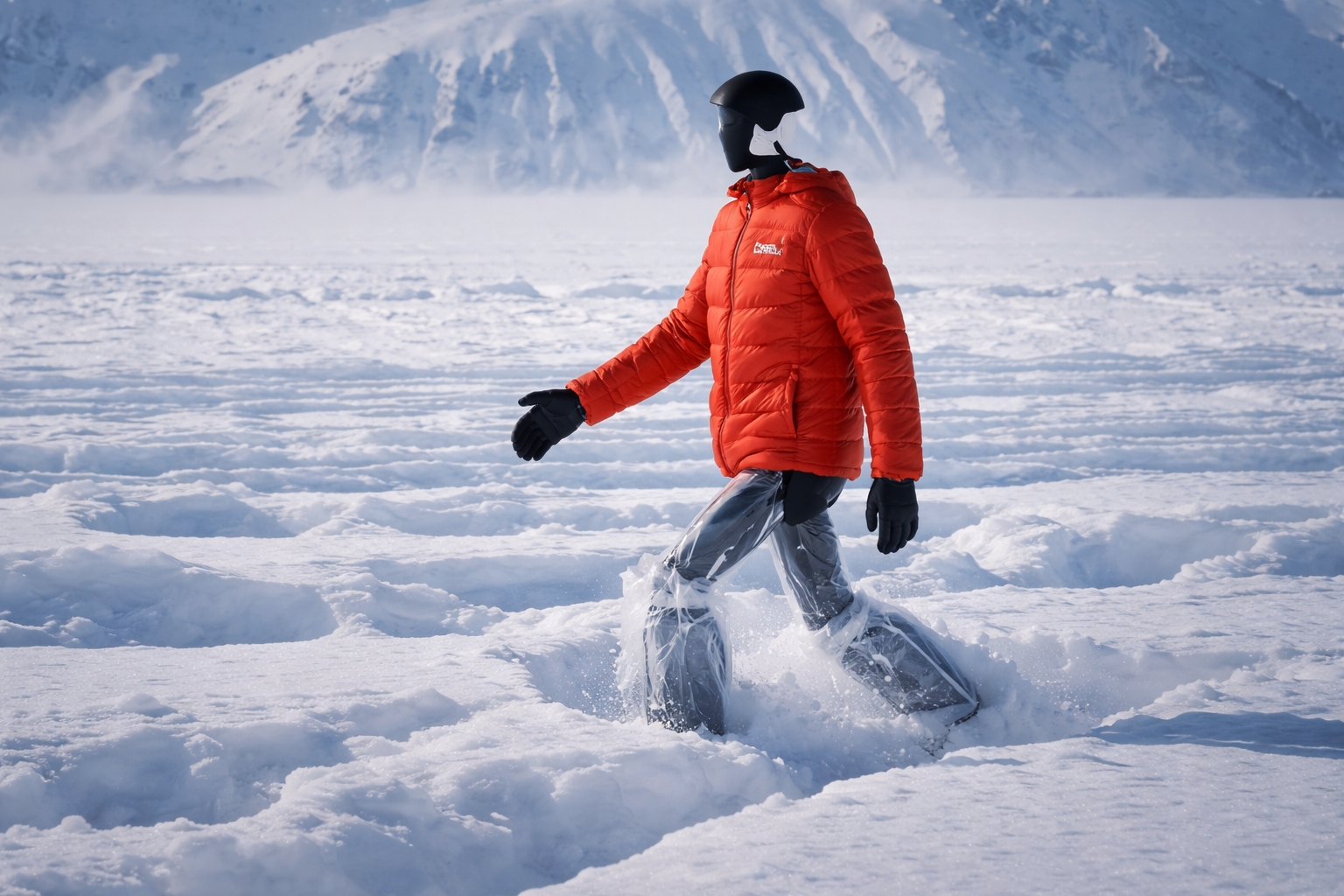


Unitree’s G1 Humanoid Robot Faces Extreme Cold in the Snow, Registers Over 130,000 Steps, and Shows That the Race for Robots Outside the Laboratory Has Begun
A humanoid robot walking on a smooth surface inside a warehouse is nice, but it doesn’t scare anyone. Now put that same robot on a snowy plain, with cutting winds, uneven ice, and temperatures that could shut down any poorly protected electronics. That’s when the test gets serious.
That was the message that Unitree tried to convey with the G1, its compact humanoid. The company had the robot take a prolonged autonomous walk in a frozen area in the Altai region of Xinjiang in northwestern China. The result caught attention because it wasn’t a short marketing video. The goal was endurance: to keep the robot walking long enough to become a real “milestone.”
The G1 reportedly registered over 130,000 steps in an environment of extreme cold, reaching around -47.4 °C, and even completed a route drawing the emblem of the Winter Olympics in a large area, approximately 186 meters long by 100 meters wide. It’s not just walking. It’s walking, maintaining stability, and following a route.
-
Scientists have captured something never seen in space: newly born stars are creating gigantic rings of light a thousand times larger than the distance between the Earth and the Sun, and this changes everything we knew about stellar birth.

-
Geologists find traces of a continent that disappeared 155 million years ago after separating from Australia and reveal that it did not sink, but broke into fragments scattered across Southeast Asia.
-
Samsung launches cordless vertical vacuum cleaner with up to 400W of suction and relies on AI to automatically recognize corners, carpets, and different surfaces.

-
The lost continent beneath Europe: separated from North Africa about 240 million years ago, comparable in size to Greenland, Greater Adria was crushed over 40 million years and left geological marks from the Alps to the Balkans.


What Smart Workarounds Were Used to Keep the Robot from Freezing

Extreme cold does not forgive. It attacks the battery, lubrication, sealing, sensors, cables, and actuators. And a humanoid robot has an additional problem: many joints, many points of failure, and balance that depends on everything responding without delay.
To withstand the conditions, the G1 was not just as it came out of the factory. Engineers dressed the robot in an orange padded coat and put improvised plastic covers on the legs. The idea was pragmatic: to reduce thermal stress and protect joints, actuators, and the battery from freezing. The look became almost comical, but it’s exactly this kind of adaptation that separates a real test from a stage demonstration.
Another important point is that the test was done outside a controlled environment. Snow and ice change foot grip, create small unevenness, and hide irregularities. This forces the robot to constantly adjust its stride and center of mass, without tripping, freezing, or wasting too much energy trying to “correct” every micro error.
According to Interesting Engineering, the walk was described as one of the first confirmed cases of a humanoid performing a sustained autonomous walk in such severe cold, with a record of over 130,000 steps and executing a route drawn in the ice with the help of satellite navigation and trajectory planning algorithms.
What This Test Says About the New Competition in Humanoid Robotics
There is one detail that is worth gold: the industry is stepping out of its comfort zone. For years, humanoid robots were trained for clean floors, good lighting, predictable routes, and indoor environments. However, the real world is the opposite of that. Anyone wanting to sell robots for inspection, patrol, logistics, fieldwork, rescue, or industrial operation needs a different metric: environmental durability.
Therefore, resistance to climate and temperature has become a competitive advantage. Some companies are already announcing “all-weather” platforms with certifications for dust and water protection and a declared minimum operating temperature. However, one thing is to say it works. Another is to take it to a frozen area and ask it to walk until it sums up 130,000 steps.
Unitree seems to have sought this symbolism: to show that the humanoid can endure more than indoor tasks, that it can move across difficult terrain, follow positioning accurately, and maintain stability for extended periods. In summary, the company signals that the game is now “robots outside the laboratory.”
What the G1 Has Inside and Why It Matters in the Cold
The G1 is a compact humanoid, about 127 centimeters tall and weighing around 35 kilograms. Depending on the configuration, it can have from 23 to 43 motors in its joints, with a maximum torque of 120 newton-meters per joint. To navigate, the robot uses a package of sensors that includes 3D LiDAR, depth cameras, and noise-canceling microphones, allowing voice control in certain scenarios.
The power comes from a rapid-release 9,000 mAh battery, with announced autonomy of up to two hours and quick-swapping capability, which makes sense for field operations. The control of the joints is managed by an octa-core processor, allowing agile movements and a maximum walking speed reported to be around 2 meters per second, close to 7 kilometers per hour.
The point is simple: batteries and actuators suffer in the cold. If the battery loses performance and the response of the joints is delayed, the robot becomes an ambulatory stumble. That’s why the coat and covers are not just for show. They are part of the test.
In the end, this type of demonstration has a direct reading: whoever can get humanoids to function in hostile environments will gain a huge piece of the future because almost everything outside of a clean room is hostile in some way.







A fábrica está na matéria: Unitree Robotics é uma empresa chinesa sediada em Hangzhou
Pdddp12
Sdhbn22456800