





 Portuguese
  English
  Spanish
  6 min of reading
  0 comments


Equipped with Artificial Intelligence and Submarine Sensors, the Smart Grapple Robot Identifies Trash at the Bottom of the Ocean and Can Grab Objects Weighing Up to 250 Kg, Helping to Remove Marine Waste.
Marine pollution has become one of the planet’s greatest environmental challenges. Estimates from scientific institutions indicate that millions of tons of waste enter the oceans every year. While much of the attention is focused on floating debris, researchers point out that most of the waste ends up sinking and accumulating on the seafloor, where removal is extremely difficult. To address this problem, European scientists have developed a new generation of underwater robots capable of locating and removing waste directly from the seabed. One of the most advanced systems created for this purpose is the Smart Grapple, a robot equipped with artificial intelligence and sensors that allow it to identify trash on the ocean floor and accurately collect heavy objects.
The equipment is part of the SeaClear 2.0 project, funded by the European Union and coordinated by researchers from the Technical University of Munich (TUM) and other European research institutions. The project’s goal is to develop technologies that allow for cleaning underwater areas where the presence of trash poses a risk to marine ecosystems.
Ocean Bottom Pollution: An Invisible Problem That Grows Every Year
Most people imagine ocean pollution as islands of plastic floating on the surface of the sea. However, scientific research shows that this is just a small part of the problem. Studies on marine pollution indicate that between 70% and 90% of the waste that enters the oceans ends up sinking over time. Ocean currents, the weight of materials, and the adhesion of organisms cause plastics, metals, fishing nets, and other waste to settle on the seafloor.
-
In Mexico, a 3,000-year-old Maya site with the dimensions of an entire city may have been built as a colossal map of the cosmos, created to represent the order of the universe and reveal how this people organized space, time, and rituals.

-
Japan wants to build a solar ring of 10,900 kilometers on the Moon to continuously send energy to Earth.
-
Weighing almost 1 ton, with temperatures of up to 3,000°C, the ability to launch 10,000 fragments within a radius of 1 km, capable of penetrating concrete and melting steel, Turkey’s terrifying bomb emerges as one of the most destructive non-nuclear weapons ever presented.

-
After a submarine disappeared beneath the “Doomsday Glacier,” scientists announce a new monstrous machine capable of operating at 3,000 meters depth to return to the heart of the ice and investigate a threat that could raise sea levels worldwide.

These residues can remain in the environment for decades or even centuries. Among the most commonly found objects at the bottom of the ocean are:
- Abandoned fishing nets
- Tires
- Fishing equipment
- Plastic bottles
- Metal parts of vessels
- Discarded industrial structures
In addition to polluting the environment, these materials pose direct risks to marine animals. Turtles, fish, and marine mammals can become entangled in nets or ingest plastic fragments. For this reason, scientists have begun to investigate technologies that enable safe and efficient removal of this waste.
The European SeaClear Project and the Development of Smart Grapple
The SeaClear project is a European research initiative created to develop robotic solutions capable of removing waste from the seabed. The program brings together universities, research institutes, and technology companies from various European countries. Among the participants are:
- Technical University of Munich (Germany)
- Delft University of Technology (Netherlands)
- University of Dubrovnik (Croatia)
- Fraunhofer Institute (Germany)
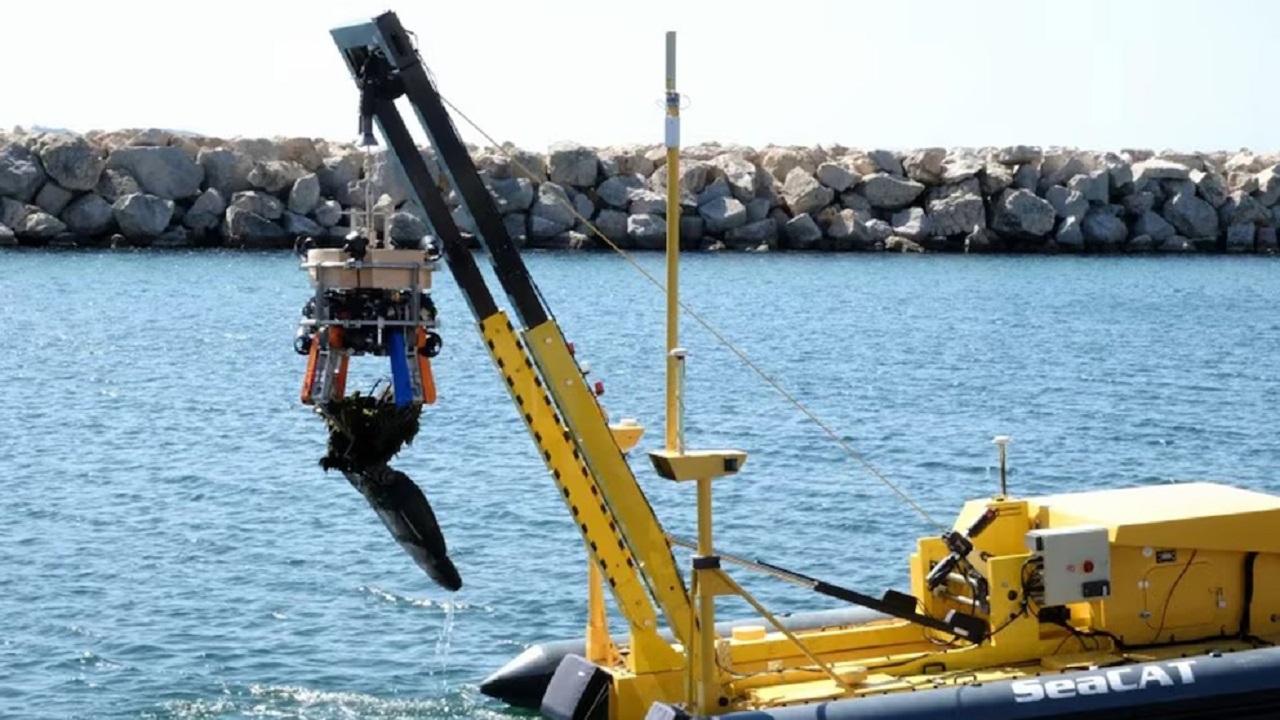
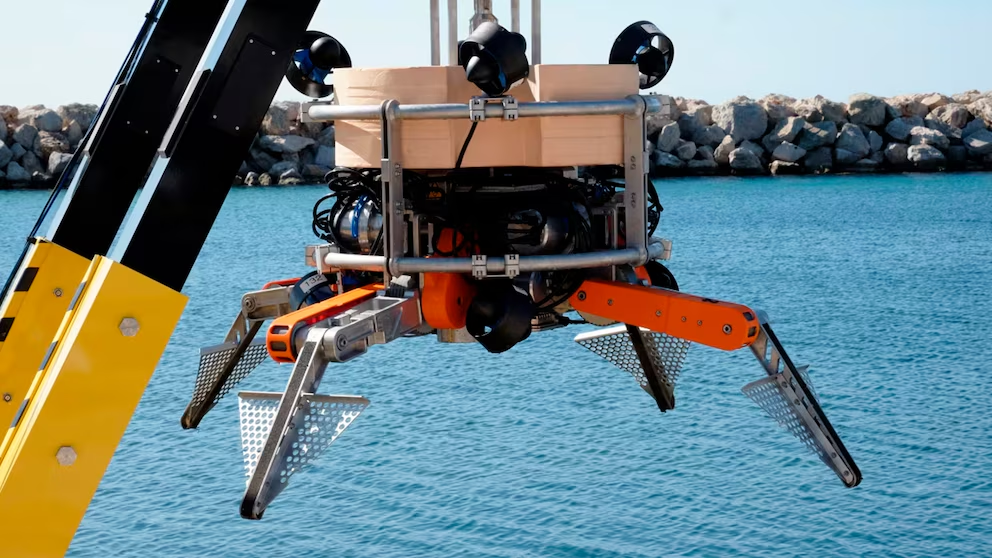
The project began with the development of algorithms capable of identifying underwater waste in images captured by drones and robots. Based on these studies, researchers created the Smart Grapple, a robotic claw equipped with sensors and artificial intelligence.
This claw was designed to operate in complex underwater environments, where visibility, pressure, and water movement make conventional operations challenging.
Artificial Intelligence Trained with Thousands of Underwater Images
One of the main challenges in removing waste from the bottom of the ocean is distinguishing between debris and natural elements. Rocks, corals, algae, and marine organisms can have shapes and colors similar to discarded objects.
To solve this problem, researchers trained the artificial intelligence system of the Smart Grapple using more than 7,500 images of underwater objects. These images include various types of waste, such as:
- Bottles
- Tires
- Fishing nets
- Metal parts
- Deformed plastics
The algorithm analyzes the images captured by the robot’s cameras and compares the patterns with the database used in the training. In this way, the system can identify debris even when it is partially buried or covered by algae. This capability is essential to prevent the robot from attempting to remove natural elements from the marine environment.
Sensors That Allow Operation at the Bottom of the Ocean
In addition to artificial intelligence, the Smart Grapple uses various sensors to operate in underwater environments.
Among them are:
- High-resolution cameras
- sonar for navigation in murky waters
- Depth sensors
- Pressure sensors
The sonar is particularly important because many areas of the ocean have extremely low visibility. In port regions or areas with sediments, the water can become murky, complicating operations based solely on cameras.
Sonar allows the robot to identify objects and obstacles even when visibility is practically zero.
The Robotic Claw Capable of Lifting Heavy Objects
The central component of the system is the four-fingered robotic claw, designed to manipulate objects of various shapes. This claw can grasp waste weighing up to 250 kilograms.
In addition to mechanical strength, the system has sensors that automatically control the pressure applied to the object. This allows the robot to handle delicate items without breaking or fragmenting them. Smaller fragments could spread throughout the marine environment, exacerbating the pollution problem.
Among the objects that the system has already demonstrated the ability to remove are:
- Car tires
- Abandoned fishing nets
- Metal scraps
- Plastic boxes
- Fishing equipment
An Integrated System of Robots Working Together
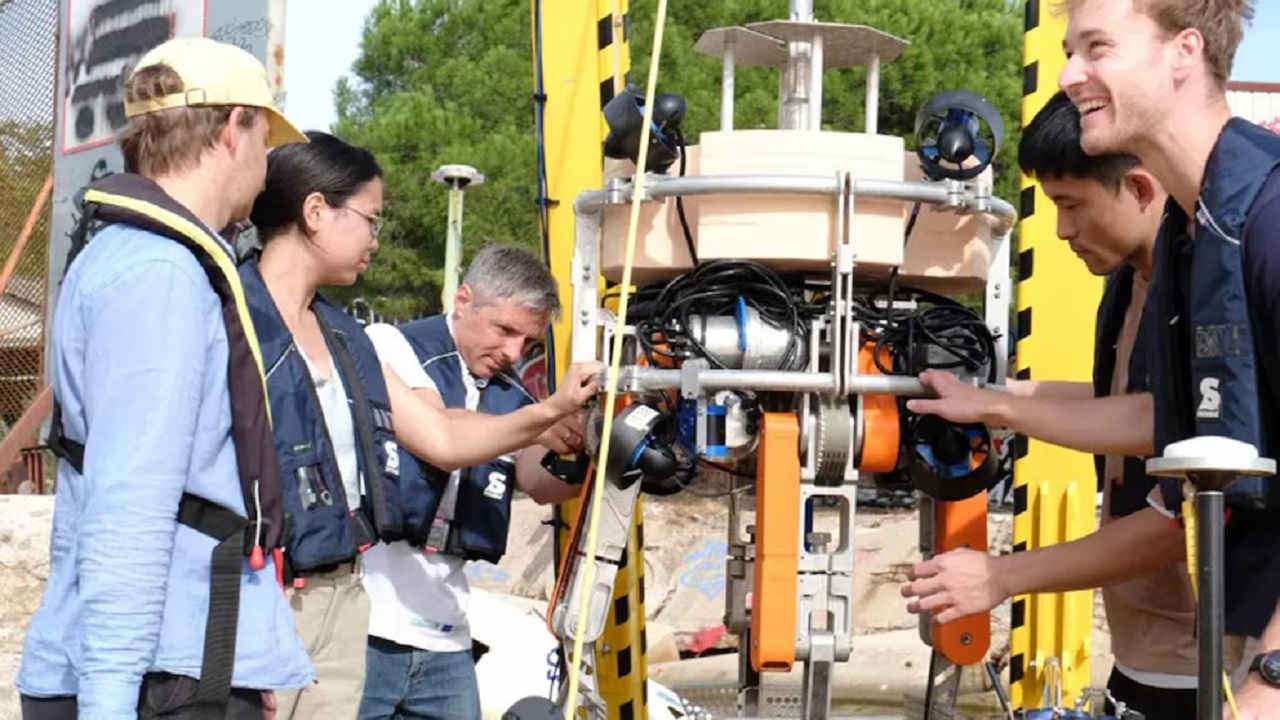
The Smart Grapple does not operate alone. It is part of a larger robotic system developed by the SeaClear project. This system functions as a team of specialized robots. Among the components are:
- Aerial drones that identify trash on the surface
- Underwater vehicles that map the seabed
- Robots equipped with claws to remove objects
- Autonomous vessels that transport collected materials
These machines work together. First, drones or sensors identify areas with a higher concentration of waste. Then, underwater robots conduct a detailed mapping of the location.
Finally, the Smart Grapple removes the larger objects and deposits them in a surface vehicle. This vehicle takes the material for recycling or proper disposal.
Tests Conducted in European Ports
The first tests of the system were conducted in port areas of Europe. Ports are particularly challenging environments for underwater robots because they have:
- A large amount of sediments
- Low visibility
- Obstacles like cables and metal structures
- Intense boat traffic
Despite these difficulties, the tests showed that the system can accurately identify and remove waste. These experiments allowed for improvements in both the artificial intelligence algorithms and the mechanical systems of the claw.
Continuous Operation Without Risk to Divers
One of the advantages of using underwater robots is the reduced need for human divers. Underwater cleaning operations performed by divers have several limitations:
- Maximum safe depth
- Limited working time
- Risk of accidents
- High operational cost
Robots like the Smart Grapple can operate for much longer periods. The system can also work in environments where divers could not operate safely. This allows underwater cleaning operations to occur continuously, potentially 24 hours a day.
An Important Step in Ocean Cleanup
The Smart Grapple represents a new generation of technologies aimed at the environmental recovery of the oceans. Combining robotics, advanced sensors, and artificial intelligence, the system is designed to address a problem that grows each year.
According to the researchers involved in the SeaClear project, the goal is not only to develop an experimental robot but to create a platform that can be used on a large scale. Ports, coastal areas, and tourist regions are some of the locations where this type of technology could be applied in the future.
As more waste continues to reach the sea, technological solutions like the Smart Grapple can become important tools for removing some of the accumulated trash at the bottom of the oceans and reducing the environmental impacts of marine pollution.








Seja o primeiro a reagir!