





 Portuguese
  English
  Spanish
  5 min of reading
  2 comments


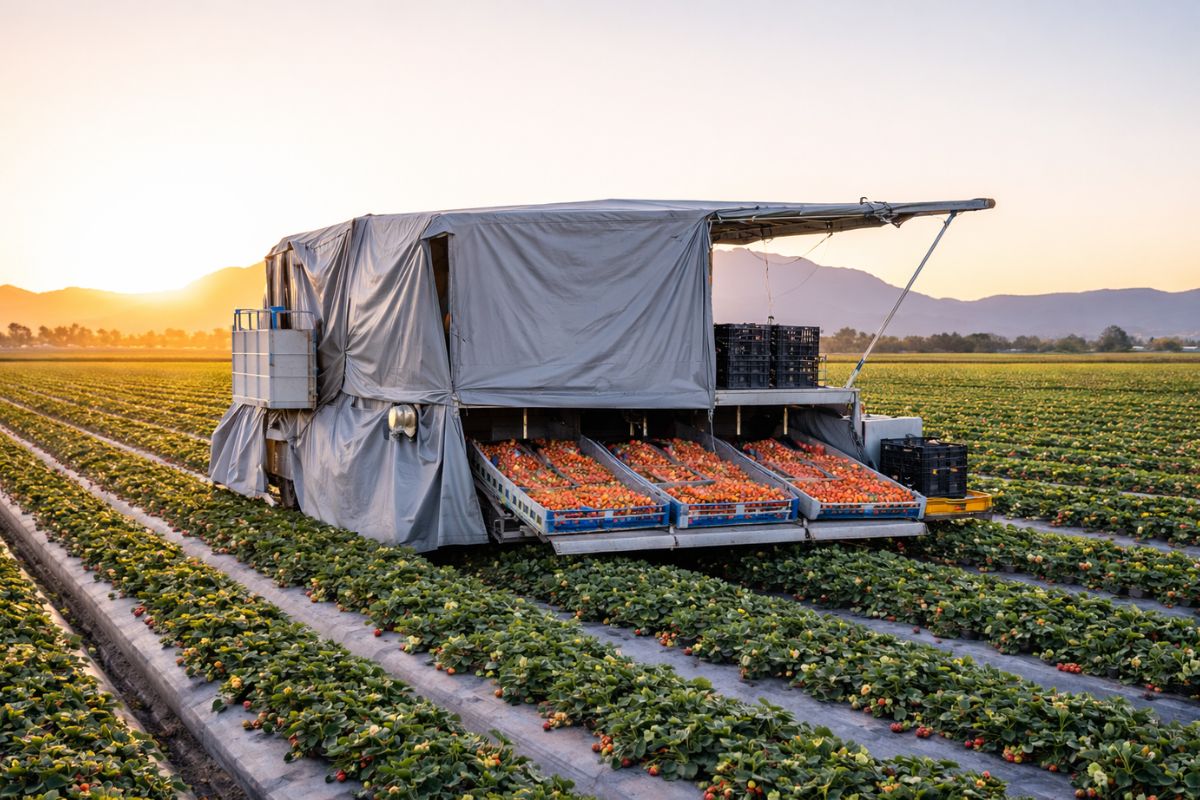


Driven By Artificial Intelligence, Agricultural Robots Work Day And Night, Enter The Harvest Of Delicate Fruits And Accelerate Automation In Strawberry Fields From The United States To Other Producing Poles Around The World
Mechanization has always been synonymous with giant tractors crossing fields of corn, wheat, and soybeans in straight lines as far as the eye can see. Now, robots are beginning to face a much more delicate challenge: harvesting strawberries without bruising the fruit, selecting only the ripe ones, and maintaining the quality that consumers expect when they open the box in the supermarket.
In Florida, a strawberry producer who cultivates about 600 hectares decided to turn his farm into an open-air laboratory. After years relying on immigrant workers to harvest each tray, he saw stricter immigration laws driving up labor costs and increasing uncertainty. The solution found was to invest in 4.0 technologies, combining robotics, artificial intelligence, big data, GPS, and computer vision to replace 30 people in the middle of the field.
The Mechanization That Did Not Reach Delicate Fruits
The history of agricultural mechanization is ancient but almost always told from the perspective of large grain crops.
-
A nutritionist reveals that the real villain of your breakfast is not butter or eggs, but rather the excess of white bread, cookies, and refined sugar that you consume every day without realizing the damage it causes.

-
The Android as we know it has its days numbered after a new rule from Google that could end free APKs and completely transform the system by 2027.

-
Archaeologists use satellite technology and find a mysterious structure of 500 m² buried up to 6 meters beneath an ancient city in Egypt.
-
Supercomputer calculates when humanity may disappear from Earth, predicts a scorching supercontinent, temperatures of up to 70 degrees, and a planet moving towards becoming uninhabitable.


Bigger tractors, high-capacity sprayers, and state-of-the-art seeders have transformed super plantations into open-air production lines, drastically reducing the need for labor.
Fruits and vegetables were left out of this narrative for a long time. Harvesting strawberries, tomatoes, or other delicate fruits is quite different from cutting a soybean stalk or gathering ears of corn.
Each unit must be handled with care, selecting only the right point of ripeness, avoiding bruising, and respecting a selective logic that has always seemed difficult to translate into code.
Delicate fruits require a touch that, until now, only the human hand seemed capable of providing safely. Therefore, even in highly mechanized countries, strawberry harvesting has continued to rely on long lines of workers bent over the plants, day after day.
Strawberries In The Sights Of Agricultural Robots
The turning point begins when producers like the one in Florida realize that relying exclusively on human labor is becoming risky and expensive.
Years of harvesting with immigrant workers ensured the supply of strawberries, but the combination of stricter immigration rules and rising costs made this model unstable.
Instead of simply accepting the new reality, the producer teamed up with a technology partner and began testing robots in the fields.
The goal is clear: to replace part of the manual labor with an intelligent platform, capable of identifying strawberries ready for harvest, making the correct removal movement, and placing each fruit carefully without crushing the pulp.
This bet is not isolated. Similar solutions are beginning to emerge in countries ranging from Spain to Japan, including Brazil.
Brazil itself has a history of pioneering in this front: about 40 years ago, a national company launched the world’s first coffee harvesting machine, showing that the field can be a great cradle of innovation in agricultural machinery.
How The Robot That Harvests Strawberries Works
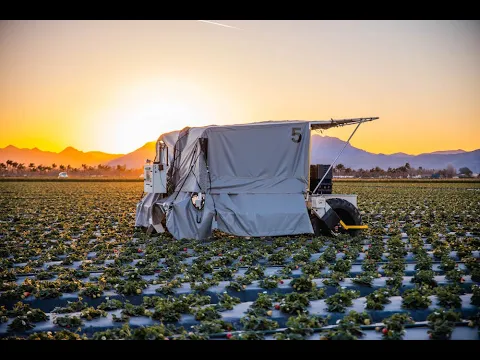

In the Florida experiment, the heart of the innovation is a prototype strawberry harvesting machine that is 30 feet long.
Instead of running alongside the plants, it moves on cultivation columns, literally hovering over the rows of strawberry plants.
Sensors and cameras feed computer vision systems that identify, in real-time, the position and ripeness of each strawberry.
From there, automated arms and mechanisms take care of making the gesture that human harvesters master: “positioning the strawberry in the mold” and twisting accurately, mimicking the small pop that releases the fruit from the peduncle without damaging it.
In this prototype’s proposal, the machine can operate day or night, under artificial lighting, and perform the work equivalent to that of 30 human harvesters in a single structure.
Instead of dealing with large teams, the producer can now monitor the performance of a machine that does not tire and maintains the same standard throughout the entire journey.
From Traditional Producer To Field Startup Owner
Behind these robots is a sixty-something producer who has, in practice, become a kind of rural startup owner.
Accustomed to dealing with planting and harvesting cycles, he now also navigates software versions, hardware testing, sensor adjustments, and algorithm updates.
The farm stops being just a place of production to become a technology testing ground. The farmer needs to hire or train professionals with a profile completely different from the traditional one, capable of understanding electronics, programming, data, and maintaining complex systems, in addition to agronomic knowledge.
This personal transformation summarizes the larger movement that is beginning to cross the agricultural sector: producers moving from the exclusive role of machine operators to becoming managers of systems, data, and intelligent platforms.
High Cost Today, Strategic Bet For Tomorrow
None of this happens overnight. Machines are still expensive, prototypes require constant adjustments, and failures are inevitable at the beginning.
Farms that invest in these robots need a team prepared for maintenance, quick repairs, and data-driven decision-making, including knowing when it’s worth turning the machine on or off.
Even so, many tasks on farms are already ripe for automation, possibly to a greater extent than we imagine.
Repetitive harvesting, pest monitoring, satellite and drone image analysis, soil and climate analysis, all of these compose a universe in which artificial intelligence and robotics are likely to integrate more and more.
In the case of strawberries, the pressure for labor, the added value of the fruit, and the need to ensure quality make the scenario even more favorable for the adoption of robots.
Each advancement in prototypes like the one in Florida brings closer the reality of crops where machines and people work side by side, with technology assuming the heavy and repetitive effort.
The question has shifted from whether robots will fully enter the harvesting of delicate fruits to when and at what speed this change will spread across the world.
And you, do you believe that robots harvesting strawberries will be more allies of productivity or a threat to jobs in the field?







A Skype net vai tomar conta dos seres humanos e os mesmos nao terá mais valor neste planeta
Na realidade estamos cada vez mais a caminho da tecnologia. É um processo que pode funcionar bem, mas também pode que não dê resultados esperados.Muitos trabalhadores podem ficar sem emprego, uma ameaça para os que tem como sustento da família este tipo de atividade. A máquina nunca vai se igualar com a mão de obra humana, por melhor que seja.