





 Portuguese
  English
  Spanish
 5 min of reading
  6 comments


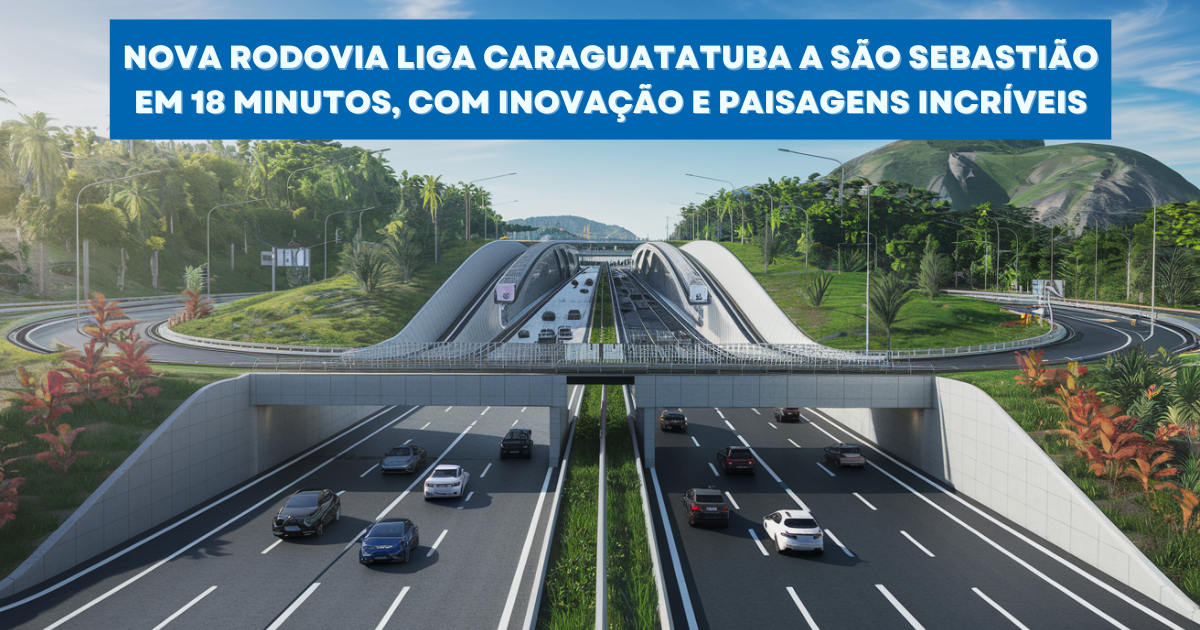

The Newest Highway in São Paulo, with an Investment of R$ 3 Billion, Promises to Transform the North Coast! In Just 18 Minutes, Caraguatatuba and São Sebastião Will Be Connected with State-of-the-Art Infrastructure, Innovative Tolls, and Direct Impact on the Economy. Discover How Mobility and Tourism in the Region Will Be Revolutionized!
Did you know that a new highway is about to completely transform the north coast of São Paulo? This is not just an ordinary road, but a monumental project that will change the lives of millions of people.
The São Paulo government has just inaugurated a R$ 3 billion project that promises a revolution in transportation, tourism, and the local economy.
But what makes this project so innovative? Read on to understand how the new highway will make all of this happen in a way you never imagined.
-
Brazilian city bets on the business environment to generate jobs and attract investments in the energy sector — secretary reveals strategy at Macaé Energy 2026.

-
50 viaducts, 4 tunnels, 28 bridges, and 40 kilometers of bike paths: BR-262 in Espírito Santo will receive 8.6 billion reais for the largest engineering project in the state’s history, inspired by the Immigrant Highway in São Paulo.

-
Brazil produces too much clean energy and doesn’t know what to do with it: over 20% of solar and wind capacity was wasted in 2025 while investors flee and 509 renewable generation projects were abandoned in the last year.

-
Piauí will produce a new fuel that replaces diesel without needing to change anything in the truck’s engine and reduces pollutant gas emissions by half: truck drivers from all over the Northeast are already celebrating the news that will arrive later this decade.


What is the New Tamoios Highway?
The new highway, called the South Bypass of the Tamoios Highway, was inaugurated on November 18, 2024, and connects the cities of Caraguatatuba and São Sebastião.
With a length of 26 kilometers, it promises to reduce travel time between these two important cities on São Paulo’s north coast from one and a half hours to just 18 minutes.
Instead of wasting time in long traffic jams, drivers and tourists will now have a faster, safer, and more comfortable route.
The total investment in the project was an impressive R$ 3 billion, and its impact is expected to be transformative for the entire region.
In addition to facilitating access, the new highway will also play a key role in the modernization of local infrastructure and in strengthening the economy.
The improvement in mobility is expected to bring direct benefits to commerce, tourism, and even to the quality of life of the local population.
What seemed to be a long-term project is now becoming a reality capable of changing the landscape of São Paulo’s coast.
The State-of-the-Art Infrastructure That Will Ensure Greater Safety
One of the standout features of this new highway is the high-tech tunnels, which total 3.4 km in length.
These tunnels are not ordinary; they have been designed with international standards and include advanced ventilation systems, 24-hour monitoring, and emergency exits.
These features are a true milestone for Brazilian road engineering, with experts stating that this will be one of the safest projects in the country.
Traffic conditions, especially in more difficult and mountainous sections, have been designed to ensure maximum comfort and safety.
Furthermore, the highway will be equipped with security cameras and real-time alert systems, providing a quick response in emergencies.
These safety elements are fundamental for driver confidence and ensuring a smooth trip.
The Economic Impact Will Be Gigantic
In addition to reducing travel time, the new highway will have a huge economic impact on the north coast of São Paulo.
The forecast is that around 25 million drivers will use the highway annually, which will be a huge incentive for tourism and local commerce.
The increase in tourist circulation and the improvement in access to cities are expected to generate a wave of new investments, as well as direct and indirect jobs.
Industry sectors such as hospitality, gastronomy, and retail are expected to benefit directly from this change.
The movement of tourists and the increased flow of people in the region should create new opportunities for both small and large businesses.
As a result, the local economy could experience significant growth, reflecting the success of the project.
The economic revitalization is already underway and is viewed with great optimism by experts, as the previously isolated region now presents itself as a location with immense potential to attract new enterprises and investors.
It is expected that tourism, particularly ecotourism, will further develop due to increased accessibility.
Free Flow Tolls: An Innovation That Will Further Speed Up Travel
Another noteworthy aspect of the highway project is the free flow tolls, a true revolution in the toll collection system in Brazil.
Unlike traditional toll booths where drivers must stop and pay, the free flow system allows drivers to continue their journey without any interruption.
Located at km 13.5 of the highway, the free flow toll will be the first in Brazil to adopt this innovative system, ensuring a smoother and queue-free experience.
This means that instead of wasting precious minutes waiting at toll booths, drivers will pass through gantries that charge automatically, with payment being made without any stops.
In addition to speeding up traffic, the system also has an environmental benefit, as it eliminates the need for constant stops, reducing pollutant emissions and contributing to the region’s sustainability.
A Project That Respects the Environment
Despite its grandeur, the new highway did not compromise its commitment to environmental preservation.
During the planning of the road, measures were taken to minimize ecological impact, especially in the areas of Atlantic Forest.
Throughout the highway, animal passages were installed to ensure the safety of local wildlife, and sound barriers were placed to protect neighboring communities from excessive noise.
This care for the environment reflects the effort to balance progress with sustainability, and the project was designed to ensure that the nature and biodiversity of the region are preserved while infrastructure is modernized.
The Future of the North Coast of São Paulo
The South Bypass of the Tamoios Highway is not just a new road, but a catalyst for change for the north coast of São Paulo.
The project represents a revolution in how residents and tourists move around the region and is expected to promote significant urban and economic growth.
The cities of Caraguatatuba and São Sebastião will become more connected and integrated with the rest of the state, attracting new businesses and opportunities.
What Are Your Expectations for the Future of the Paulista Coast?
Will the new highway really change everything? Will the economy of the region take off? What do you think about this revolution in transportation and mobility?








Agora é pensar em uma ponte ligando São Sebastião a Ilha Bela.
Que mentira!!..na foto, uma maravilhosa pista de 4 faixas..na verdade, é só uma faixa em cada sentido..ou seja..se quebrar um caminhão…trava todo mundo..18 só se estiver vazia.
Vai causar mais transtorno ainda caso não deem um jeito na fila da travessia São Sebastião x Ilhabela e vice versa.