





 Portuguese
  English
  Spanish
  4 min of reading
  0 comments


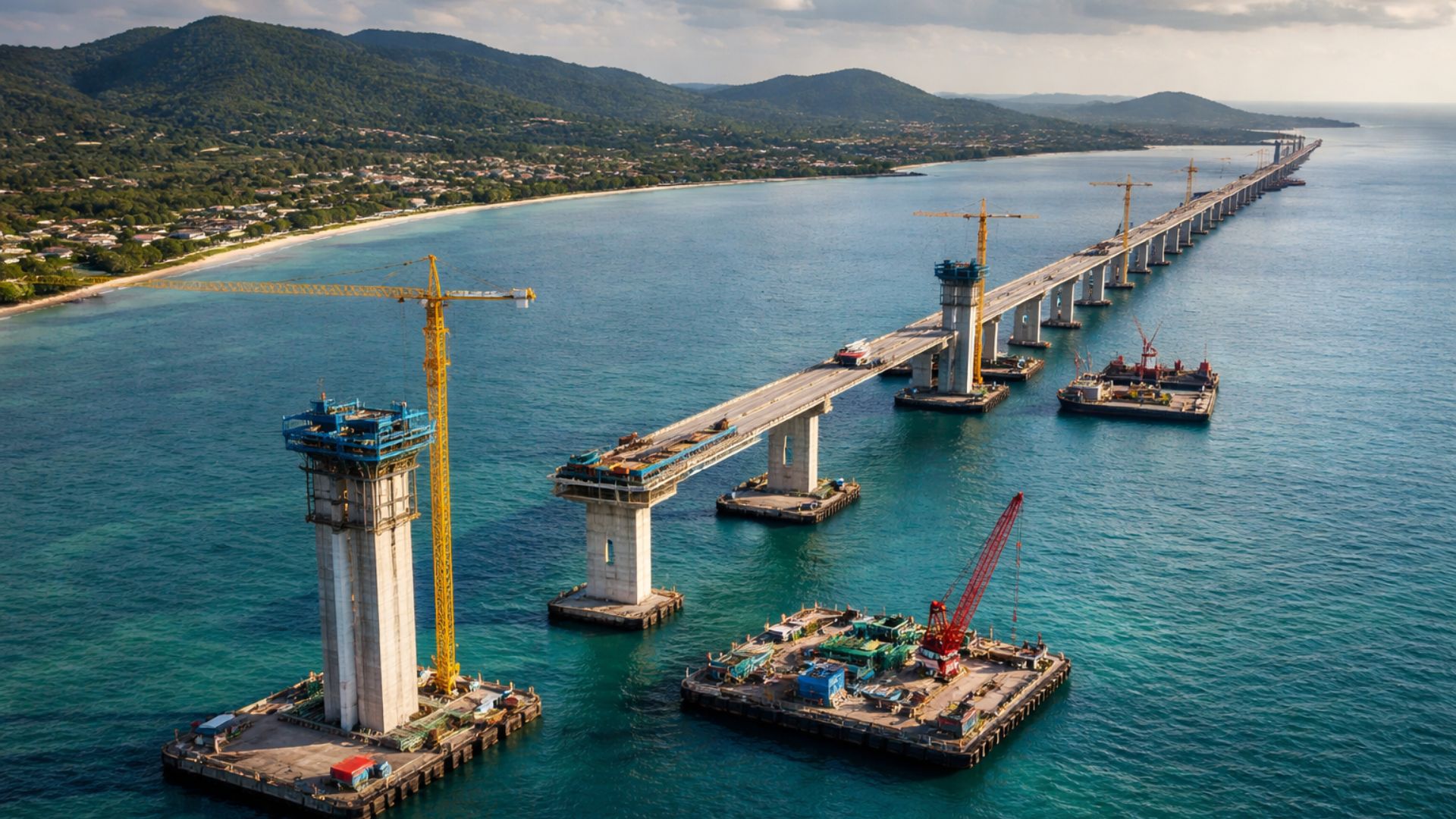
Infrastructure Project Under Study in Thailand Plans Expressway with Elevated Maritime Crossing, Billion-Dollar Investment and Significant Reduction in Travel Time to Koh Samui, with Direct Effects on Mobility, Logistics, and Regional Tourism.
An expressway project under study in Thailand plans a direct road connection between the mainland and the island of Koh Samui through a corridor of approximately 37.4 kilometers, with sections on land and an elevated crossing over the sea.
The initiative is led by the Expressway Authority of Thailand and is part of a set of projects aimed at expanding transportation infrastructure in the country.
According to technical information released by Thai authorities and reported by local media, the proposal includes operation throughout the day and seeks to reduce dependence on ferries, currently responsible for the regular transport of vehicles and passengers to the island.
-
While Brazil wants to end the 6×1 work shift, the president of Argentina wants 12 hours for his workers, increasing political tension in the country.

-
The village where two rivers run side by side without mixing in Santarém and Alter do Chão reveals some of the most beautiful freshwater beaches on the planet.
-
Mars is accelerating, and scientists have discovered that the planet’s day is getting shorter, revealing surprising signs of internal activity.

-
Artemis 2 is set to launch on April 1 at 7:24 PM to orbit the Moon with four astronauts, but a class X solar flare and coronal mass ejection could interfere with communications and threaten the launch.

According to estimates presented in preliminary studies, the travel time over the maritime segment could be between 15 and 20 minutes.
Currently, ferry crossings usually take 1.5 to 3 hours, varying based on demand, operational logistics, and weather conditions.
The estimated cost of the project is 55 billion baht, a figure cited in official documents and Thai reports.
The route includes segments on solid ground and a longer bridge over the Gulf of Thailand, which would provide a direct link to Samui.
Route of the Expressway and Connection to the Mainland

Technical data released indicate that the corridor will be around 37.41 kilometers, with approximately 15 kilometers on land and about 22 kilometers over the sea.
The design aims to create a continuous link with the road network of the mainland, allowing traffic without the need to embark on ferries.
Materials associated with the project also mention the possibility of the structure serving as support for public utility networks, such as electricity, water supply, and telecommunications.
According to the technical responsible parties, this solution would allow different infrastructures to be concentrated in a single axis, reducing the need for independent underwater interventions.
Despite being frequently described as a bridge, the work is officially classified as an expressway, consisting of land accesses, elevated sections, and maritime crossing.
Reduction in Travel Time and Logistic Effects
The reduction in travel time appears as one of the main indicators analyzed in the feasibility studies.
With the fixed link, access to the island would no longer depend on ferry schedules and queues, a factor considered relevant for regional mobility.
Experts cited in local reports point out that the change could affect logistics for supply and daily commutes for workers, particularly in the tourism and service sectors.
Samui is home to hotels, resorts, and activities related to visitor traffic, making land access a recurring theme in local planning.
The same studies indicate that the route would also serve as an alternative during periods of maritime restriction, when weather conditions limit or suspend ferry operations.
Billion-Dollar Investment and Technical Challenges of the Project

The value of 55 billion baht is presented as a central reference for the project.
In international publications, the investment is rounded to around US$ 2 billion, although authorities officially use the local currency.
The construction of the maritime segment involves specific technical requirements.
Preliminary reports mention foundations adapted to the coastal environment, as well as solutions for resistance to corrosion, winds, and tide variations.
For this reason, the progress of the project is conditioned to the completion of detailed engineering studies and environmental approval.
Estimated Toll and Impact on Drivers
Initial studies work with the hypothesis of a toll around 1,000 baht per trip for passenger cars, resulting in about 2,000 baht for round trip.
This figure is treated as a projection and has not yet been officially defined.
Based on quotations from December 2025, 2,000 baht corresponds to approximately R$ 360.
Authorities and analysts cited in the local press state that the final value will depend on assessments of economic impact, competitiveness compared to ferries, and user profiles.
There is also preliminary discussion about differentiated rates for island residents.
So far, however, there is no official confirmation of a specific tariff model.
The circulation of motorcycles remains under analysis.
Technical information indicates that factors such as road safety, allowed speed, and the influence of winds on the crossing are being considered in the studies.
Environmental Licensing and Expected Timeline
The project is still in the phase of technical, economic, and environmental feasibility studies.
As reported by the Thai press, the preparation and analysis of the environmental impact study are mandatory steps before the release for construction.
After this phase, the plan will need to go through approval by the central government and the definition of the concession model, which may involve public resources and private participation in the operation and maintenance of the road.
Reports published throughout 2025 indicate a preliminary timeline that envisions sending the project to the government cabinet in 2026.
The opening of bids is cited for 2027. The start of construction is mentioned for 2028, provided there are no delays in the authorization processes. The completion appears, in some scenarios, projected for the early 2030s.







-

2 pessoas reagiram a isso.