





 Portuguese
  English
  Spanish
 6 min of reading
  0 comments


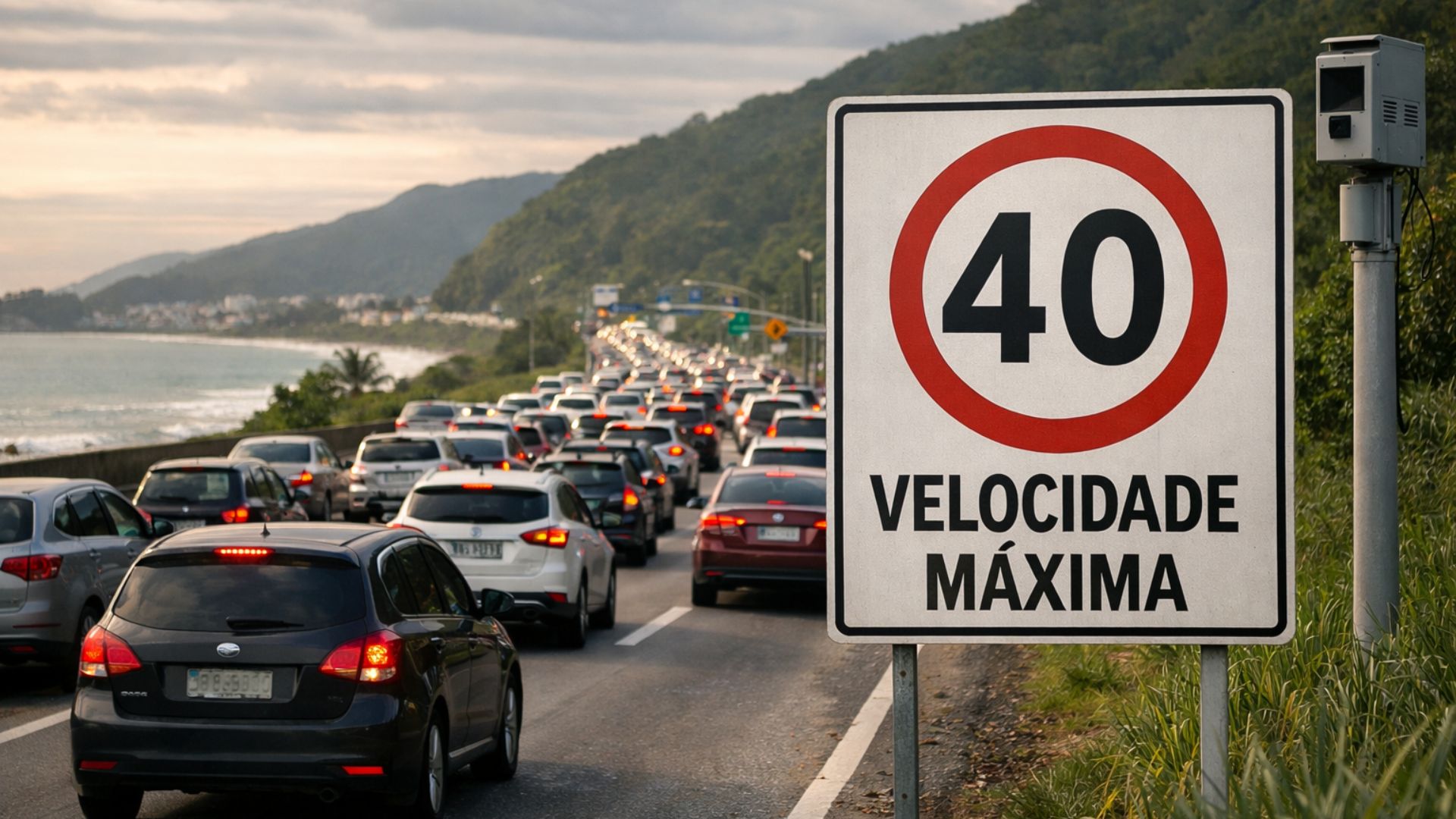
New Radar Starts Monitoring Section of Rio-Santos in São Sebastião, with Speed Limit of 40 km/h, Surprising Drivers and Increasing the Presence of Electronic Surveillance in the Region, Within a State Package from DER Aimed at Reducing Accidents and Speeding.
A new electronic monitoring radar began operating on the Rio-Santos highway (SP-055), in São Sebastião, on the North Coast of São Paulo, in the early hours of this Tuesday (6).
The equipment is installed at km 160.5, in the East/West direction, and monitors the limit of 40 km/h, according to the Department of Highways (DER-SP).
With the radar in operation, drivers exceeding the regulated speed are already subject to penalties.
-
Friends have been building a small “town” for 30 years to grow old together, with compact houses, a common area, nature surrounding it, and a collective life project designed for friendship, coexistence, and simplicity.

-
This small town in Germany created its own currency 24 years ago, today it circulates millions per year, is accepted in over 300 stores, and the German government allowed all of this to happen under one condition.

-
Curitiba is shrinking and is expected to lose 97,000 residents by 2050, while inland cities in Paraná such as Sarandi, Araucária, and Toledo are experiencing accelerated growth that is changing the entire state’s map.

-
Tourists were poisoned on Everest in a million-dollar fraud scheme involving helicopters that diverted over $19 million and shocked international authorities.

The measure has drawn the attention of those traveling on the highway.
The speed limit signage is the parameter adopted for monitoring the section, the agency reported.
Location of the New Radar on the Rio-Santos Highway
The DER-SP locates the new monitoring point at km 160.5 of SP-055, in São Sebastião, on the axis connecting the cities of the North Coast and Baixada Santista.
The listing of radar points from the department also registers km 160.500 on the SP-055 within the municipality, in the East/West direction.
According to the information released about the start of operation, the equipment began to function during the night.
In practice, this means that from the activation hour, the recording of violations becomes possible whenever the vehicle exceeds the regulated speed for the location.

The limit of 40 km/h has been the main point of surprise for some drivers.
This value is considered low for a highway and requires a more significant reduction in speed when approaching the monitored section.
Announcements about the radar highlight that the installation occurred in a specific segment of the road.
There is no detail, in public statements, about the previous limit at that kilometer.
Strategy of the DER to Reduce Accidents and Deaths in Traffic
The new radar is part of a strategy to expand electronic monitoring on state highways managed by DER-SP.
In communications about the subject, the department states that the intention is to reinforce road safety and reduce accidents.
“The measure aims to intensify safety on highways, prevent accidents and save lives, with radars installed in high-risk locations and properly signposted with the permitted speed limits.”
Also according to DER-SP, the choice of locations for installation considers a set of technical factors.
Among them are accident history, occurrences of speeding, road characteristics, wildlife crossing areas, and points classified as critical.
The approach seeks to concentrate monitoring in segments where speed reduction tends to have a greater impact on preventing collisions and pedestrian accidents.
In addition to km 160.5, there are other recorded radar points on the SP-055 in São Sebastião listed in documents from DER itself.
This indicates that the highway has different segments with planned or mapped electronic monitoring throughout the municipality.
Package of New Radars in the Vale do Paraíba
DER-SP links the activation of the radar in São Sebastião to a larger set of new equipment being deployed in the state.
Regional publications indicate that the department announced a package of 89 new radars aimed at the Vale do Paraíba region in the same year that the equipment at km 160.5 was put into operation.
The strategy involves installation stages, tests, and homologation procedures before each point actually starts monitoring.
In communications about other radars in the region, DER-SP emphasizes this technical flow.
The agency mentions that some of the equipment comes into operation while others remain in the installation phase.
In the case of São Sebastião, the activation of the radar at km 160.5 appears linked to this broader movement of increased monitoring on non-conceded highways.
The declared goal is to curb speeding and reduce the severity of accidents.
Direct Impact on Those Traveling at Km 160.5
For the driver, the immediate effect is the need to adjust driving to the signposted limit of 40 km/h when passing through the monitored point.
As the equipment records speeding violations, attention to signage and the speedometer becomes crucial to avoid penalties.
The presence of radars also usually alters the local traffic dynamics.
This occurs because monitoring induces speed reduction in a specific area of the highway.
DER-SP maintains that the points are defined based on technical and risk criteria.
These criteria include accident history and road characteristics, such as curves, accesses, crossings, and areas with greater vulnerability.
Even with the activation of the radar, the agency did not detail in the available public information about this point whether the section at km 160.5 is associated with a specific type of occurrence.
There is no confirmation if there are recurring records of collisions, pedestrian crossings, or frequent presence of wildlife on the road at this kilometer.
This explanation appears only as a general criterion for defining the locations.
With increased monitoring and lower limits in specific segments, the tendency is for the driver to need to redouble attention to speed changes along the route on SP-055.
In this context, adapting to the new radar at km 160.5 adds to a scenario of expanding equipment on different state highways.
This movement is more noticeable in regions linking the coast and the interior.
Will the 40 km/h radar at km 160.5 become a standard for other sections of Rio-Santos, or will new speed reductions still surprise those who frequently use the highway?









-

-

2 pessoas reagiram a isso.