





 English
  Francês
  Alemão
  Italiano
  Japonês
  Norueguês
  Portuguese
  Spanish
  4 min of reading
  0 comments


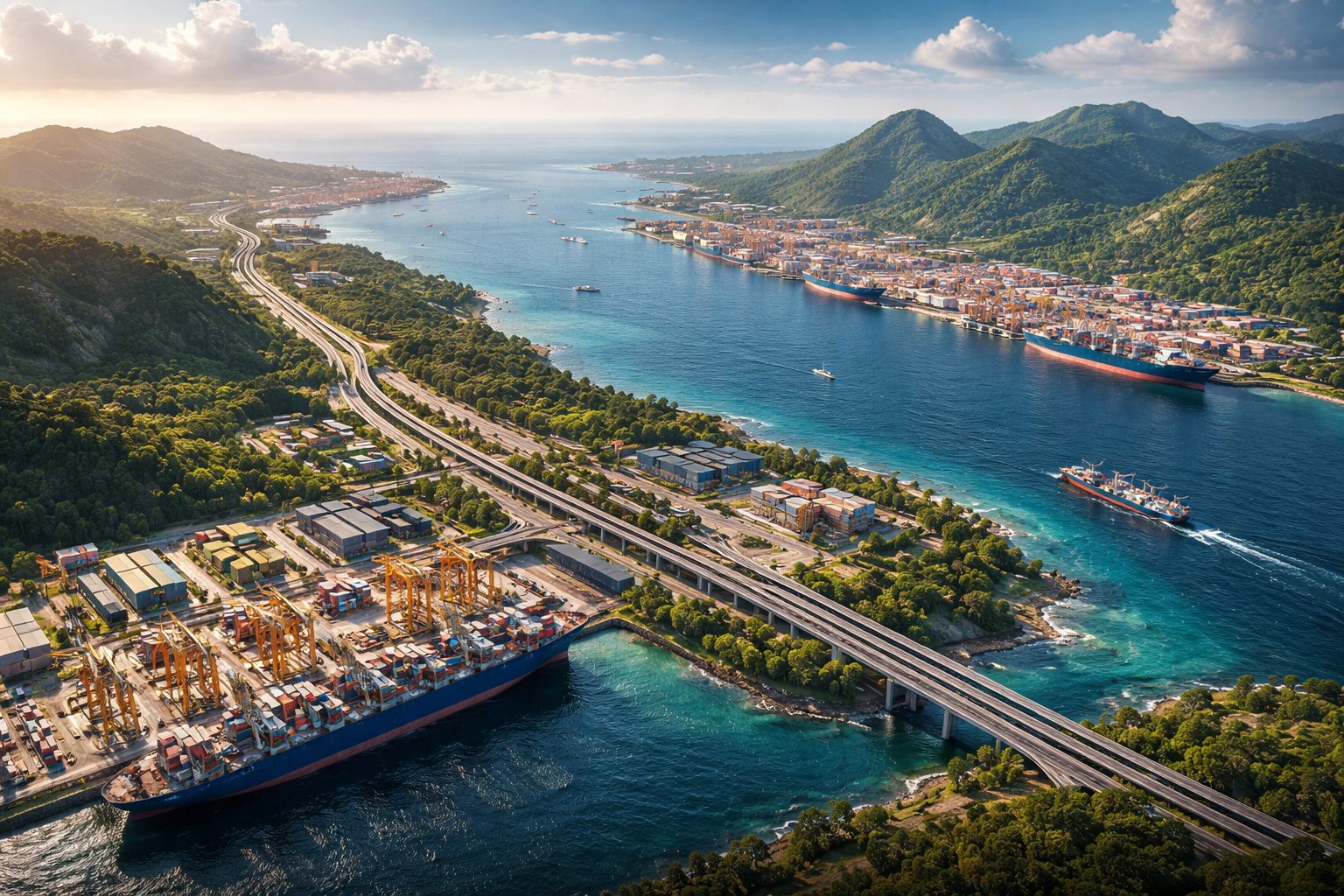
Landbridge Project Connects Ports, Railways, and Highways to Provide a Logistical Alternative to the Congested Strait of Malacca
An ambitious logistical plan has begun to attract attention in the international maritime trade scene.
Thailand has unveiled a project estimated at around US$ 28 billion to directly connect the Indian and Pacific Oceans through a land-based structure.
Thus, the initiative aims to reduce shipping times on maritime trade routes by up to four days, especially for those that currently depend on the Strait of Malacca.
-
São Paulo surprises the world with a colossal railway network project that promises over 1,000 km of tracks, R$ 194 billion in investments, and 40 projects connecting the capital to the interior with fast and sustainable trains.

-
The world’s largest escalator, measuring 905 meters in China, reduces urban travel time from 1 hour to about 20 minutes and transforms mobility in mountainous regions with an engineering solution adapted to the terrain.

-
A R$ 300 million logistics giant is taking shape in Serra with over 100,000 m² and raises a question: how can this transform e-commerce and distribution in the state?
-
Could Uber Rides Lose Minimum Fare? Understand What’s Happening!


Furthermore, the proposal emerges at a time of continuous growth in global maritime transport, which heavily relies on strategic routes in Asia.
In this context, analyses released by logistics infrastructure specialists and the channel BeyondTheBuild highlight that the new route may alter the flow of goods between different regions of the world.
Therefore, the project is viewed as an attempt to reduce logistical risks and improve efficiency in international maritime transport.
Strait of Malacca Pressures Global Shipping Routes
Currently, the Strait of Malacca is considered one of the most important maritime routes on the planet.
However, at the same time, the region is also known for experiencing intense congestion of cargo ships.
Additionally, historically, the strait has recorded episodes of maritime piracy, which increases risks for commercial vessels.
Consequently, the high flow of ships creates logistical delays that directly affect international cargo transport.
In this scenario, the route proposed by Thailand emerges as a strategic alternative for the flow of goods.
Thus, by avoiding the complete circumvention of the Malay Peninsula, vessels can significantly reduce travel times between the two oceans.
Moreover, this shorter route also decreases operational costs associated with maritime transport.
Therefore, the proposal presents itself as a logistical alternative capable of alleviating congestion in one of the busiest waterways in the world.
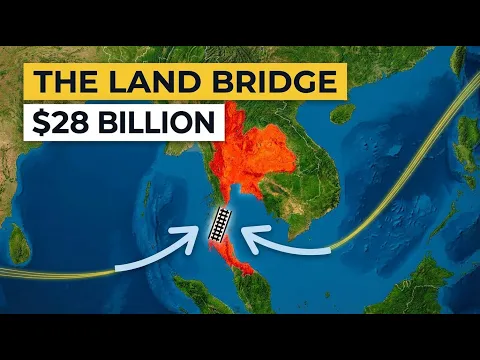

Difference Between the Kra Canal and the New Land Bridge
Historically, for decades, the possibility of constructing the so-called Kra Canal has been discussed.
This project envisioned the excavation of an artificial canal cutting through Thailand, creating a direct maritime passage between the oceans.
However, the plan raised environmental, economic, and political concerns.
For this reason, the proposed model currently follows a different strategy.
Instead of excavating a canal, the new project relies on the construction of a “landbridge,” or logistical land bridge.
In this model, two deep-water ports would be installed on opposite sides of the Thai isthmus.
These ports would then be connected by high-capacity highways and railways.
Thus, cargo transported by ships would be quickly transferred between the two terminals.
Additionally, the logistical system will utilize automated cargo handling processes.
Therefore, this engineering solution is considered more economical and less complex than constructing an artificial canal.
Time Savings Can Transform Global Logistics
Reducing travel time represents one of the main attractions of the project.
Currently, vessels that traverse routes between the Indian and Pacific Oceans must navigate around the Malay Peninsula and through the Strait of Malacca.
Consequently, this journey increases navigation time and raises logistical costs.
With the new infrastructure proposed by Thailand, transport could be conducted more quickly.
Thus, the estimated savings of up to four days of travel represents a significant advantage for logistics operators.
Moreover, the reduction in time could also decrease operational costs related to fuel, insurance, and port logistics.
According to analyses presented by the channel BeyondTheBuild, the logistics corridor was conceived to facilitate the transfer of cargo between the two oceans.
Therefore, the project could help reorganize some of the maritime routes used in international trade.
In this context, the infrastructure proposed by Thailand stands out as a strategic alternative amid the continuous growth of global maritime transport.
Logistics Infrastructure Gains Strategic Importance
The project emphasizes how investments in infrastructure can directly influence international trade routes.
By creating a logistics corridor between two oceans, Thailand seeks to enhance its relevance in global maritime trade.
Moreover, the initiative may also reduce reliance on single, highly congested routes.
Thus, logistics operators and shipping companies will have more navigation options.
Consequently, new transportation alternatives may increase the efficiency of international supply chains.
In this context, the billion-dollar US$ 28 billion project is part of a set of initiatives aimed at modernizing global logistics.
The Future of Asian Maritime Routes
The advancement of large-scale logistical projects demonstrates how maritime transport continues to evolve to meet global demands for efficiency.
Meanwhile, Thailand’s proposal shows that new routes can emerge as alternatives to traditional maritime corridors.
Moreover, the search for faster and safer logistical solutions underscores the strategic importance of investments in infrastructure.
Therefore, as international trade continues to grow, projects like this will influence logistical and commercial decisions.
Will the new Thai landbridge really reduce dependence on the Strait of Malacca and redefine part of global trade routes?









Seja o primeiro a reagir!