





 Portuguese
  English
  Spanish
  4 min of reading
  0 comments


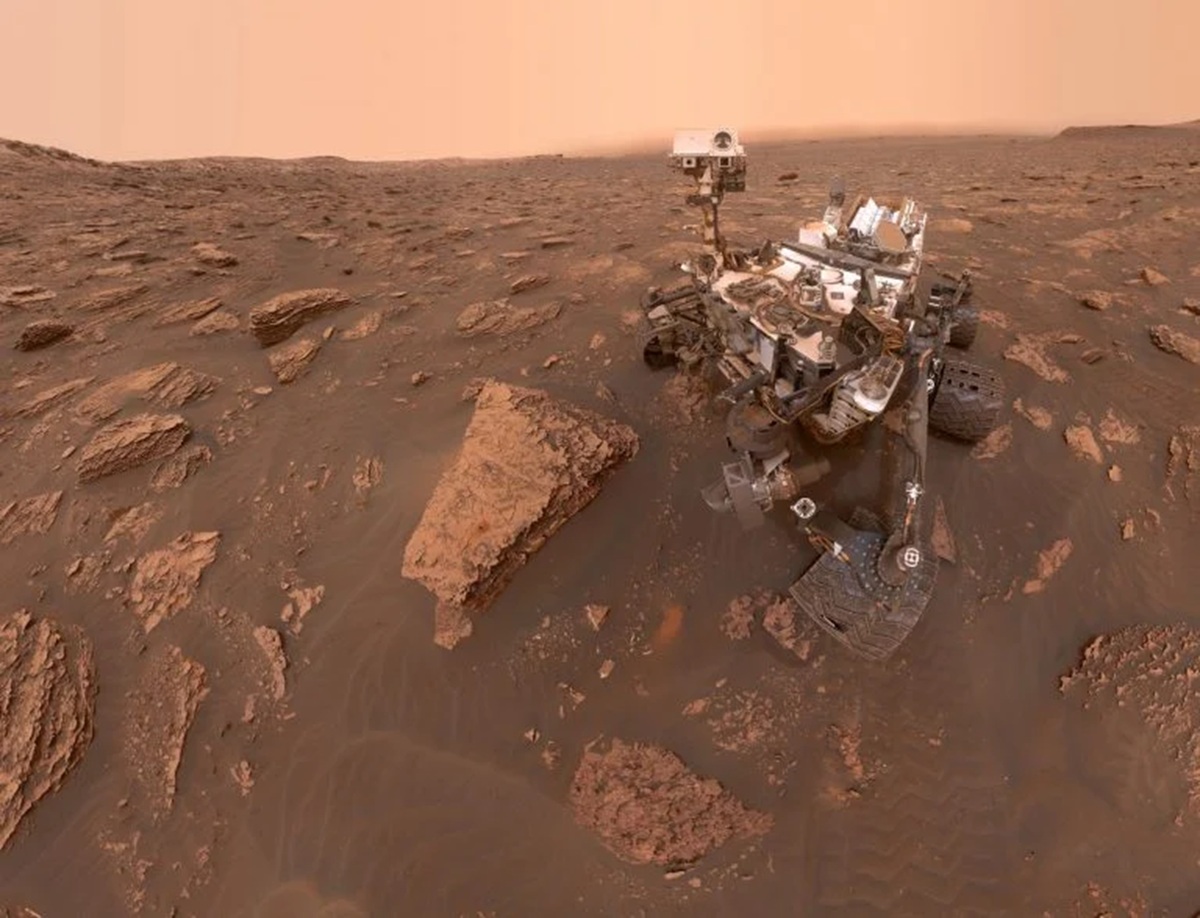
Analysis Published on February 4 in the Journal Astrobiology Indicates That the Amounts of Decane, Undecane, and Dodecane Detected by the Curiosity Rover in Gale Crater Are Not Fully Explained by Meteorites or Abiotic Chemical Reactions, After Modeling That Reconstructed About 80 Million Years of Exposure to Radiation on Mars
The NASA Curiosity rover identified decane, undecane, and dodecane in rock from Gale Crater, and a study published on February 4 in Astrobiology indicates that non-biological processes do not explain the measured abundance, according to analysis based on data collected since 2012.
Since 2012, the Curiosity rover has been exploring Gale Crater on Mars, equipped with the compact chemical laboratory SAM, which stands for Sample Analysis at Mars. The instrument heats powdered rock obtained by drilling and analyzes the gases released.
Organic compounds are molecules structured around carbon atoms. On Earth, carbon-based chemistry supports life, although organic molecules can also arise from non-biological chemical reactions under certain conditions.
-
Motorola launched the Signature with a gold seal from DxOMark, tying with the iPhone 17 Pro in camera performance, Snapdragon 8 Gen 5 that surpassed 3 million in benchmarks, and a zoom that impresses even at night.

-
Satellites reveal beneath the Sahara a giant river buried for thousands of kilometers: study shows that the largest hot desert on the planet was once traversed by a river system comparable to the largest on Earth.

-
Scientists have captured something never seen in space: newly born stars are creating gigantic rings of light a thousand times larger than the distance between the Earth and the Sun, and this changes everything we knew about stellar birth.

-
Geologists find traces of a continent that disappeared 155 million years ago after separating from Australia and reveal that it did not sink, but broke into fragments scattered across Southeast Asia.

Curiosity Rover Identifies the Largest Organic Molecules Ever Found on Mars
In March 2025, researchers announced the detection of small amounts of decane, undecane, and dodecane in a sample analyzed aboard the Curiosity rover. These hydrocarbons, made up only of carbon and hydrogen, are the largest organic molecules ever identified on Mars.
Scientists assess that these compounds may represent fragments of fatty acids preserved in ancient clay shale from Gale Crater. These shales originate from fine sediments deposited in water, indicating that the area may have harbored lakes billions of years ago.
On Earth, fatty acids comprise cell membranes and are primarily produced by living organisms. Still, specific geological processes can also generate similar molecules under appropriate conditions, without biological involvement.
Evaluation of Meteorites and Other Non-Biological Sources
The instruments on the Curiosity rover can identify and measure molecules, but they do not determine their biological or non-biological origin. Given this limitation, researchers conducted a follow-up study to test alternative explanations.
One hypothesis analyzed was the transport of organic compounds by meteorites. It is known that meteorites contain carbon-rich materials, and Mars has experienced frequent impacts throughout its geological history.
The team evaluated whether this external transport, combined with abiotic chemical reactions, could justify the levels of organic compounds measured in the rock. The results were presented in a paper published on February 4 in the journal Astrobiology.
According to the study, the non-biological sources examined do not fully explain the observed abundance of organic material. Based on the data, the authors find it reasonable to evaluate the hypothesis that living organisms may have contributed to the production of the molecules.
Reconstruction of 80 Million Years of Exposure to Radiation
To estimate the original amount of organic matter, researchers combined laboratory radiation experiments, computational simulations, and data from the Curiosity rover. Mars lacks a dense atmosphere or a global magnetic field comparable to Earth’s.
This condition leaves the Martian surface exposed to cosmic radiation, which can degrade complex molecules over long periods. The team sought to look back about 80 million years, the estimated time of exposure of the rock on the surface.
By modeling the progressive destruction of organic compounds by radiation, scientists estimated the amount that would exist before degradation. The calculations indicate that the original amount was likely much greater than that produced by common non-biological processes.
Need for New Studies Before Definitive Conclusions
The authors warn that additional studies are needed to more accurately determine the rate of decomposition of organic molecules in rocks similar to those on Mars, under Martian environmental conditions.
More precise laboratory simulations may help refine current estimates and clarify the chemical history preserved in the rocks analyzed by the Curiosity rover.
The findings do not confirm the existence of past life on Mars. They indicate that isolated non-biological explanations may not fully resolve the mystery of the observed abundance.
The scientific paper titled “The Measured Abundance Suggests a Biological Origin for the Ancient Alkanes Preserved in a Martian Shale?” was published on July 15, 2025, in Astrobiology, with DOI 10.1177/15311074261417879.
The study is authored by Alexander A. Pavlov, Caroline Freissinet, Daniel P. Glavin, Christopher H. House, Jennifer C. Stern, Amy C. McAdam, Anais Roussel, Jason P. Dworkin, Luoth Chou, Andrew Steele, Paul R. Mahaffy, Denise Buckner, and Felipe Gomez, gathering experimental data and modeling about the identified organic material.








Seja o primeiro a reagir!