





 Portuguese
  English
  Spanish
  4 min of reading
  0 comments


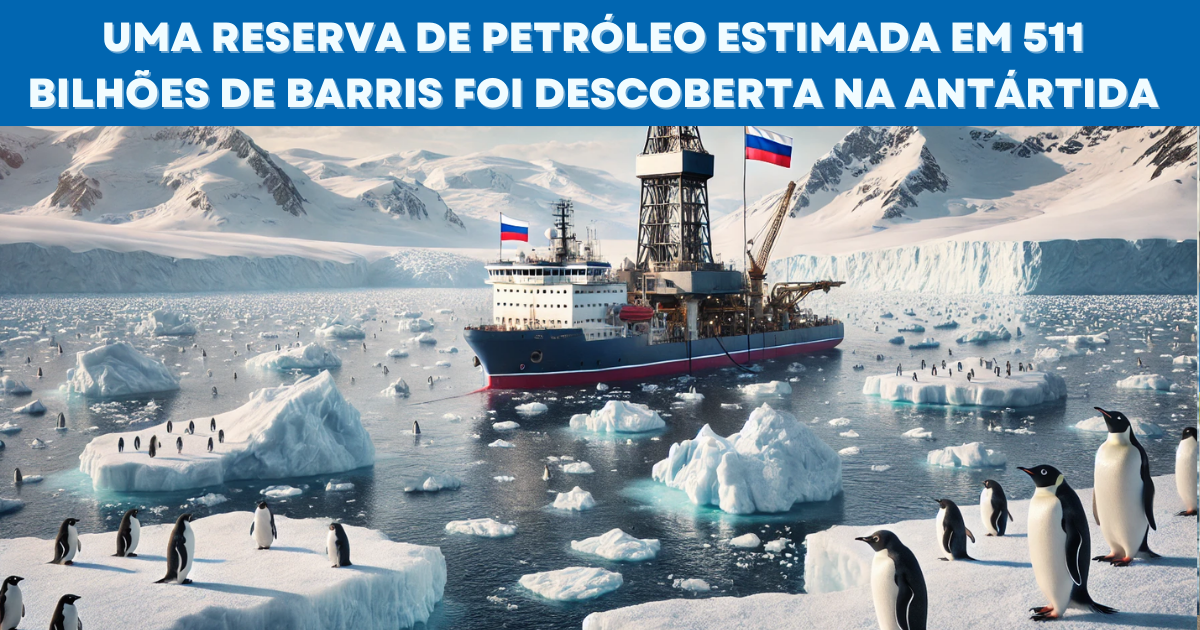
Russia Reveals A Gigantic Oil Reserve In Antarctica, Raising Global Concerns About Environmental Impact And Preservation Of The Continent. Argentina And Chile Oppose Exploration, Defending The Antarctic Treaty.
The climate of international dispute in Antarctica has never been so intense, and the reason is a discovery capable of transforming global energy geopolitics: a colossal oil reserve, estimated at 511 billion barrels, was recently revealed by Russia.
With a volume that exceeds the sum of Saudi Arabia’s reserves, the discovery positions the icy continent as a unprecedented strategic and economic potential.
With the world’s eyes on the region, the discovery raises an urgent question: to what extent should the exploration of this resource advance in one of the planet’s most fragile ecosystems? The implications go beyond the economic sphere, generating a wave of reactions and environmental concerns, especially among Latin American countries such as Argentina and Chile, which advocate for the protection of the continent under the Antarctic Treaty.
-
Offshore industrial demand in Macaé skyrockets with the recovery of oil and gas and could grow by up to 396% by 2026 in the Campos Basin.
-
Offshore industrial demand in Macaé surges with the recovery of oil and gas and could grow by up to 396% by 2026 in the Campos Basin.
-
Brazilian giant expands borders in the Southeast: Petrobras confirms new oil discovery in ultra-deep waters in the pre-salt of the Campos Basin.

-
Alert in the global energy market: Severe tropical cyclone hits the coast and disrupts gas production at major plants in Australia, threatening global supply.


What Did Russia Discover?
According to the Russian agency Rosgeo, specialized in mineral exploration, the operation that revealed the new oil reserve was carried out by the ship Alexander Karpinsky, famous for expeditions in unexplored regions.
The reserve, located in the British Antarctic Territory – one of the most remote and ice-covered areas of the continent – is seen by experts as a result of geological and climatic transformations that occurred millions of years ago, when Antarctica still had dense forests and a milder climate.
It is estimated that the total volume found would be enough to keep the world supplied for decades, given that the value exceeds approximately 32 times Brazil’s oil reserves and greatly surpasses the accumulated production in the North Sea over the last 50 years.
This potential for exploration makes Antarctica a point of strategic interest, yet extremely controversial.
The Environmental Threat
The exploration of oil in Antarctica is a major concern among environmentalists and scientists from various nations, especially due to its possible contribution to accelerating global warming.
According to specialists, the extraction of oil in the region could intensify the melting of glaciers, a phenomenon already underway and which causes serious consequences for local wildlife, directly affecting the survival of species such as penguins.
For these animals, the loss of habitat means a direct threat: penguin chicks, for example, are already facing high mortality rates due to the lack of natural protection against the cold ocean water, a condition that could be exacerbated by the environmental degradation caused by oil exploration.
Moreover, the melting of Antarctica’s glaciers directly contributes to rising sea levels, putting coastal areas of various countries around the world at risk.
The Antarctic Treaty And The Response Of Argentina And Chile
According to the Antarctic Treaty of 1959, the continent must remain protected from mining and military activities, being reserved for environmental preservation and scientific research.
Argentina and Chile, which have territorial claims in Antarctica, argue that the treaty should remain in force and stand against oil exploration in the region.
For them, the preservation of the continent is a fundamental point, not only for the protection of local flora and fauna but also as a commitment to the future of the planet.
These countries highlight the risks of loosening the treaty in favor of economic interests, arguing that such a move could set dangerous precedents.
The environmental impact would not be felt only in the Antarctic region, but worldwide, due to climate change and global ecosystem alterations that may occur in the long term.
Oil Vs. Preservation: A Global Dilemma
This revelation from Russia puts a global dilemma into debate: to what extent is it valid to explore resources in ecologically fragile regions? According to environmentalists, extracting oil in such delicate areas places humanity at an ethical crossroads.
Decisions that, once made, can shape the planet’s trajectory for future generations.
Experts warn that resource exploration in Antarctica is not only a logistical and environmental challenge but also a central theme in discussions about energy transition.
With the growing need for sustainable alternatives, many nations believe that increasing dependence on fossil fuels may be a short-term action, while renewable solutions offer greater environmental security in the long term.
Thus, interest in Antarctica reopens an essential dialogue for the future of international relations and the debate on energy and environmental preservation.
Rosgeo And Its Role In Mineral Exploration
Founded in 2011, the Rosgeo agency is responsible for more than 1,000 discoveries of mineral resources in remote areas of Russia and regions outside the country, such as the British Antarctic Territory.
Its operations have already located significant deposits of gas, gold, and other minerals, establishing the company as one of the largest explorers in the world in uninhabited regions.
According to information from Rosgeo itself, the discovery of oil in the Antarctica represents a milestone in its operational history and may establish the company as a pioneer in the exploration of frozen and isolated regions.
Is The Future Of Antarctica At Stake?
With an estimated amount of oil that could change the global economic course, Antarctica becomes the stage for a new international dispute.
However, the question that remains is whether the pursuit of oil on the icy continent would justify the potentially irreversible environmental damage.
Do you think Antarctica should be protected from oil exploration or do you believe the resource is necessary for global development?






Seja o primeiro a reagir!