





 Portuguese
  English
  Spanish
  5 min of reading
  0 comments


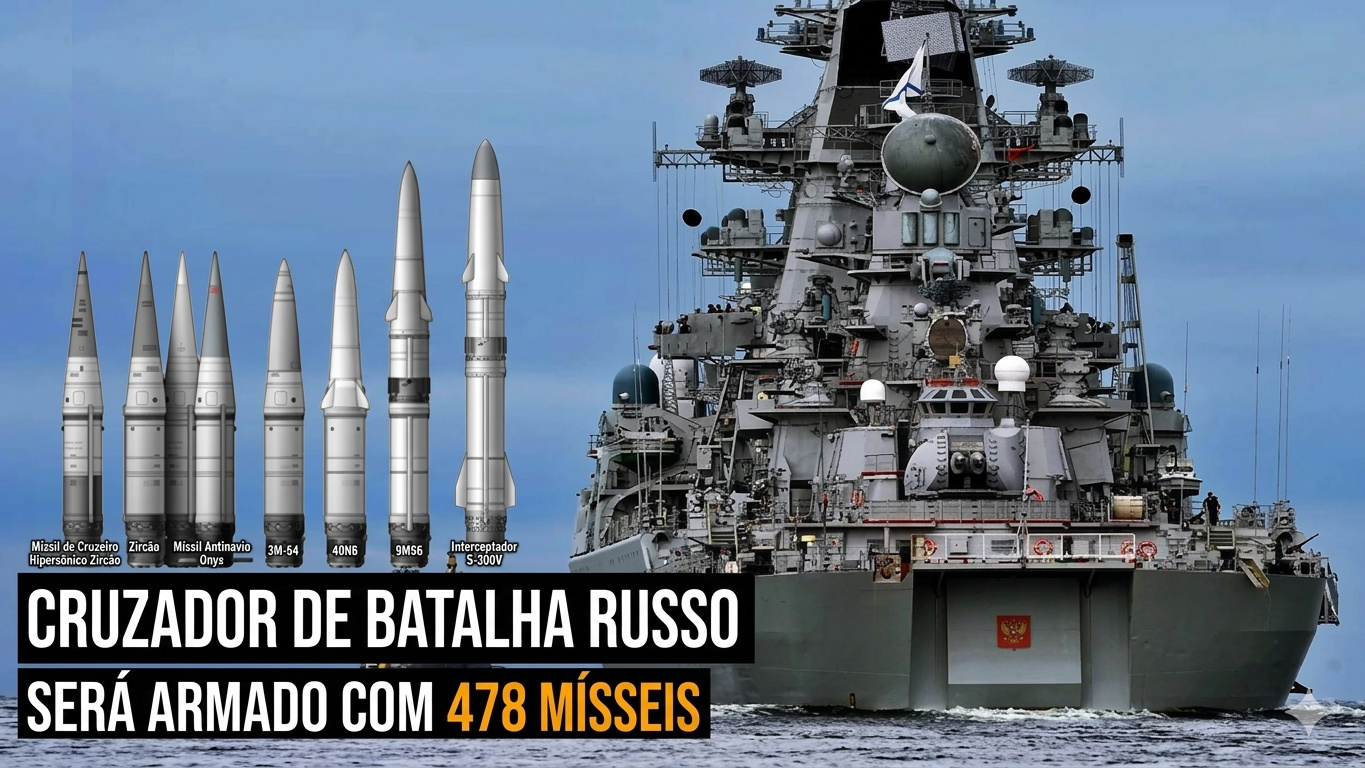
Admiral Nakhimov returns after 28 years and $5 billion as the most powerful warship in the world with 176 missiles and nuclear propulsion
On August 18, 2025, according to Naval News, the nuclear cruiser Admiral Nakhimov left the dry dock in Severodvinsk and sailed through the White Sea under its own power for the first time since 1997. After a modernization process that lasted 28 years and consumed about 200 billion rubles, equivalent to approximately $5 billion, the ship returned with a completely reconfigured arsenal and capabilities that place it as the heaviest and most armed surface combat ship in operation in the world.
Equipped with 176 missile launchers, including hypersonic Zircon systems, the Admiral Nakhimov represents not only a technological upgrade but also an attempt at strategic repositioning of the Russian Navy in the global naval landscape.
Kirov Class: the nuclear cruiser that redefined the concept of warship
To understand the impact of the Admiral Nakhimov, it is necessary to understand the Kirov class. Developed during the Cold War, this class was designed as a hybrid between a cruiser and a modern battleship.
-
James Webb finds 300 galaxies with mysterious scars, and this discovery may show that the universe was born much more violently than astronomers had imagined.

-
Haiti’s capital is experiencing an energy and construction crisis, facing blackouts, a blocked port, and buildings at risk after years of instability and a significant earthquake.

-
Government unlocks R$ 554 million for a highway that has been requested for decades and accelerates the duplication of BR.

-
Without bricks, without cement, and without endless construction: the cardboard house that is assembled in modules and can be moved.


With a length of 252 meters and a displacement of 28,000 tons, the ships of the Kirov class were too large for any traditional category. NATO analysts even classified them as “battlecruisers,” a designation that had not been used since World War II.
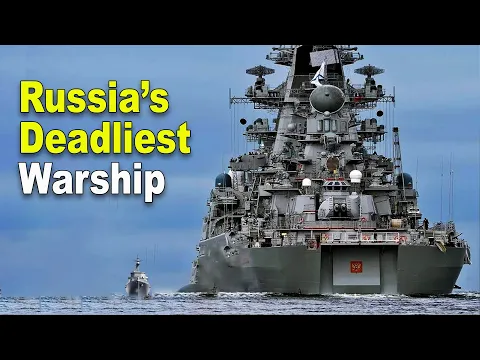

The original armament included 20 P-700 Granit missiles, each weighing about 7 tons, designed to attack carrier groups with coordinated strikes.
The operational logic was based on defense saturation, where multiple missiles would be launched simultaneously to ensure that some would hit the target.
Strategic impact of the Kirovs led the US to reactivate World War II battleships
The introduction of the Kirovs had a direct impact on US military planning. During the Reagan administration, the US Navy decided to reactivate the Iowa-class battleships.
The USS New Jersey, Wisconsin, Missouri, and Iowa returned to service between 1982 and 1988. The justification was clear: only large ships with significant armor could survive a direct confrontation with Soviet cruisers.
This move highlights the level of threat perceived by Western strategists in the face of the Kirov class.
Modernization of the Admiral Nakhimov: 28 years, seven deadlines, and $5 billion invested
The modernization process of the Admiral Nakhimov has been marked by successive delays. Initially scheduled for completion in 2002, the project was postponed several times, with forecasts in 2012, 2018, 2019, 2020, 2021, 2022, 2023, and 2024.
The effective modernization only began between 2013 and 2014, when Moscow decided to invest significant resources in the program.
The ship was practically rebuilt. Obsolete Soviet systems were replaced with modern radar, electronic warfare, and armament technologies.
This was not a renovation, but a complete reconstruction of one of the largest military ships in the world.
Armament of the Admiral Nakhimov: 176 missiles with hypersonic Zircon and naval S-400 system
The modernization completely transformed the ship’s arsenal. The old inclined launchers were replaced by 80 cells of the UKSK system, capable of firing Kalibr, Oniks, and Zircon missiles. Additionally, 96 air defense cells with a system equivalent to the naval S-400 were added.
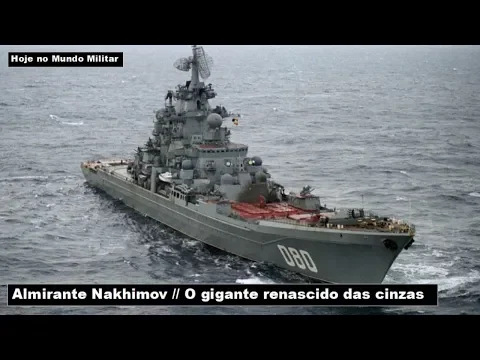
The ship also received Pantsyr-M systems for short-range defense and the modern AK-192M gun.
The total of 176 launchers places the Admiral Nakhimov above any other surface ship in operation, surpassing models such as the Chinese Type 055 and the American Ticonderoga.
Hypersonic Zircon and nuclear capability elevate the combat power of the Russian ship
The Zircon missile, one of the highlights of the new arsenal, has a declared speed of up to Mach 9 and an approximate range of 1,000 kilometers.
This capability drastically reduces the reaction time of enemy defense systems. Combined with nuclear propulsion, which allows prolonged operation without refueling, the ship has virtually unlimited range.
This positions the Admiral Nakhimov as one of the deadliest platforms ever built for naval combat.
Moskva case reveals vulnerability of large modern warships
Despite its capabilities, recent history raises questions. In April 2022, the cruiser Moskva was sunk by two Ukrainian Neptune missiles.

The attack revealed operational flaws, such as inactive defense systems at the moment of impact. The episode demonstrated that even large and well-armed ships can be vulnerable.
The central lesson is not the obsolescence of large ships, but the importance of the correct operation of their systems.
Modern warfare and drones challenge billion-dollar ships
Recent conflicts show a shift in naval dynamics. Low-cost drones and anti-ship missiles have been able to damage or destroy much more expensive vessels.

In the Black Sea and the Red Sea, asymmetric attacks have shown that the cost-benefit ratio favors the attacker. A $5 billion ship becomes simultaneously a strategic asset and a priority target.
In light of these risks, the trend is for the Admiral Nakhimov to operate mainly in regions like the Arctic and the North Atlantic, where the environment is more controlled and predictable. The vessel is expected to take on the role of flagship of the Northern Fleet, replacing the Pyotr Velikiy.
This strategy reduces exposure to asymmetric threats and maximizes the use of the ship as a power projection platform.
21st Century Paradox: the largest warship may also be the most vulnerable
The Admiral Nakhimov represents a paradox of modern warfare. While it is one of the most powerful platforms ever built, it is also a unique and irreplaceable asset.
Analysts highlight that its main weakness is precisely this uniqueness. A single ship cannot be quickly replicated in the event of a loss.
This raises doubts about the strategic viability of investing billions in unique platforms in a scenario dominated by asymmetric warfare.
The ship completed the first phase of testing in September 2025 and advanced to more complex stages by December of the same year.
Operational commissioning is scheduled for 2026, when it will officially assume the role of the main ship of the Northern Fleet.
After 28 years of modernization and $5 billion invested, the Admiral Nakhimov returns to the sea as the largest and most armed surface combat ship in operation on the planet.










Seja o primeiro a reagir!