





 Portuguese
  English
  Spanish
  5 min of reading
  2 comments


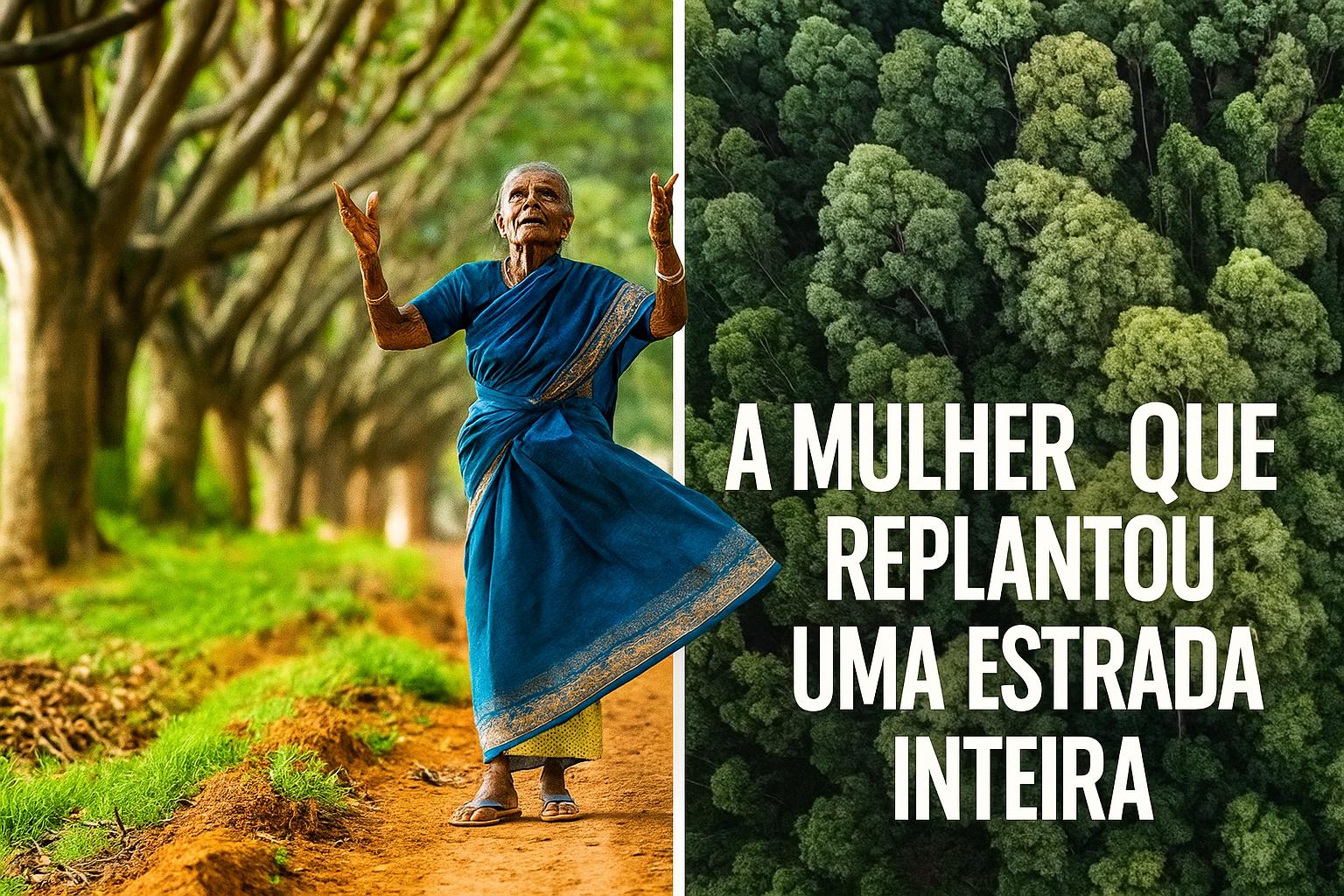


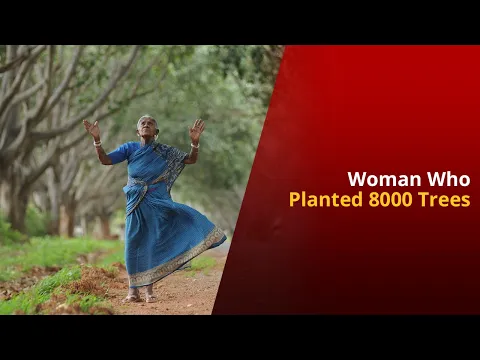
At Over 100 Years Old, Saalumarada Thimmakka Alone Planted Over 8,000 Trees Along 45 Km in India and Transformed an Arid Region into a Living Forest.
In the arid interior of Karnataka, in southern India, a simple woman, without academic training and without financial resources, dedicated her life to an act that seemed insignificant — planting trees. Thirty years later, this act became one of the greatest examples of environmental regeneration carried out by a single human being. Her name is Saalumarada Thimmakka, and her real story is studied by environmentalists and celebrated by international institutions such as UN Environment.
At just over 100 years old, Thimmakka is considered a national heroine in India. Alongside her husband, who passed away in 1991, she began in the 1980s a silent journey: planting banyan saplings (the sacred tree of India) along the road connecting the villages of Hulikal and Kudur in Karnataka. Without sponsorship, without government help, and driven only by the conviction that nature could heal the dry soil of the region, she transformed a degraded area into a 45-kilometer green corridor, now home to over 8,000 mature trees.
A Forest Born of Love and Patience
The beginning was modest. Thimmakka and her husband, Bikkala Chikkayya, could not have children. As a way to fill the void and “leave something alive for the world,” they began to plant trees by the roadside near their home.
-
Friends have been building a small “town” for 30 years to grow old together, with compact houses, a common area, nature surrounding it, and a collective life project designed for friendship, coexistence, and simplicity.

-
This small town in Germany created its own currency 24 years ago, today it circulates millions per year, is accepted in over 300 stores, and the German government allowed all of this to happen under one condition.

-
Curitiba is shrinking and is expected to lose 97,000 residents by 2050, while inland cities in Paraná such as Sarandi, Araucária, and Toledo are experiencing accelerated growth that is changing the entire state’s map.

-
Tourists were poisoned on Everest in a million-dollar fraud scheme involving helicopters that diverted over $19 million and shocked international authorities.


Without running water or modern tools, they carried buckets of water for miles and protected the saplings with dry branches to prevent livestock from destroying them.


For years, the routine repeated with an almost sacred discipline. Each monsoon, new saplings were planted; each dry season, the couple cared for the trees with the dedication of parents raising children.
Over time, the couple noticed that the local microclimate was changing, the temperature dropped, the soil became wetter, and the birds returned. What was once an arid stretch began to bloom.
When her husband died, Thimmakka continued on alone. And she never stopped. “I didn’t have blood children, but I have thousands of leaf children,” she said in an interview with BBC India.
From Anonymous Farmer to Global Environmental Symbol
What started as a local story soon caught the attention of the media and Indian authorities. The Karnataka Forest Department found that Thimmakka’s trees helped stabilize the soil, reduce erosion, and increase the biodiversity of the region. Some of them now reach over 20 meters in height and host dozens of bird species.
At 80 years old, Thimmakka received the National Citizen Award, one of India’s highest civilian honors, and was later included in the BBC’s list of 100 Most Inspiring Women in the World. In 2019, she received the Padma Shri, one of the highest awards in the Republic of India, personally presented by President Ram Nath Kovind.
In a simple speech, she said:
“I didn’t do this for awards. I did it because the land is our mother, and we must take care of her.”
The Ecological Impact Recognized by Science
Thimmakka’s personal project has become the subject of study at Indian universities. Researchers from Bangalore University and the Indian Institute of Science analyzed the impact of the planted trees and confirmed a reduction of up to 2.5°C in the average temperature of the area, as well as a significant increase in humidity and the return of local wildlife.
The linear forest she created is now part of a state conservation program, the Thimmakka Green Belt, which seeks to replicate the model on other roads in Karnataka. It is estimated that the trees planted by the environmentalist absorb over 4,000 tons of carbon dioxide each year, the equivalent of the annual emissions of about a thousand cars.
The example has inspired ecological movements and environmental foundations across the country, such as the Thimmakka Foundation, which promotes reforestation and environmental education in rural communities.
The “Mother of Trees of India”
In a country with 1.4 billion inhabitants and one of the highest rates of urban deforestation in the world, Thimmakka is seen as a guardian of nature.
Her story is told in schools, textbooks, and documentaries. In villages and towns of Karnataka, she is affectionately called “The Mother of Trees” (Vriksha Mathe).

Even at an advanced age, she continues to monitor the growth of the trees, supported by a cane and by the admiration of those who visit her. She refuses luxury and lives simply in a small house in the village of Hulikal.
When journalists ask why she started, she answers with a serenity that seems to come from the forest itself:
“I didn’t do this for myself. I did it because the trees also feel thirsty. I did it because someone needed to care for them.”
Saalumarada Thimmakka: the Legacy of a Life Planted in the Earth
The impact of Thimmakka goes far beyond India. In 2020, UN Environment recognized her as a global example of individual action for the climate. Her story is cited in reports on ecological restoration and has inspired initiatives in Vietnam, Kenya, and Brazil.
Her biography is a lesson in patience and purpose, demonstrating that deep changes can arise from the silent effort of just one person. While corporations and governments debate environmental goals, Thimmakka showed that transformation begins with a shovel, a handful of soil, and an act of will.
Today, travelers along the road from Hulikal to Kudur pass under the shade of the trees she planted. The stretch, once arid and forgotten, is now a living green tunnel, filled with birds and the sound of wind through the leaves.
There, every tree stands witness to a love story for nature and a woman who did alone what many believed impossible.










É o ser útil sem almejar aplausos
Este gigantesco exemplo deve ser veiculado em nossas comunidades, escolas e universidades e, é o que procurarei praticar.