





 Portuguese
  English
  Spanish
  5 min of reading
  24 comments


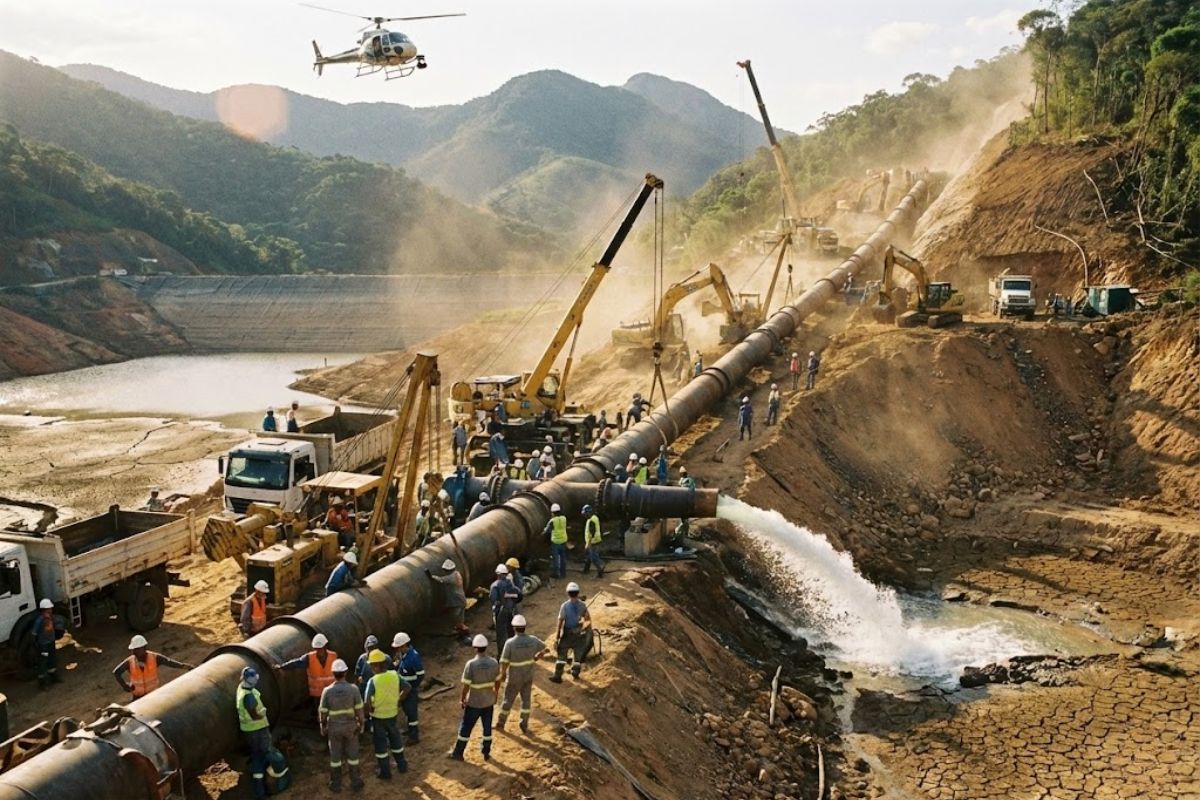


Sabesp Accelerates New Water Transfer System in Serra do Mar to Pump 2,500 Liters per Second to the Alto Tietê System After Investing R$ 300 Million While Reservoirs in Greater São Paulo Reach Lowest Level in a Decade and Contingency Plan Expands Daily Pressure Reduction for Consumers.
Sabesp began collecting water in Serra do Mar on December 1, 2025, to reinforce the Alto Tietê System, precisely when the level of the Integrated Metropolitan System reaches its lowest level in a decade, requiring the application of the strictest measures of the contingency plan launched on October 24, 2025. The company believes that the new project, estimated at R$ 300 million, will help secure the supply of millions of residents in Greater São Paulo amid the lack of rain.
By the end of the afternoon on December 10, 2025, official data showed the system’s useful volume at just 25 percent, down from the 28.7 percent recorded when Arsesp announced the emergency plan in October. The combination of falling reservoirs, reduced pressure in networks, and emergency reinforcement from Serra do Mar shows that Sabesp is currently operating in crisis mode to avoid a widespread water rationing in the capital and metropolitan area.
Sabesp Opens Duct from Serra do Mar to Send 2,500 Liters per Second to Alto Tietê

The new water transfer system inaugurated on December 1 begins at the Sertãozinho stream, one of the tributaries of the Itapanhaú River, about 60 kilometers from the capital and near the Serra do Mar State Park.
-
The gaucho city reduced the number of Bolsa Família beneficiaries by almost 40% in just a year and a half with active outreach that connects each registered person directly to job vacancies in Bento Gonçalves in Rio Grande do Sul.

-
The bluest city in Brazil has just gained a new floating bridge for the free crossing between the island and the mainland, connecting residents and visitors to the historic center of São Francisco do Sul every day of the week.
-
In a silent race, Shopee signs a mega contract in Guarulhos and accelerates the e-commerce war with faster deliveries, pressured shipping, and a new threat to rivals in Brazil.

-
Oil surged to $115 a barrel due to the war in the Middle East, and diesel in Brazil has already risen to R$ 7.45 per liter, while the United States…


Sabesp has set up a structure capable of transporting up to 2,500 liters per second directly to the Alto Tietê System, which is responsible for supplying approximately 4 million people.
The water route covers about 9 kilometers through pipelines supported by concrete blocks.
The project also includes a tunnel of about 500 meters dug into the mountain, near the Mogi-Bertioga highway, a solution adopted to prevent the burial of the ducts and to preserve native vegetation.
According to the company, the investment of R$ 300 million will allow for an increase of about 17 percent in the volume of water considered “new” that reaches the Alto Tietê reservoir.
In practice, Sabesp is trying to put more clean water into the system’s entrance while squeezing the output at the taps, with programmed pressure reduction, to buy time until it rains again.
Reservoirs Falling and Useful Volume at Lowest Level in a Decade
On October 24, 2025, when Arsesp launched the contingency plan to reduce consumption, the useful volume of the Integrated Metropolitan System was at 28.7 percent.
On December 10, the index fell to 25 percent, confirming a worsening trend. An infographic released by the authorities shows that the level of reservoirs in the metropolitan region of São Paulo is the lowest in ten years.
The useful volume is the difference between the total volume of stored water and the so-called dead volume, which is below the normal intake point and can only be removed by pumping.
According to technicians, the current scarcity is mainly caused by the lack of rain in the region. The lower the useful volume falls, the closer the system gets to needing to use the dead volume, a more expensive and riskier operation that relies on extra equipment.
When the contingency plan was enacted, the Cantareira System, the main source of water for the metropolitan region supplying about 9 million people, was already operating with 24.2 percent of the useful volume, the lowest level in nine years.
Today this indicator is at 19.9 percent. With Cantareira so low, Sabesp needs to maximize all other water sources and count on emergency help from Serra do Mar to maintain supply.
How the Sabesp Contingency Plan Works and Risk Ranges
Since its launch, the contingency plan has remained in range 3. At this stage, Sabesp reduces water pressure in the network for 10 hours a day to reduce consumption and losses.
The increase in the cut to 12 hours will be implemented if the level of the integrated system falls below 22.8 percent.
The ranges of the plan are not fixed and can be reviewed, but today they are defined as follows:
Range 1 (below 34.68 percent): review of basin transpositions and reinforcement of campaigns for conscious water use.
Range 2 (below 28.68 percent): reduction of pressure in the supply network for 8 night hours.
Range 3 (below 22.68 percent): pressure reduction for 10 daily hours, current stage in effect.
Range 4 (below 16.68 percent): pressure reduction for 12 hours.
Range 5 (below 6.68 percent): pressure reduction for 14 hours.
Range 6 (below 3.32 percent negative): pressure reduction for 16 hours, installation of pumps to capture the dead volume and emergency connections in hospitals, dialysis clinics, prisons, and fire stations.
Range 7 (below 3.32 percent negative): adoption of water rationing, with alternating supply cuts between neighborhoods.
Sabesp only changes ranges, tightening restrictions, when the level of the system stays below the limit for 7 consecutive days; to relax measures and return to a milder range, the level must stay above the limit for 14 consecutive days.
Lower Pressure at Taps, Risk of Rationing, and Race Against the Rain
With range 3 activated and reservoirs falling, consumers’ routine is already feeling the impact.
In several neighborhoods in Greater São Paulo, the pressure reduction for 10 hours a day makes water take longer to fill tanks and reach higher floors, especially in properties without adequate storage.
Sabesp’s strategy is to spread discomfort throughout the day to try to avoid a more drastic scenario of concentrated rationing.
If the Integrated Metropolitan System surpasses the 22.8 percent mark and approaches ranges 4 and 5, the pressure reduction could reach up to 14 hours a day.
Below that, range 6 begins to require intensive use of the dead volume, with extra pumps and prioritization of essential services.
In the last stage, range 7, water rationing comes fully into play. It is this scenario of alternating cuts that Sabesp is trying to avoid with the combination of transfer works, conservation campaigns, and strict pressure control in the network.
In the coming days, the company and regulatory authorities will continue to monitor rainfall behavior and its direct impact on reservoirs.
While recovery is not forthcoming, the institutional message is clear: without a real reduction in consumption in homes, businesses, and industries, no Sabesp project will be enough to avert the risk of water shortages in São Paulo.
And you, do you think Sabesp is reacting at the right time, or should the government have adopted harsher water conservation measures much earlier than allowing reservoirs to reach the lowest level in a decade?







Sinceramente não entendo está questão de reservatórios baixos … Não muito distante temos em Juquitiba..rio com grande volume.de água correndo livremente para o mar ..porque não canalizar para uma das represas .. ?? Mas é melhor ficar citando a baixa nos reservatórios..
Falta planejamento e manutenção das redes de distribuição de água. Sanando metade do desperdício, seria suficiente. O desgoverno só sabe privatizar e criticar o governo federal. O litoral além de ficar sem água, vai pagar pedágios!
A falta de planejamento é absurda! O desgoverno atual que se vangloria de ter planejamento, não é verdade. Faz propaganda de obras, como sendo só do Estado, quando na realidade é do estado e a união. Privitaviza tudo! A Sabesp vai fazer o que agora, sem água? Quando terminar o mandato o estado estará nas mãos da iniciativa privada, não que isso seja ruim, mas, eles não vão trabalhar sem ganhar dinheiro! O que está acontecendo com Enel, é o que vai acontecer com a Sabesp amanhã!