





 Portuguese
  English
  Spanish
  6 min of reading
  0 comments


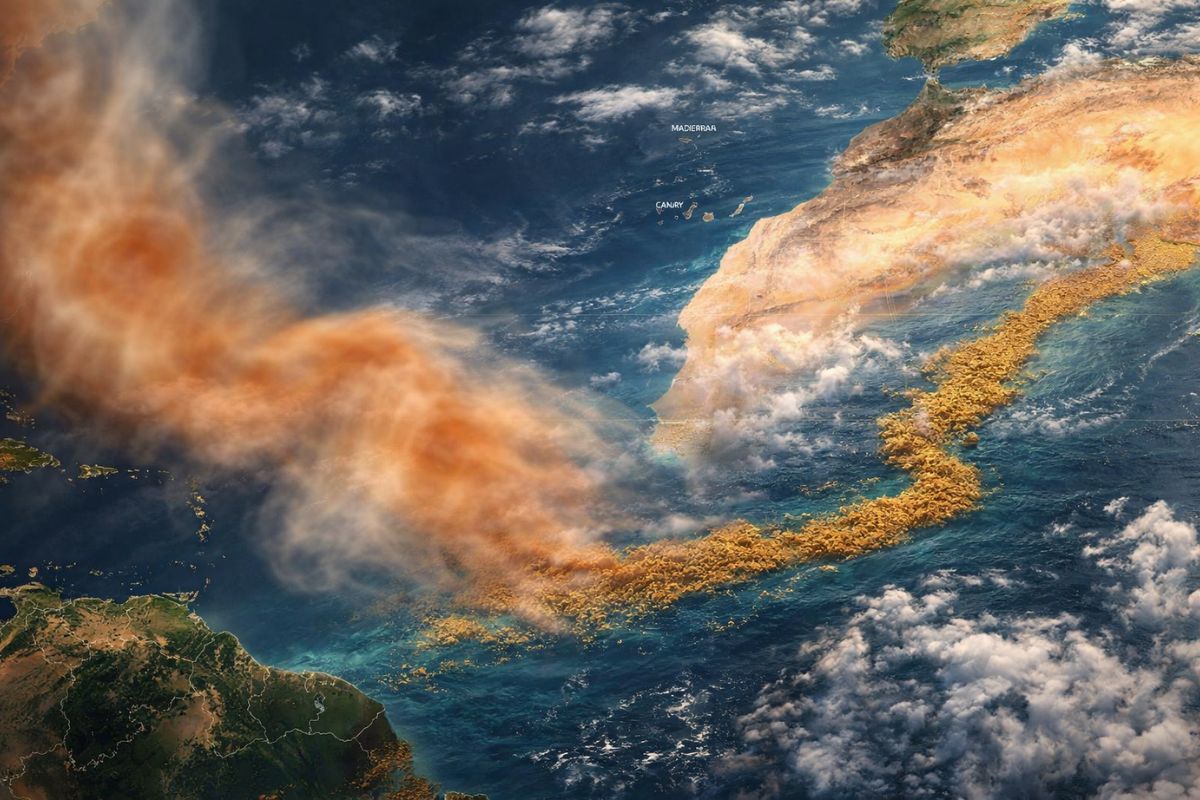
Satellites record two simultaneous phenomena crossing the Atlantic Ocean: a cloud of Saharan dust that worsens air quality in European islands and cities, and a record belt of sargassum that extends from the African coast to the Caribbean, releasing toxic gases as it decomposes on the beaches.
The Atlantic Ocean is being crossed by two phenomena visible from space that together affect the lives of millions of people on both shores. Since mid-February 2026, a large cloud of Saharan dust, known in the Canary Islands as calima, travels over the water carrying fine particles that worsen air quality and trigger health alerts in Cape Verde, Madeira, and now also in Northwestern Europe. At the same time, on the ocean’s surface, satellite images confirmed that sargassum reached 37.5 million metric tons in May 2025, a record that stretches like a brown belt from West Africa to the Gulf of Mexico and the Caribbean.
The two stories may seem separate, one in the air and the other in the water, but they share a common origin: materials that leave the African continent and travel thousands of kilometers over the ocean. The mineral dust crossing the atmosphere can even act as fertilizer for phytoplankton and contribute to the growth of algae like sargassum, closing a cycle that connects the desert, the ocean, and the tourist beaches of the Caribbean. For coastal communities on both sides of the Atlantic, the effects range from respiratory irritation to beaches covered by masses of decomposing algae that release harmful gases.
What is calima and how does Saharan dust cross the ocean

Calima is the name given in the Canary Islands to a dry haze that forms when strong winds lift fine dust from the Sahara Desert into the atmosphere. It can make the sun appear weaker and the horizon seem closer, even on cloudless days. On land, the signs are immediate: a brown layer settles on cars and patios, and many people notice irritation in their eyes or throat after spending some time outdoors.
-
A study revealed nine careers that pay over $100,000 a year with below-average stress levels, and most recent graduates are unaware that these professions exist.

-
A young Indian woman passed the police exam after years of dedication, and the first thing she did upon learning the result was to put her father on her shoulders and dance in the street while neighbors stopped to film and cry along, and the video has already been viewed by millions of people around the world.

-
The most hated villain on Brazilian television left everything behind, moved to a secluded farm in the mountains of Rio, and today Marcello Novaes, at 63 years old, cultivates an organic garden, builds furniture from logs, raises chickens that he does not kill, and drinks spring water 800 meters away from the nearest human.
-
Eight out of ten Brazilian families are in debt, and the historical record of 80.4% in March 2026 worries even those earning more than ten minimum wages, with almost 30% of their income already committed to debts.

Once the dust rises high enough, the same winds that steer weather systems carry it over the ocean for thousands of kilometers. The Meteosat-12 satellite, which orbits about 36,000 kilometers from Earth, captured the dust plume moving westward over the Atlantic on February 17, 2026. The Copernicus Atmosphere Monitoring Service produces analyses and short-term forecasts of atmospheric composition, including aerosols, to support decisions related to health, transportation, and meteorological services. The latest forecasts indicate that the plume is expected to move toward Northwestern Europe in the coming days.
Why Saharan dust is a public health problem
The main concern with calima is what it contains. Dust clouds include tiny particles classified as PM10, which penetrate the respiratory tract and can cause irritation to the eyes, throat, and lungs, especially in children, the elderly, and people with asthma or chronic respiratory diseases. Public health guidelines recommend limiting outdoor time, exercising indoors, and keeping windows closed during periods of high concentration.
In addition to the direct health effects, dust significantly reduces visibility. Roads become more dangerous, and aviation can face disruptions even when weather radar does not detect any conventional clouds. The phenomenon can arise suddenly: on some mornings, the sky looks normal until a person steps outside and realizes the air is hazy. In the Canary Islands and Cape Verde, calima is a recurring event, but the intensity and frequency of the episodes in 2026 have drawn the attention of health authorities and meteorological services.
The sargassum belt covering the ocean from Africa to the Caribbean
On the ocean’s surface, another continental-scale phenomenon is unfolding. Sargassum, a brown algae that floats instead of anchoring to the seabed, has formed since 2011 what scientists call the Great Atlantic Sargassum Belt. A team led by Mengqiu Wang from the University of South Florida published in the journal Science that this belt contained over 22 million tons in June 2018. In 2025, an estimate from EUMETSAT raised this number to 37.5 million metric tons, a new record.
In open water, sargassum acts as a floating habitat, providing shelter for fish and small animals. The problem begins when this mass reaches the coast. The U.S. Environmental Protection Agency (EPA) warns that the decomposition of sargassum on beaches can release hydrogen sulfide and ammonia, gases associated with respiratory irritation, headaches, and greater risks for sensitive groups. For tourist destinations in the Caribbean and the Mexican coast, the mountains of decomposing algae represent both a health crisis and an economic blow to the ocean of revenue that tourism generates.
What feeds the record growth of sargassum in the Atlantic Ocean
The explosive growth of sargassum is not random. A review published in the journal Harmful Algae, led by Brian E. Lapointe from the Harbor Branch Oceanographic Institute at Florida Atlantic University, analyzed four decades of data and found that the nitrogen content in the algae has increased by about 55% over time, based on 849 samples collected in different decades. This increase indicates that the ocean is receiving more nutrients than normal.
The sources of this nutrient excess are well known: runoff from farms, wastewater leaks, and atmospheric deposition of nitrogen compounds. The upwelling of nutrient-rich waters off the West African coast during winter and the flow of the Amazon River in the warmer months also contribute to feeding the proliferation in the ocean. When nitrogen and phosphorus arrive in excess, they turn stretches of the sea into a feast for fast-growing algae. The result is a belt that stretches for thousands of kilometers and seems larger and harder to contain each year.
The connection between Saharan dust and sargassum in the ocean
According to the portal Ecoticias, the two stories crossing the Atlantic Ocean are not as independent as they seem. The same mineral dust that worsens air quality can also act as fertilizer for phytoplankton, the microscopic plants that sustain marine food chains. Iron and phosphorus particles present in Saharan dust settle on the ocean’s surface and provide nutrients that stimulate the growth of aquatic organisms, potentially including sargassum itself.
This connection between the atmosphere and the ocean illustrates how seemingly distant systems influence each other. A calima event in the Canary Islands can contribute, days later, to the growth of algae thousands of kilometers away, in the middle of the Atlantic Ocean. The satellites monitoring both phenomena, such as Meteosat-12 and Copernicus instruments, allow scientists to track these interactions in almost real-time, transforming spatial data into practical alerts for coastal communities, health authorities, and sectors such as aviation, fishing, and tourism.
What to expect for 2026 and why ocean monitoring is essential
An article from 2025 published in Nature Geoscience brought concerning news: the distribution of sargassum may be changing, not just expanding. Researchers reported a sharp decline of the algae in the northern Sargasso Sea since 2015 and suggested that warming waters and more frequent marine heatwaves in the ocean may be reshaping the distribution of sargassum each year. This means that regions that were previously unaffected may begin to receive masses of algae, while traditionally covered areas may have less.
More accurate forecasts are becoming practical tools, not just research projects. The satellite products developed by EUMETSAT already allow for the detection and prediction of floating algae in the ocean in almost real-time, offering coastal communities a window of anticipation to organize collection and reduce the impact on beaches and populations. The dust will continue to cross the Atlantic, sargassum will continue to grow, and the ocean connecting two continents will remain the stage where these forces meet. What changes is the ability to anticipate and react.
Saharan dust in the air and record algae in the ocean: two visible phenomena from space that affect millions of people on both shores of the Atlantic. Have you felt the effects of calima or seen sargassum on the beaches? Do you think satellite monitoring is enough to protect coastal populations? Leave your opinion in the comments.






Seja o primeiro a reagir!