





 Portuguese
  English
  Spanish
  3 min of reading
  0 comments


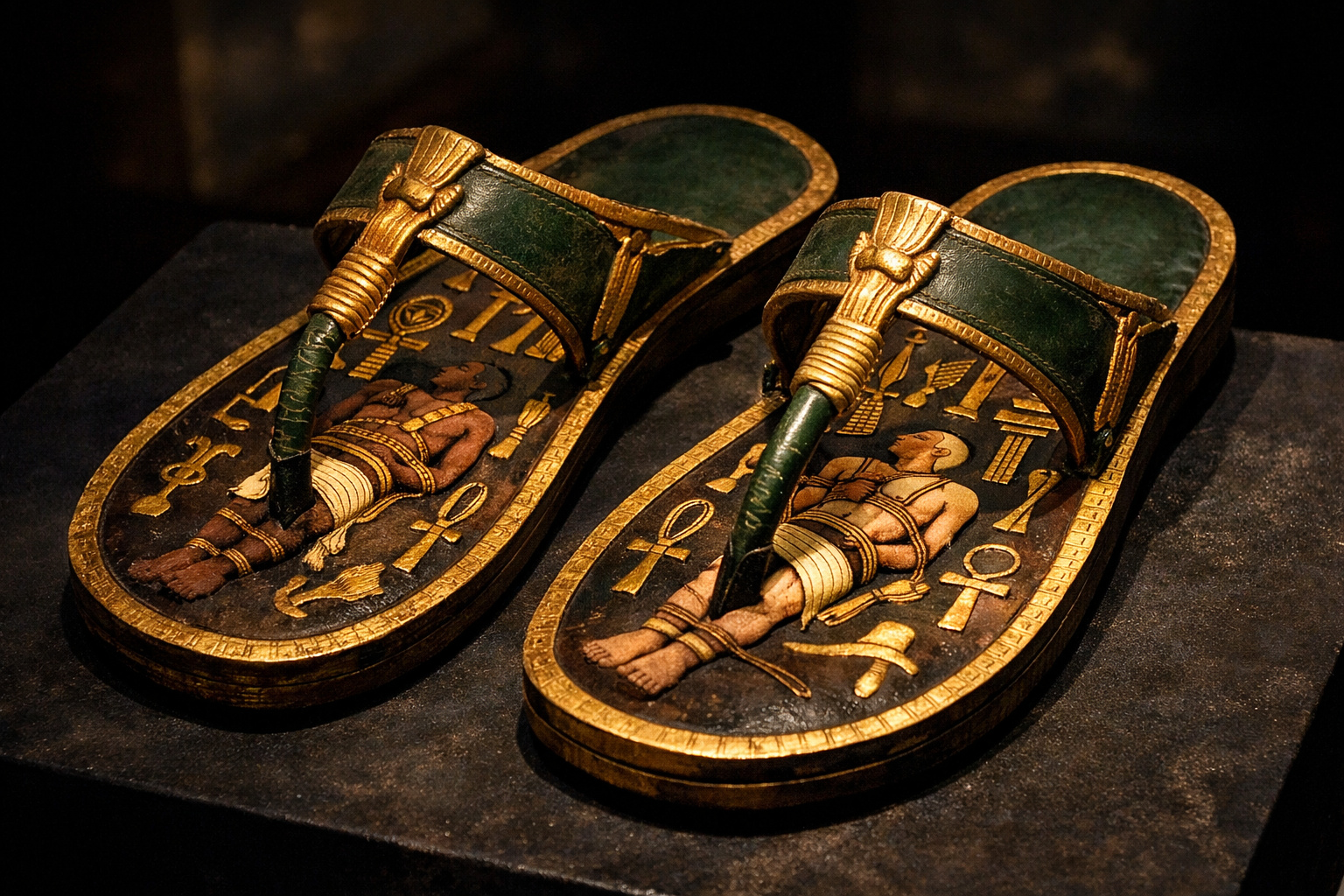
Ceremonial Footwear Found in the Pharaoh’s Tomb Reveals How Art, Political Power, and Religious Symbolism Intertwined to Immortalize Egypt’s Domination Over Its Enemies
Much more than just gold, funerary masks, and richly decorated sarcophagi, one of the most symbolic artifacts ever found in the tomb of Tutankhamun reveals how power in Ancient Egypt was exercised even in the smallest details of royal daily life. These are a pair of sandals about 3,300 years old, whose soles were decorated with explicit images of defeated enemies, strategically positioned to be trampled upon with each step of the pharaoh.
This information was originally disclosed by specialized articles in archaeology, based on excavation records made in the early 20th century and subsequent analyses by experts in ancient Egyptian art. These ceremonial footwear, although discreet at first glance, carry a profound political meaning and help to understand how royal power was constantly reaffirmed, even after death.
Tomb Artifacts Reveal the Symbolic Power Beneath the Pharaoh’s Feet

When British archaeologist Howard Carter, accompanied by Egyptian workers, opened Tutankhamun’s tomb in 1922, in the Valley of the Kings, he found thousands of funerary objects carefully placed to accompany the young pharaoh into the afterlife. Among dozens of pairs of footwear, these sandals caught attention due to an unusual detail: the insoles displayed bound human figures and stylized weapons.
-
Friends have been building a small “town” for 30 years to grow old together, with compact houses, a common area, nature surrounding it, and a collective life project designed for friendship, coexistence, and simplicity.

-
This small town in Germany created its own currency 24 years ago, today it circulates millions per year, is accepted in over 300 stores, and the German government allowed all of this to happen under one condition.

-
Curitiba is shrinking and is expected to lose 97,000 residents by 2050, while inland cities in Paraná such as Sarandi, Araucária, and Toledo are experiencing accelerated growth that is changing the entire state’s map.

-
Tourists were poisoned on Everest in a million-dollar fraud scheme involving helicopters that diverted over $19 million and shocked international authorities.

According to the original records, the sandals measure 11.2 by 3.6 inches, equivalent to 28.4 by 9.2 centimeters, approximately corresponding to size US 11.5 or EU 45. Carter found the pair under a basket inside the tomb, although it is impossible to determine if that was their original position, as many items had been moved or looted during Antiquity.
Despite this, the state of preservation allowed for detailed analyses of the materials and iconography, revealing a highly sophisticated craftsmanship, reserved exclusively for the Egyptian royalty.
Materials, Measurements, and Symbols Representing Egypt’s Enemies
The sandals were made from wood, covered with a layer of plant bark, green leather, gold leaves, and set on a base of white paint. In the arch of each sandal, there are figures of two people bound with lotus and papyrus, plants that symbolized, respectively, Upper and Lower Egypt.
Furthermore, each sandal features eight arches—four near the toes and four at the heel—along with a strap in the shape of an arch. These elements together form the symbol known as “Nine Arches”, a collective representation of the traditional enemies of Ancient Egypt, including foreign peoples and political rivals.
According to scholars, the positioning was not random. As the pharaoh walked, he literally stepped on his adversaries, visually reinforcing the idea of absolute domination. This concept was fundamental in pharaonic ideology, where the king not only ruled but maintained the cosmic and political order of the world.
Ritual Use, Afterlife, and the Eternal Meaning of Power
Currently, the sandals are on display at the Egyptian Museum in Cairo, accompanied by an informative plaque explaining that the represented prisoners symbolize the power of the king, while the Nine Arches were positioned “so that the monarch’s feet trample on them,” materializing Egypt’s dominance over its enemies.
Curiously, when Tutankhamun’s mummy was analyzed, the pharaoh was found wearing shining gold sandals, along with golden toe guards. However, it remains unknown whether the sandals decorated with enemies were used during his lifetime or if they were produced exclusively for his funerary attire.
Even so, the meaning remains intact: even in death, the pharaoh continued to govern, symbolically walking over those who dared to challenge Egypt. Thus, a simple pair of sandals transforms into a powerful historical document about politics, religion, and art in the ancient world.
With information from: Live Science









-

-

-

-

-

-

41 pessoas reagiram a isso.