





 Portuguese
  English
  Spanish
  9 min of reading
  0 comments


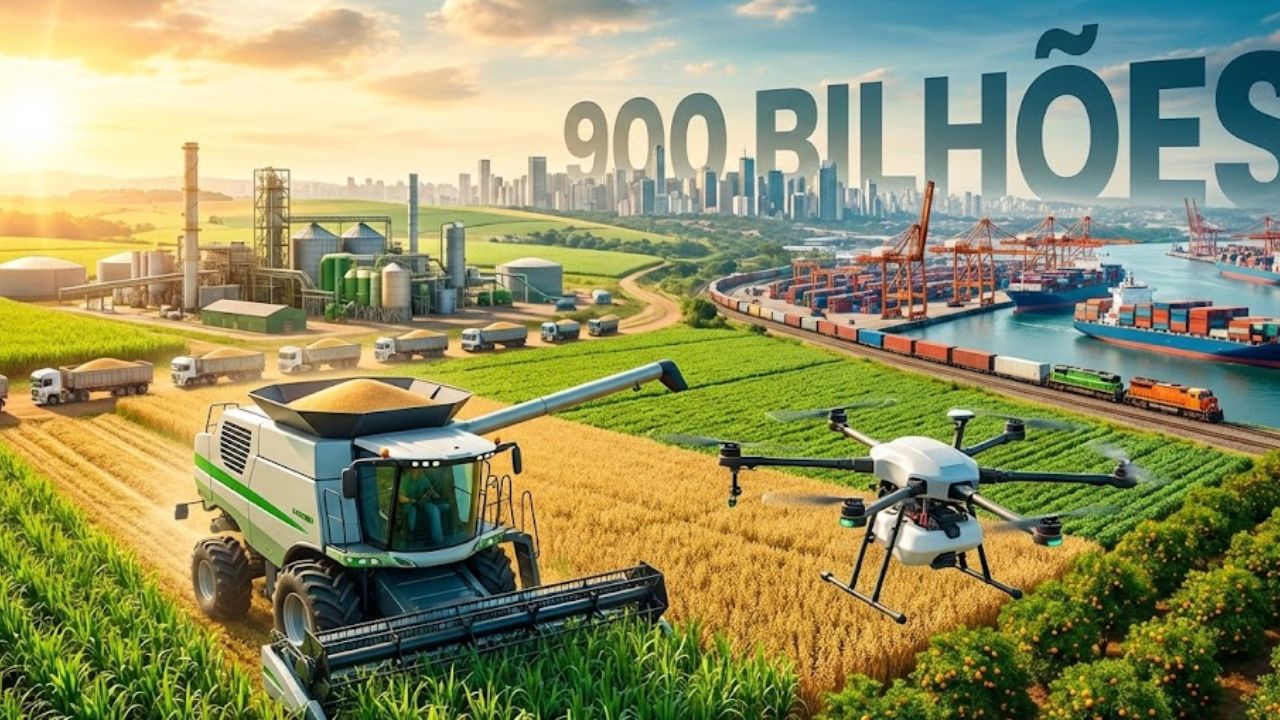
Even Seen As An Urban State, São Paulo Moves R$ 900 Billion In Agro, Concentrates 25% Of The Sector’s Wealth, Accounts For 19% Of Exports And Receives Over R$ 2 Billion In New Incentives That Are Redesigning The Paulista Countryside
Before the skyline of Avenida Paulista, the banks and the automakers, it was the countryside that put São Paulo on the map of economic power. The state that today moves R$ 900 billion in agro was born from the coffee hills, the first crops, and a rural structure that financed railways, banks, theaters, schools, and entire neighborhoods of the capital. What many forget is that behind the image of an urban state, there is a powerful interior that has never ceased to produce wealth.
Now, the Paulista agro is experiencing a new chapter. Billion-dollar public investments, land regularization, tax incentives, and a package of policies focused on agribusiness are redesigning the interior. While São Paulo continues to have the largest agricultural GDP in the country, responsible for R$ 900 billion in agro, the state is also becoming a stage for land disputes, criticism of regularization programs, and intense debates about who really benefits from this new cycle of wealth.
The Strength Of Paulista Agro In A Country That Looks Toward The Midwest
When the topic is agribusiness, the mental map of Brazilians often points directly to the Midwest. Mato Grosso, Goiás, and Mato Grosso do Sul concentrate some of the largest farms on the planet, with properties the size of cities, gigantic herds, and harvesters working from sunup to sundown. The Midwest has become synonymous with agro, but rural Brazil cannot fit into just one region.
-
The water that almost everyone throws away after cooking potatoes carries nutrients released during the preparation and can be reused to help in the development of plants when used correctly at the base of gardens and pots, at no additional cost and without changing the routine.
-
The sea water temperature rose from 28 to 34 degrees in Santa Catarina and killed up to 90% of the oysters: producers who planted over 1 million seeds lost practically everything and say that if it happens again, production is doomed to end.

-
An Indian tree that grows in the Brazilian Northeast produces an oil capable of acting against more than 200 species of pests and interrupting the insect cycle, gaining ground as a natural alternative in soybean, cotton, and vegetable crops.

-
The rise in oil prices in the Middle East is already affecting Brazilian sugar: mills in the Central-South are seeing their margins shrink just as ethanol gains strength.

As the cerrado expands, São Paulo remains one of the most important cogs in this machine. Even known for its congested avenues and the hustle and bustle of the capital, the state maintains a strong, diverse, and highly productive countryside. It is this agro that finances research, technology, exports and helps sustain 5.6% of the national economy. And this strength did not start yesterday.
From Coffee Beans To The Barons Who Built The Richest State

In the early 19th century, São Paulo was a state of small villages, simple economy, and discreet rural life. Everything changed when coffee found the right soil. The fertile hills of the Paraíba Valley were the starting point of an economic revolution. What began as an experiment quickly became the foundation of the Brazilian economy for almost a century.
Coffee spread to Campinas, Limeira, Ribeirão Preto, and Araraquara. Entire cities were born around the farms, and many of these farms became true empires, with big houses, drying yards, slave quarters, chapels, warehouses, and even railroads cutting through the yard. From the interior, the grain went straight to the port of Santos and then to the world. This is how the coffee barons emerged, men who grew rich quickly and began financing practically everything: railroads, banks, theaters, schools, and the first upscale neighborhoods of the capital.
Every cup of coffee served in Europe carried a piece of Paulista fortune. But, like any wealth based on a single product, this empire would not last forever. With the collapse of the New York Stock Exchange in 1929, coffee prices plummeted. Tons were burned, farms went into debt, and many barons lost a good part of their fortunes. The state that lived off the grain had to seek another path.
From The Coffee Crisis To The Sugarcane And Sugar Cycle

While other states tried to save the old coffee farms, the interior of São Paulo began to look to another crop: sugarcane. Sugarcane was not new, but the crisis had left lands free, infrastructure ready, and labor accustomed to the countryside. It was enough to change the cultivation for a new cycle of prosperity to emerge.
From the 1930s, sugarcane spread throughout the interior. Piracicaba, Sertãozinho, Ribeirão Preto, and many other cities began to see the rise of mills with tall chimneys and trucks loaded with harvested cane. Paulista sugar began to supply the internal market and, over time, made its way to the world. The progress was so great that, in the 1970s, when Brazil launched the National Alcohol Program, São Paulo was already ahead. The mills adapted, created distilleries, and turned cane into fuel. It was the beginning of Brazilian ethanol, and once again, the state was leading the country.
Rural life changed its face. The old mansions made way for metal silos, heavy machinery, and a routine marked by the sound of mills and steam from boilers. With the foundation of sugar consolidated, the Paulista countryside began to diversify. Orange plantations arrived, dairy farming in the São Carlos region, eucalyptus for paper and cellulose in the Paraíba Valley, as well as the vegetables from Mogi das Cruzes that supply the capital daily. The Paulista agro was leaving monoculture to become a complex and diversified system.
When The Countryside Becomes A Technology Laboratory
From the second half of the 20th century, the interior of São Paulo entered another phase. Machines took over the farms, harvesters replaced manual cutting, and tractors took the place of oxen teams. The time in the countryside began to be measured by productivity per hectare.
It was in this environment that research gained prominence. Universities like USP and UNESP, along with the Agronomic Institute of Campinas, created laboratories and experimentation centers that changed the way of producing. New varieties of cane, orange, and eucalyptus emerged, more efficient irrigation methods, soil management improvements, and the first experiences with biotechnology. Paulista agriculture became an open-air laboratory.
The old farms adapted. The baron became a businessman, and the land, once a symbol of status, began to be treated as a calculated business. The Paulista countryside organized itself into complete chains: from planting to industry, from truck to port. Every ton of cane, every orange harvested, every liter of milk processed underwent some industrial step within the state itself. From this integration was born the modern Paulista agro, sophisticated, diversified, and connected, uniting countryside, city, and technology in the same machinery.
R$ 900 Billion In Agro: The Weight Of São Paulo In Brazilian Agribusiness
Today, even with the prominence of the Midwest, São Paulo continues to be the state that moves the most money within the national agribusiness. According to sector benchmark studies, the Paulista agribusiness moved around R$ 900 billion in agro in 2023. Alone, the state accounts for approximately a quarter of all wealth generated by agro in the country, maintaining the highest agricultural GDP among all Brazilian states.
In exports, the performance is also impressive. In 2024, São Paulo was responsible for about 19% of everything Brazil sold abroad in the sector, and the initial numbers for 2025 indicate continuity of this strength, with significant surpluses right in the first quarter. This combination of strong internal production and consistent presence in the external market helps explain why the R$ 900 billion in agro is not an isolated event, but the result of a structure built over decades.
The Sugarcane and Orange Belt and The Value Per Hectare

According to official data, sugarcane and orange shape the agricultural map of São Paulo. The citric belt that runs through Araraquara, Limeira, and Bebedouro is the largest orange producing hub in the world, responsible for a large part of the juice that supplies the United States and Europe. Meanwhile, the cane feeds one of the most sophisticated industrial chains in the country. In the mills of the interior, the plant turns into sugar, alcohol, ethanol, and electricity, especially in the Ribeirão Preto region, which is among the largest producers of biofuels in the world.
But Paulista agriculture does not stop there. The state still harvests corn, cassava, vegetables, coffee, maintains strong dairy and pig farming, in addition to a forestry sector with millions of hectares of eucalyptus aimed at paper and cellulose. The difference is not just in what São Paulo produces, but in how much value it can extract from each hectare, combining technology, logistics, and industry.
Infrastructure, Technology And The Machinery That Sustains Paulista Agro
No other region in Brazil combines, with the same intensity, highways, railways, ports, and industrial hubs like São Paulo. The logistics are fast, integrated, and aimed at the quick flow of production. The countryside operates with high technology, with drones flying over fields, GPS-guided harvesters, and genetic research going straight from laboratories to farms.
That is why many analysts say that São Paulo does not lead agro because of the size of its crops, but because of the value created in each hectare. And it is precisely this structure that helps turn R$ 900 billion in agro into a recurring reality, not a statistical exception.
The New Incentives That Are Redesigning The Paulista Countryside

If public investment is any indication, the Paulista agro should continue to grow. In recent years, the state government has prioritized agribusiness. In 2024, for example, a package of around R$ 1.4 billion was launched to boost the sector. Part of it was allocated to rural credit, another to tax incentives, and another for property modernization. Programs like Pró-Tractor helped small and medium producers buy new machines at a discount, putting technology in the hands of those still working with older models.
In 2025, the movement gained momentum. During Agrishow in Ribeirão Preto, the government announced a new package of over R$ 600 million in investments directed to the countryside. Some of the resources were directed to expand rural insurance, protecting producers from losses caused by droughts and floods. Another part was allocated for the recovery of rural roads, essential for harvesting. There were also funds to modernize cooperatives and finance new agricultural equipment, with a special focus on small producers. Together, these programs exceed R$ 2 billion in recent incentives directly related to Paulista agro.
The Land Controversy: Land Regularization And The “Land Grabber’s Grant”
No policy, however, has generated as much debate as the land regularization program in Pontal do Paranapanema, in western São Paulo. The proposal provides discounts of up to 90% for producers interested in regularizing illegally occupied public lands. In total, the government estimates it will grant around R$ 18.5 billion in discounts and defends the measure as a way to ensure legal security for rural producers.
The numbers and profiles of the beneficiaries, however, raised questions. Among the cited cases is that of the Itapiranga farm in Marabá Paulista. With a 90% reduction, the owners regularized 2,000 hectares paying just over 2.7 million reais for an area valued at 25 million. The most controversial point is that the farm has no direct relation to agricultural production, being used as a private airfield. In other words, land that should be rural became a landing strip and still counted towards public discounts.
For some, the program is a way to resolve historical disputes, unlock investments, and boost the rural economy. For others, it is a loophole to regularize grabbed lands using public money. It’s no surprise that the nickname “land grabber’s grant” caught on and came to symbolize this conflict between development, social justice, and the use of state funds.
São Paulo As A Reflection Of Brazilian Agribusiness
All this discussion about land, incentives, and investments shows how São Paulo is the most faithful portrait of the contradictions of Brazilian agribusiness. On one side, technological advancement, research, productivity, and R$ 900 billion in agro helping sustain the economy. On the other hand, the old debate about land ownership, occupation, and distribution that has existed since the days of the coffee barons.
The Paulista countryside has always lived in this tense balance between progress and historical heritage. It is the state capable of mixing tradition, innovation, high productivity, and land conflicts in the same landscape, with ethanol plants next to disputed areas, drones flying over fields in regions still marked by inequality.
And now that you understand how São Paulo moves R$ 900 billion in agro, leads 25% of the sector’s wealth, and receives billions in incentives, tell me in the comments: in your opinion, should these investments prioritize technology, small producers, or the resolution of land conflicts in the Paulista countryside?









Seja o primeiro a reagir!