





 Portuguese
  English
  Spanish
  6 min of reading
  0 comments


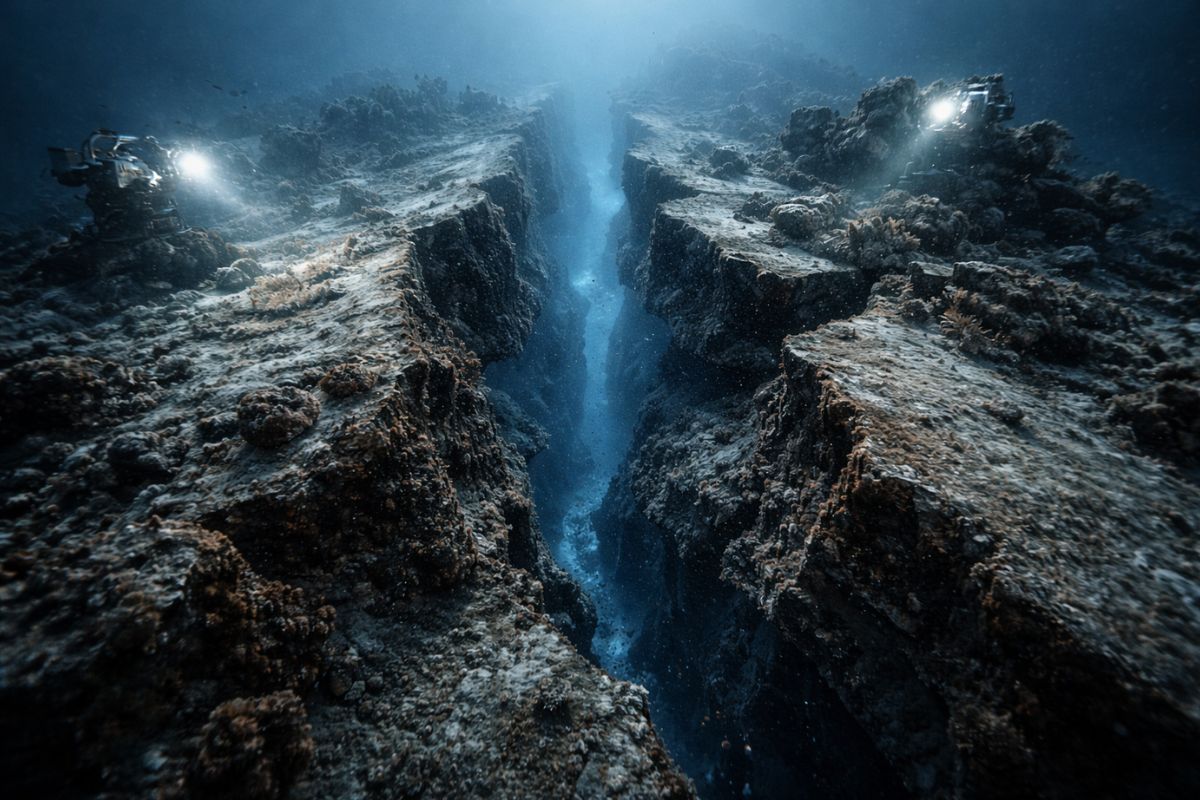
The tectonic plate that is breaking is located off the coast of Vancouver Island and has sunk about five kilometers, creating smaller microplates in a process that could influence the concentration of earthquakes, tsunamis, and even the release of methane from the seafloor in one of the most seismically active areas of the planet.
Scientists have captured exceptionally clear images for the first time of a tectonic plate fragmenting as it sinks beneath North America, off the coast of Vancouver Island in the Pacific Northwest. The images reveal a sinking of about five kilometers and a rupture that occurs in stages, creating “microplates” instead of a single abrupt break. The lead author of the study, Brandon Shuck, compared the process to “watching a train derail slowly, one car at a time.”
The study was published in the journal Science Advances and may seem like a topic restricted to geology books, but the consequences are real and imminent. The fragmentation of this tectonic plate influences the concentration of earthquakes, the risk of tsunamis and even the release of hot fluids and methane from the seafloor shaping marine habitats and posing concrete risks to millions of people living on the Pacific coast. It is a subduction zone caught, for the first time in history, in the act of falling apart.
What scientists have discovered about the tectonic plate that is breaking

The research focuses on the northern Cascadia region, where the Juan de Fuca and Explorer plates dive beneath the North American plate near a complex intersection of ocean ridges, trenches, and faults.
-
Antarctica hides fortunes in gold and silver that could spark a giant conflict among nations!
-
A study reveals that the hungriest black holes in the universe are going dormant due to a lack of matter.
-
Gigantic lithium deposit hidden in supervolcano in the US could transform the battery industry, boost electric vehicles, and place Elon Musk at the center of a new global energy race.
-
Specialists warn that a super El Niño, potentially the strongest in 140 years, could form as early as 2026 and lead the planet to record temperatures never seen before, with impacts that Brazil is expected to feel starting in June.
A boundary called the Nootka Fault Zone is responsible for fragmenting the approaching tectonic plate into separate pieces, while other nearby segments continue to sink normally. It is as if the plate is disassembling while still moving.
To capture these images, the team used what can be described as a seismic “ultrasound”: sound waves sent from a ship and recorded by a set of underwater sensors spanning 15 kilometers.
The echoes revealed faults and fractures at great depths below the ocean floor, including the significant five-kilometer displacement where part of the tectonic plate simply sank. The data was combined with regional earthquake catalogs from the Cascadia Seismic Imaging Experiment, creating the most detailed portrait ever made of a subduction zone in the process of rupture.
Why the fragmentation of this tectonic plate matters for coastal residents

( A ) Tectonic structure of the Cascadia margin and subducting oceanic plates. Thick black lines show primary tectonic boundaries and triple junctions are marked with cyan stars. The deformation front is marked by a red dashed line. Seismicity (magenta points) is a compilation of refs. ( 47 83–85 ) . The subducting plate structure from Slab2 ( 86 ) is indicated by colored contours every 10 km. The red dashed line represents the northernmost edge of the subducting plate, from ( 38 ). Black triangles denote the major volcanoes of the Garibaldi Volcanic Belt (GVB), the northern segment of the Cascade Arc. Light pink thin lines represent magnetic isochrones and their corresponding polygons are colored by age, while dark gray regions delineate spreading ridges ( 87 ). Black arrows with half arrows show relative motion across plate boundaries, while the large black arrow shows the direction of convergence of JdF relative to a fixed North American MORVEL plate ( 88 ). The blue rectangle delineates the study area shown in (B). NFZ, Nootka Fault Zone; RDF, Revere-Dellwood Fault; MTJ, Mendocino Triple Junction. ( B ) Study area of northern Cascadia showing the location of the CASIE21 seismic profiles and regional seismicity. Earthquake epicenters (magenta) from ( 40 – 43 ), and focal mechanisms colored by their slip style are from ( 40 , 46 ). Thick red lines show mapped surface traces of the NFZ ( 30 ). Thin gray lines show CASIE21 seismic profiles, while thick black lines represent the extensions of the profiles shown in
Fig. 3 . Exp, Explorer Plate; JdF, Juan de Fuca Plate; NA, North American Plate; PAC, Pacific Plate; STF, Sovanco Transform Fault; NNF, North Nootka Fault; SNF, South Nootka Fault; BP, Brooks Peninsula; WB, Winona Basin. Focal mechanism types: N, normal; Nss, normal/strike-slip; SSn, strike-slip/normal; SS, strike-slip; SSr, strike-slip/reverse; Rss, reverse/strike-slip; R, reverse.
The Canadian Pacific coast is the most earthquake-prone region in the country. More than 100 earthquakes of magnitude 5 or greater have occurred on the west coast of Vancouver Island in the last 70 years.
The largest subduction earthquake events capable of generating devastating tsunamis occur at estimated intervals of 300 to 800 years, according to geological evidence gathered by the Geological Survey of Canada. The tectonic plate that is fragmenting is a central part of this system.
The team from Louisiana State University emphasizes that the findings “do not significantly alter the risk perspective for Cascadia” in the short term.
But the new rupture map of the tectonic plate could help researchers understand how fragmentations direct future ruptures and improve earthquake and tsunami scenario modeling. For coastal communities, fishermen, and urban planners, this means more accurate predictions about where and how the next major quake might manifest.
Methane and heat escaping through the cracks of the tectonic plate
There is a less obvious environmental dimension to the findings. The Nootka Fault Zone appears in the images as a network of faults about 20 kilometers wide, and the broader shear zone extends over 100 kilometers.
This geometry functions like a giant set of cracked pipes in the Earth’s crust, through which hot fluids and methane gas escape from the planet’s interior to the ocean floor.
Scientists reported seismic disturbances consistent with the expulsion of methane in the sediment column, confirming previous observations of plumes of hot water and methane emanating from structures like Mount Maquinna along the tectonic plate fault system.
Methane is a potent greenhouse gas, and in the ocean, it also shapes local chemistry and biology. Studies in the Nootka Fault Zone have already documented seafloor communities that depend on hydrothermal circulation generated by the fractures. Tectonics not only shakes the ground; it creates ecosystems.
What happens when a tectonic plate “dies” in pieces over millions of years
The process that scientists are documenting is not a sudden event; it is a transformation that unfolds on a geological scale.
Over millions of years, the detachment of the tectonic plate can alter how heat moves through the region, opening “windows” that allow hot mantle to rise and potentially fuel pulses of volcanism and crustal uplift.
The authors describe a future where the northern Cascadia subduction zone could shorten by about 75 kilometers as the Explorer segment detaches.
For those living on the Pacific coast, the lesson is that tectonic plate boundaries are not fixed lines drawn on a map; they are living borders that move, break, and reconfigure.
The next step, according to the researchers, is to improve monitoring and create more accurate maps of where the plates are locked, sliding, or already separated. This does not prevent earthquakes, but it allows coastal communities to know exactly what is beneath their feet—literally.
Did you know that tectonic plates can fragment slowly like a train derailing? What surprised you the most about this discovery? Share in the comments.







Seja o primeiro a reagir!