





 Portuguese
  English
  Spanish
  5 min of reading
  0 comments


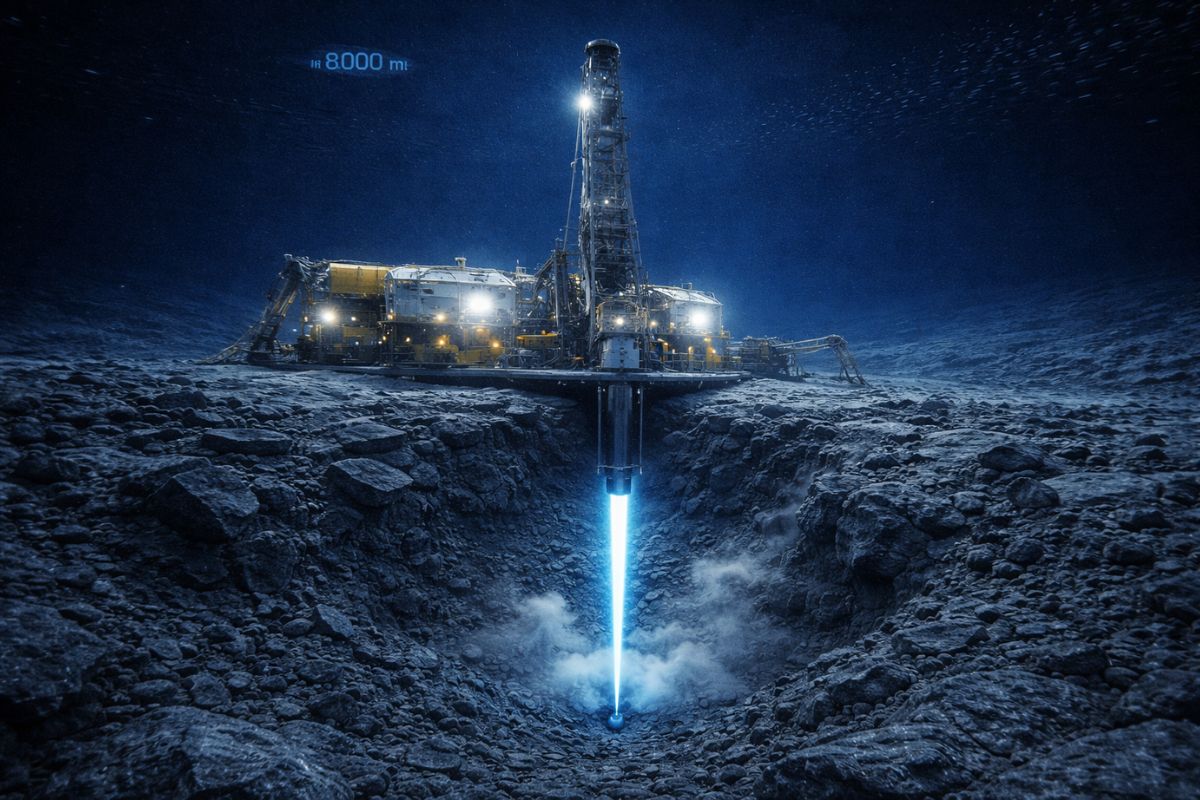
An international team aboard the Chikyu ship drilled almost 8,000 meters to the ocean floor in the Japan Trench and discovered that the 2011 tsunami was amplified by a 130-million-year-old extremely slippery clay layer that made the ocean floor rise between 50 and 70 meters per second, turning the earthquake into a wall of water greater than any forecast indicated
Scientists drilled almost 8,000 meters to the bottom of the ocean, above the fault that caused the earthquake and tsunami of 2011 in Japan.
The goal was to answer a question that had intrigued geologists for over a decade: why did that wave grow so much and advance so far inland, even though the earthquake had already been well studied?
The samples collected from the ocean floor revealed that the rupture occurred along a 130-million-year-old, extremely thin and slippery clay layer, which made the ocean floor rise between 50 and 70 meters in seconds and turned the earthquake into a tsunami much worse than any model predicted.
-
Thousands of years after causing the largest eruption of the Holocene, one of the world’s largest supervolcanoes is rebuilding itself beneath the sea south of Japan, receiving new magma and alarming scientists with its transformation.
-
China has activated a magnet 700,000 times more powerful than the Earth’s magnetic field that operates for over 200 consecutive hours while consuming little energy, and now the world wants to know what Beijing plans to do with this technology in 2026.
-
Mercado Livre has started selling medications in Brazil with delivery in up to 3 hours, and the project that launches in São Paulo may expand to the entire country, transforming the way millions of Brazilians buy medicines.

-
While the South begins April with sun and heat, a change in the weather already has a defined scenario in Brazil, and forecasts indicate heavy rain in the North and a sharp drop in temperature in the coming days.

The study, published in the journal Science, was led by geologist JD Kirkpatrick and conducted aboard the Chikyu drilling ship, operated by the Japan Agency for Marine-Earth Science and Technology.
Drilling at the ocean floor in the Japan Trench set a Guinness World Record for scientific ocean drilling, with over 7,900 meters of pipes descending through nearly seven kilometers of water to reach the boundary between tectonic plates.
What they found down there explains why the 2011 tsunami killed tens of thousands of people and overflowed levees that were supposed to protect coastal cities.
What scientists found almost 8,000 meters to the ocean floor

In the Japan Trench, the Pacific tectonic plate slides beneath Japan in a process called subduction.
A huge plate of the Earth slowly dives beneath another, and the two surfaces can become stuck for centuries until the accumulated tension separates them in a sudden jolt.
Scientists expected to find a broad zone of fragmented rock at the fault. That was not what happened.
The samples taken from the ocean floor showed that the 2011 rupture concentrated on a clay-rich layer just a few meters thick.
This clay is made up of microscopic particles of mud that settled on the Pacific plate over about 130 million years before being dragged into the trench, forming a natural rupture line within the fault.
Professor Ron Hackney from the Australian National University described this fragile zone as the place where the movement likely began.
How the 130-million-year-old clay made the ocean floor rise 70 meters in seconds
When the 9.1 magnitude earthquake ruptured the fault in March 2011, the rupture was channeled into the extremely soft and slippery clay layer.
As the clay offered minimal resistance to movement, parts of the plate boundary near the trench slid between 50 and 70 meters, pushing the ocean floor upward by several meters in just a few seconds.
This jolt of the ocean floor was what transformed the earthquake into a wall of water that advanced toward the Japanese coast.
The analogy used by scientists is that of a stuck kitchen drawer: it resists when you pull, but when it finally releases, it slides violently to the end of the track.
The 130-million-year-old clay layer acted like that drawer: it stored centuries of tension while the Pacific plate moved westward a few centimeters per year, until the pressure overloaded the material and the fault slipped almost freely.
The result was a tsunami larger and more concentrated than any forecast had suggested, which corresponds to what coastal communities actually witnessed.
Why no model predicted that the tsunami would be so destructive
Before this drilling at the ocean floor, tsunami prediction models relied mainly on the magnitude of the earthquake to estimate wave size.
The problem is that magnitude alone does not capture what happens at the fault. Two earthquakes of the same magnitude can produce completely different tsunamis depending on the material present at the rupture point.
In the case of 2011, the presence of the slippery clay layer allowed the ocean floor to shift much more than models predicted for that magnitude.
The water overflowed levees and flooded neighborhoods far beyond the coastline, hit the Fukushima Daiichi nuclear plant, and caused one of the greatest disasters of the 21st century.
Scientists now understand that the decisive factor was not just the strength of the earthquake, but the type of material at the ocean floor where the fault ruptured, and this changes how we assess tsunami risk worldwide.
What the discovery at the ocean floor of Japan means for future tsunami risk
The results offer a new model for identifying other locations around the world where tsunami risk may be exceptionally high.
Hackney notes that there are indications of equally soft sediments being dragged into subduction zones in regions like Sumatra, although only future drilling at the ocean floor can confirm whether these faults hide the same type of fragile clay layer.
In practice, this means that tsunami risk maps can go beyond simple rules that relate only wave size to earthquake magnitude.
Planners can start investigating whether certain stretches of coastline are situated in front of geological faults with slippery layers that could thrust the ocean floor upward in violent motion.
This knowledge directly informs building codes, evacuation routes, and early warning systems that alert coastal populations when they should leave their homes and move to higher ground.
Drilling at the ocean floor of Japan does not save those who died in 2011. But it may save those living in similar regions who do not know that a layer of millions-year-old clay can turn the next earthquake into something much worse than models predict.
8,000 meters to the ocean floor and the answer that took 13 years to arrive
Scientists drilled almost 8,000 meters to the ocean floor in the Japan Trench and found the answer to why the 2011 tsunami was so devastating.
A 130-million-year-old, extremely thin and slippery clay layer made the ocean floor rise between 50 and 70 meters in seconds, turning the earthquake into a wave that no model could predict and that killed tens of thousands of people.
The discovery changes how we assess tsunamis and shows that sometimes the difference between a big wave and a catastrophe is hidden thousands of meters below the ocean floor, in a layer of mud older than most dinosaurs.
Did you know that the ocean floor rose 70 meters in seconds during the 2011 earthquake? Did you imagine that a 130-million-year-old clay layer could cause such a devastating tsunami? Do you think this discovery will change disaster prevention? Leave your thoughts in the comments and share with those interested in science and geology.







Seja o primeiro a reagir!