





 Portuguese
  English
  Spanish
  5 min of reading
  0 comments


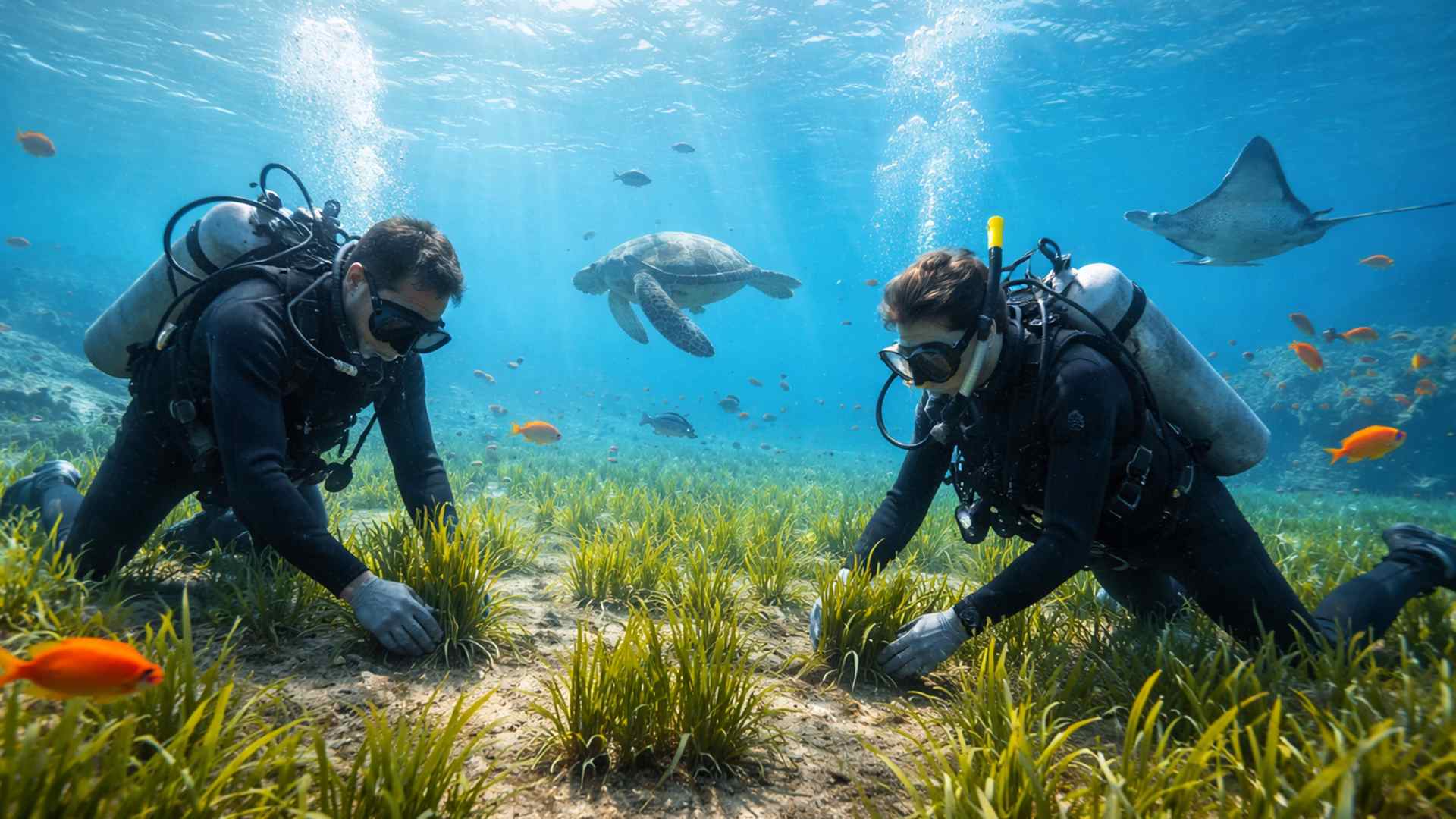
Study conducted off the coast of Catalina Island showed that restored seagrass beds in open water recovered ecological functions quickly, attracted new species in a short time, and strengthened the potential of these habitats in biodiversity, carbon storage, and coastal protection
Scientists in California managed to restore seagrass beds in open water off Catalina Island and observed, in just one year, the return of marine life in the area, with results that in two years already indicated a significant increase in biodiversity.
For decades, seagrass beds received less attention than ecosystems like coral reefs and mangroves, despite their ecological importance. Now, a study from UC San Diego, led by scientists from the Scripps Institution of Oceanography, reinforces the role of these environments in the regeneration of marine life in a short time frame.
The work focused on the restoration of Zostera marina, a common species of seagrass, in exposed areas of open water.
-
Scientists find about 1 million giant live eggs hatching in an active underwater volcano, discover a natural furnace on the ocean floor, and reveal one of the most unlikely nurseries ever seen in the ocean.
-
Scientists launched a bait camera to the bottom of the Pacific Ocean and saw something that no one expected.
-
Is a smart plug worth it in a regular home? What does it offer: turns on and off via smartphone, creates routines by schedule, prevents forgotten devices, sometimes monitors consumption, and improves habits without renovation or miracles.

-
Airbus and Mercedes take the G-Class to the skies: the ACH145 helicopter priced at R$ 78 million debuts in São Paulo, unit goes to Brazilian, AMG cabin, 5-blade rotor, and a 2-year wait.


The chosen location was off the coast of Catalina Island, in a more dynamic environment that had previously been considered unsuitable for this type of initiative.
Restoration of seagrass beds in open water changes conservation approach
Traditionally, restoration projects of this type were limited to protected bays and estuaries, where conditions are more stable. With less wave action, these environments offer less uncertainty for the establishment of plants, but also have more restricted available space.
The study breaks with this logic by showing that open water areas can also be viable for the recovery of these habitats.
After nearly a decade of monitoring, researchers analyzed everything from the structure of seagrasses to fish communities, identifying suitable locations to carry out the first successful transplant in this type of environment.
The results drew attention due to the speed of the ecological response observed. In just one year, the restored area was already functioning as a natural pasture, and in the second year, it began to register biodiversity higher than that of some reference pastures.
This rapid recovery was considered a significant finding by researchers, as ecological processes of this magnitude typically do not show such accelerated responses. The case reinforces the possibility of expanding restoration efforts in previously dismissed regions.
How seagrasses reconstruct the underwater environment
Seagrasses act as ecosystem engineers, physically transforming the space around them. Their leaves form a kind of underwater forest that reduces the force of currents, retains sediments, and creates shelter for various organisms.
This alteration in the environment favors the gradual arrival of other species. First, small invertebrates appear, then juvenile fish, and later predators, in a process that helps reactivate the food chain.
Among the examples observed in the study, the California sheephead, identified as Oxyjulis californica, uses these meadows as a breeding area. There were also occasional appearances of larger animals, such as rays and even endangered sea turtles.
The presence of these species was considered a sign that the restored ecosystem was beginning to function more completely. The return of these animals indicates not only occupation of the space but also the resumption of more complex ecological relationships.
Biodiversity, blue carbon, and coastal protection
The study highlights that the value of seagrass meadows is not limited to the increase in biodiversity. These ecosystems also play an important role in so-called blue carbon, by capturing carbon dioxide and storing it in sediments for long periods.
According to the work, this storage has a relevant characteristic of stability. Unlike terrestrial forests, where carbon can return to the atmosphere due to fires or logging, in the seabed it remains buried under sediments.
Moreover, seagrasses help protect coastal areas. By reducing wave energy and stabilizing sediments, they contribute to mitigating erosion, an increasingly important factor in light of rising sea levels.
This set of functions enhances the importance of these habitats in the environmental context. Seagrass meadows now gather direct ecological benefits, support for fauna, and contribution to coastal resilience.
Expansion of restorable areas increases resilience of coastal ecosystems
The success of restoration in open water comes at a critical time for many coastal regions. Various areas traditionally used in these projects are degraded or directly occupied by infrastructures, limiting environmental recovery.
By expanding the locations where seagrasses can be restored, the capacity for recovery of coastal ecosystems also grows. More available areas mean greater potential for response to pressures associated with climate change.
Another noted effect is the possibility of reducing pressure on already overcrowded habitats. With a more balanced distribution of biodiversity, it prevents the concentration of species in the same areas, which, in the long term, favors greater ecological stability.
The study also emphasizes that these projects usually require little human intervention once established. When conditions are suitable, the system tends to self-organize, reducing costs, maintenance, and environmental impact associated with restoration efforts.
Seagrass meadows gain space in large-scale conservation strategies
The research suggests that open ocean environments can become an important tool in conservation strategies, especially in regions like California. In this scenario, coastal development has sharply reduced the available natural spaces.
The proposal aligns with broader movements for large-scale environmental restoration. Initiatives related to ecosystem recovery seek scalable, replicable, and efficient solutions, and the progress made with this transplant in open water fits this type of objective.
The study also points out that advances in transplant techniques, monitoring with marine sensors, and analysis of oceanographic data are making this type of project more precise. As a result, there is less trial and error and greater use of applied science in defining restorable areas.
The recovery observed off the coast of Catalina Island thus reinforces the importance of reconsidering the role of these habitats.
Previously seen as secondary and restricted to protected areas, seagrass beds are now treated as a concrete front for ecological restoration, biodiversity, and coastal protection.






Seja o primeiro a reagir!