





 Portuguese
  English
  Spanish
  6 min of reading
  0 comments


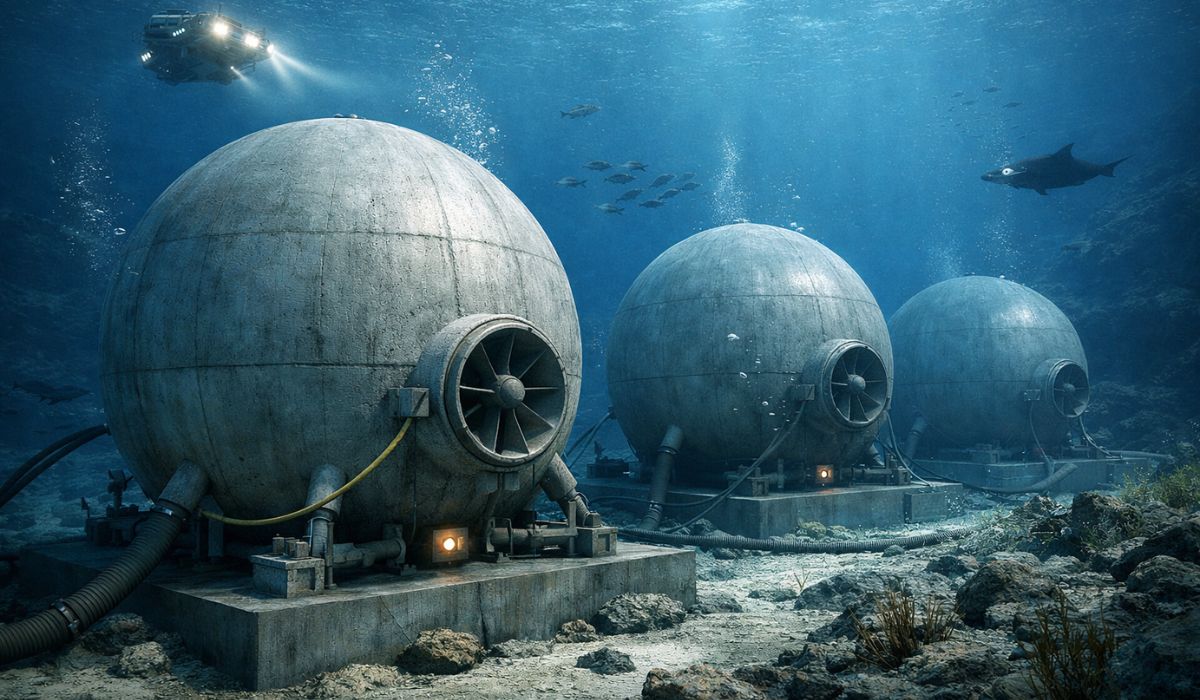
A technology in testing tries to take electricity storage to the bottom of the sea, combining submarine engineering, ocean pressure, and renewable energy in a model that seeks to expand the capacity of networks without occupying land space.
Energy storage at the bottom of the sea
Hollow concrete spheres installed at the bottom of the sea are at the center of a proposal developed by the German institute Fraunhofer IEE to store electricity generated by renewable sources.
The project, called StEnSea, is based on a principle already known in the electric sector and tries to adapt it to the marine environment to create a reserve of energy without occupying land areas.
The logic of the system is based on water pressure at great depths.
-
Researchers dive nearly 5,000 meters deep in Japan, discovering a rare “glass castle” inhabited by unknown species and demonstrating that the oceans remain one of the greatest mysteries of the planet.
-
Researchers in Dubai develop a solution for concrete with biodegradable plastic that resists corrosion, provides ductility comparable to that of steel, and paves the way for modular, temporary, and prefabricated structures.
-
The mysterious giant blue sphere in the middle of the Amazon that went viral on the internet is the Planetarium of Médio Solimões, an impressive project that is revolutionizing access to astronomy in Brazil.
-
Earth is “pulling” water from the oceans into the core at nearly 3,000 km deep, and scientists finally explain how this slow and invisible process may be completely transforming the planet from the inside over billions of years.
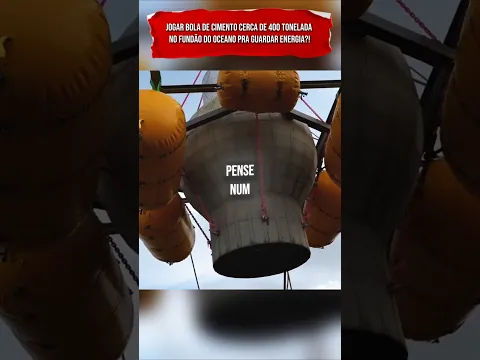
According to Fraunhofer, when the sphere is empty, it functions as a charged unit.
When the valve is opened, seawater enters under pressure, moves a pump-turbine, and activates a generator that delivers electricity to the grid.
In the reverse process, water is removed from inside the structure using electrical energy, which restores the storage capacity for a new cycle.
According to the institute, the proposal uses the same concept of pumped hydro storage in the sea, a technology already employed on land in systems with reservoirs at different levels.
How the StEnSea system works
In this model, the column of water in the ocean replaces part of the infrastructure required in conventional installations.
Instead of two reservoirs at different elevations, the system relies on the natural pressure of the sea at great depths to perform the charging and discharging cycles.
According to Fraunhofer, the locations considered most suitable for this type of installation are between 600 and 800 meters deep.

In this range, according to the institute’s studies, there is a more favorable balance between pressure, necessary wall thickness of the sphere, weight of the structure, and use of submerged equipment.
The depth and size of the sphere directly influence the amount of energy that can be stored.
In the parameters presented by Fraunhofer for a commercial application, each full-scale unit would have 30 meters in diameter, a weight of approximately 20,000 tons, a capacity of 20 MWh, power between 5 and 7 MW, and an estimated efficiency of 80%.
StEnSea tests in Lake Constance
Before moving to an operation in open sea, the concept underwent an experimental phase in Lake Constance, in the border region between Germany, Switzerland, and Austria.
The test used a sphere with 3 meters in diameter, installed at about 100 meters deep.
According to Fraunhofer and the authors of the scientific study on the experiment, the system operated automatically in the winter of 2016/2017.
The goal was to verify not only the principle of operation but also practical steps, such as installation, control, removal of the structure, and operation under real pressure.
The researchers reported that the trial contributed to raising the technological maturity of the project.
In addition to the system’s performance, the stage served to observe environmental and operational aspects in a non-laboratory environment.
According to the institute, the water intake was equipped with protection to reduce risks to aquatic fauna.
Underwater inspections conducted during the test indicated low environmental impact under the conditions observed in that experiment.

Prototype in California and next phase of the project
The next phase planned by Fraunhofer is a 1:3 scale prototype off the coast of California, in an area near Long Beach, in the Los Angeles region.
The institute reports that the planned structure will have 10 meters in diameter, a weight of about 1,000 tons, an operational depth between 500 and 700 meters, a capacity of 0.5 to 1 MWh, and power between 0.5 and 1 MW.
The announced goal by Fraunhofer is to put this unit into operation by the end of 2026.
The project is part of a phase called StEnSea 2.0, aimed at demonstrating the system on a scale closer to practical application.
According to the institute, the manufacturing of the sphere should be done by the American company Sperra, using 3D concrete printing combined, when necessary, with conventional methods.
The technical unit with pump-turbine, sensors, and control systems is being developed with the participation of Pleuger Industries.
The choice to produce the structure close to the test area is linked to the logistical evaluation of the project.
In this stage, the team intends to verify manufacturing, transportation, and installation costs, as well as the system’s behavior in a real marine environment for longer periods.
Applications for renewable energy and electric grid
According to Fraunhofer, the technology was designed to operate alongside electric grids that need to deal with the fluctuation of renewable sources, such as solar and wind.
The storage allows for shifting the supply of energy over time, storing electricity during periods of higher generation for later use.
According to the institute, this type of system can be employed in services such as grid stabilization, operational reserve, and energy arbitrage.

In the latter case, the application involves storing electricity during periods of lower prices and returning it to the system when prices are higher.
Another possibility pointed out by researchers is the installation near offshore wind farms.
In this configuration, storage at sea could support maritime generation, although feasibility depends on technical, economic, and geographical factors of each region.
Differences in relation to pumped hydro storage
Pumped hydro storage remains one of the main references when it comes to storing large volumes of electricity.
The difference, in the case of StEnSea, is that the system was designed to operate at the bottom of the sea and reduce the need for large structures on land.
According to Fraunhofer, the technology can be organized in “parks” with several interconnected spheres.
This would allow for capacity expansion by modules, according to demand and the conditions of the installation site.
The institute’s studies also indicate a global technical potential of 817 TWh, considering criteria such as suitable depth, seabed slope, and distance from electrical and port infrastructure.
This number refers to the estimated technical potential and not to capacity already available or ready for immediate deployment.

Funding, costs, and data that will come from the pilot
The advancement of the project also depends on public funding and international cooperation.
According to Fraunhofer, the German government contributes nearly € 3.4 million for the current phase, while the U.S. Department of Energy contributes about US$ 4 million for the development of the pilot in California.
With this, the next stage becomes crucial to measure the performance of the concept on a larger scale.
The operation of the prototype should provide data on reliability, maintenance, costs, and integration with the grid, points considered essential to evaluate whether the technology can advance beyond the demonstration stage.
In the context of expanding renewable sources, Fraunhofer’s proposal adds to other attempts to broaden the range of solutions for large-scale energy storage.
The result of the test in California should indicate whether the use of concrete spheres at the bottom of the sea can move out of the experimental field and find space in future projects.







Seja o primeiro a reagir!