





 Portuguese
  English
  Spanish
  4 min of reading
  0 comments


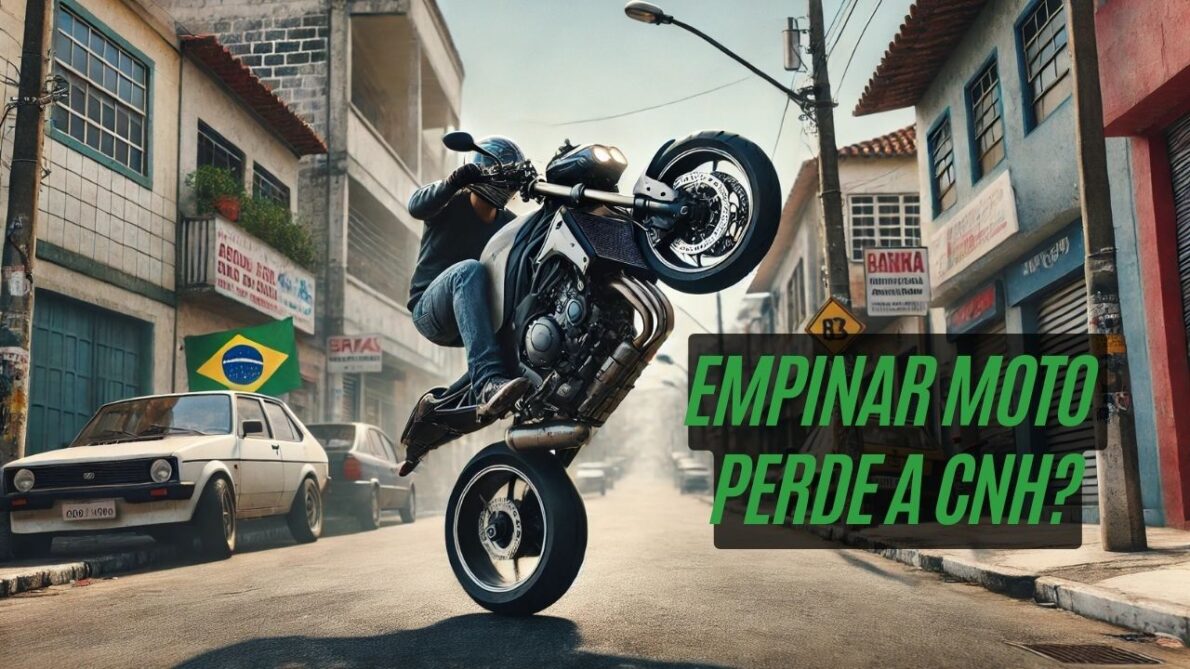
If You Think Wheelies Are Just Another Radical Move to Impress, It’s Best to Put Both Tires on the Ground. Jokes Aside, This Practice Can Be Quite Costly, and We Are Not Only Talking About the Risk of a Fall. Brazilian Legislation Is Clear: Doing Wheelies Is a Serious Violation, and the Price Paid for This “Joke” Includes Fines, Seizure of the Motorcycle, and, Most Seriously, the Immediate Suspension of the Driver’s License.
In the Brazilian Traffic Code (CTB), doing wheelies is listed among the most severe infractions, with penalties that can drastically change the life of the motorcyclist. When someone decides to defy gravity and ride on just one wheel, the cost is higher than one might imagine: a fine of R$ 293.47, the immediate suspension of the driver’s license, and the risk of having the motorcycle seized. The law is straightforward and offers no loopholes: doing wheelies is serious and risky for both the motorcyclist and other road users.
The CTB establishes two ways to suspend the National Driver’s License. The first is through the accumulation of points for various infractions over the course of a year. The second, and faster method, is the direct suspension of the driver’s license, applied for infractions considered to be very serious – like doing wheelies. For many, this practice may seem like just a display of skill, but, in the eyes of the law, it is a reckless act that puts lives at risk.
The Severity of the Infraction of Doing Wheelies and the Importance of Enforcement
Dangerous maneuvers with motorcycles are not new on Brazilian roads. In addition to doing wheelies, other behaviors, such as riding standing up or lying down, also face severe penalties. The justification is public safety, especially in a country that leads the statistics of accidents involving motorcyclists. Experts affirm that the seriousness of the consequences for those who do wheelies is necessary to discourage behaviors that can easily lead to tragedies.
-
Brazilian city bets on the business environment to generate jobs and attract investments in the energy sector — secretary reveals strategy at Macaé Energy 2026.
-
50 viaducts, 4 tunnels, 28 bridges, and 40 kilometers of bike paths: BR-262 in Espírito Santo will receive 8.6 billion reais for the largest engineering project in the state’s history, inspired by the Immigrant Highway in São Paulo.

-
Brazil produces too much clean energy and doesn’t know what to do with it: over 20% of solar and wind capacity was wasted in 2025 while investors flee and 509 renewable generation projects were abandoned in the last year.

-
Piauí will produce a new fuel that replaces diesel without needing to change anything in the truck’s engine and reduces pollutant gas emissions by half: truck drivers from all over the Northeast are already celebrating the news that will arrive later this decade.


To ensure that this legislation is respected, the presence of stringent enforcement is essential. According to experts, without constant action on the roads, practices like doing wheelies will be difficult to eliminate. The visible presence of enforcement aims not only to issue fines but also to promote a change in behavior, creating a culture of respect and caution on the road.
Safety Above All
In a busy traffic scenario like Brazil’s, where accidents involving motorcycles are already a concern, doing wheelies is an action that can further aggravate safety on the roads. The legislation, in addition to being punitive, also carries an educational character. Penalizing those who do wheelies is, above all, a measure for preserving life, not just of the motorcyclist but also of everyone who shares the roads.
Ultimately, the message is clear: doing wheelies is a risk not worth taking. The suspension of the driver’s license, the fine, and the possibility of losing the vehicle are just the beginning of the consequences of a maneuver that can jeopardize much more than one’s license; it can cost lives.
The Most Expensive Fines for Motorcyclists in Brazil in 2024
Participation in illegal street racing or competitions: With fines of up to R$ 19,468.10, the practice of racing and competing on public roads is severely penalized. In addition to the high fine, those involved may have their driver’s licenses suspended and their vehicles seized. Recidivism can double the fine due to the serious risk to public safety.
Refusal to take a breathalyzer test: This refusal results in a fine of R$ 2,934.70 and a 12-month suspension of the driver’s license. The fine can double if the motorcyclist reoffends within a year. This rigor aims to deter driving under the influence of alcohol, which is a significant cause of accidents.
Dangerous maneuvers or stunts: Fines of R$ 2,934.70 are applied to motorcyclists who perform risky maneuvers, such as doing wheelies or skids. The practice not only involves a high fine and the suspension of the driver’s license but also elevated risks, especially for those exposed without the protection of a car. These infractions receive a multiplicative factor due to the extreme risk involved, and this higher penalty is common for infractions that seriously compromise public safety.
Speeding exceeding 50% of the limit: With a fine of R$ 880.41, exceeding the limit by more than 50% is a very serious infraction and results in immediate suspension of the driver’s license. This infraction is particularly common on high-displacement motorcycles on highways.
Overtaking on the wrong side or in prohibited areas: Fines of up to R$ 1,467.35 are applied to those who make dangerous overtaking on curves or in areas where signage prohibits it. Upon recidivism, the fine increases to R$ 2,934.70. These infractions represent serious collision risks and receive special attention from authorities.










Seja o primeiro a reagir!