





 Portuguese
  English
  Spanish
  5 min of reading
  0 comments


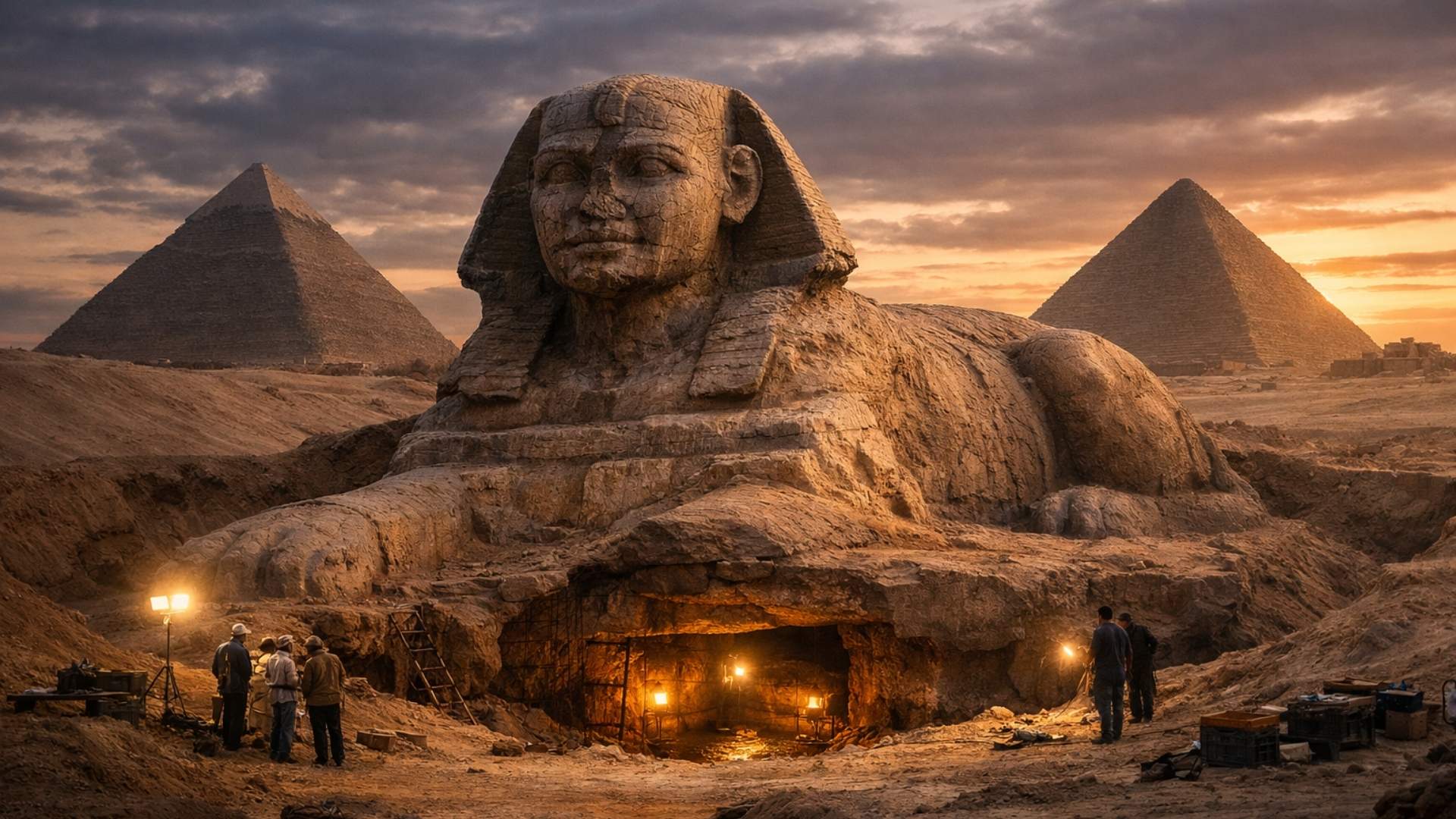
Subterranean structure detected by radar reignites debate over possible hidden monument in Giza, with indications of cavities and geometric alignments still without official archaeological confirmation.
The hypothesis of a second Sphinx beneath the sands of Giza has returned to the center of archaeological debate after Italian researcher Filippo Biondi claimed to have identified, through synthetic aperture radar, a large anomaly near the already known monument.
The reading, according to him, suggests a large structure associated with underground cavities and passages, but so far there has been no excavation, independent validation, or official confirmation from Egyptian authorities.
The new round of international attention arose after statements released on Matt Beall’s podcast at the end of March 2026, when Biondi linked the signals detected by satellite to a mound on the plateau that, in his assessment, does not behave like a common geological formation.
-
In China, the world’s longest road tunnel is 22 km long, cuts through a mountain that has challenged engineers for 70 years, includes a 706 m ventilation tower, and reduces dangerous journeys from hours to just 20 minutes.
-
More than one million North Americans were ordered to close their windows and stay indoors because the air in the southern United States became so toxic that pollution levels reached 18 times above the World Health Organization’s safety limit.

-
China has accumulated up to 1.4 billion barrels of oil in strategic reserves, invested 25 years in renewable energy, and purchased 80% of cheap Iranian oil: how Beijing has prepared for decades for the crisis that is now shaking the world.

-
A single lake holds 20% of the planet’s non-frozen freshwater and is also the deepest and oldest on Earth.

The researcher stated he works with about 80% confidence in interpreting the data, but presented the estimate as his own reading, still subject to field verification.
What the radar detected beneath the Giza plateau
According to the account presented by Biondi, the scans show a buried mass with geometric similarities to the Great Sphinx, as well as vertical shafts and horizontal passages that would be distributed in a point of the plateau aligned with the main monuments of Giza.
In one of the statements that circulated, he stated: “We examined the first sphinx, all the pyramids, the junction between the sphinx and the pyramid of Khafre, and found vertical shafts and horizontal passages.”
Along the same lines, the researcher maintains that the supposed structure coincides with geometric correlations previously observed in his surveys.
The interpretation he presented also mentions a large subterranean void in a rectangular shape, which reinforced, among supporters of the hypothesis, the reading that the plateau would hold a more extensive monumental set than currently known.
So far, however, these elements remain in the realm of technical claim, without public archaeological endorsement.
The technology used by Biondi is not new in his research trajectory.
In 2022, he co-authored with Corrado Malanga an article in the journal Remote Sensing on the use of synthetic aperture radar tomography in the analysis of the Great Pyramid of Giza.
This work exists and has been published, but it does not equate to proof of a second Sphinx, nor does it serve, by itself, as confirmation of the new hypothesis raised.
Dream Stele and the idea of duality in Ancient Egypt
Part of the repercussion of the new hypothesis relies on the old discussion about the possibility of monumental symmetry in Giza.
In this context, the Dream Stele, installed between the paws of the Great Sphinx, is often cited by independent researchers and enthusiasts as an indication of iconographic duality.
The stele was erected by Thutmose IV and became famous for recording the episode in which the future pharaoh supposedly fell asleep next to the monument and received, in a dream, the promise of royalty if he freed the Sphinx from the sand.
The connection between this piece and the theory of the second Sphinx, however, is a matter of dispute.
Alternative readings see in the iconography of the stele a clue for a pair of monuments, but the predominant interpretation among specialists does not treat it as material proof of a buried twin sphinx.
The text of the stele, according to the reference bibliography, does not explicitly mention a second Sphinx.
This point is relevant because the discussion often mixes symbolic tradition and archaeological evidence.
The Great Sphinx was carved directly into the bedrock during the 4th Dynasty and is linked to the Khafre complex, alongside the valley temple and the pharaoh’s causeway.
In other words, the known monument integrates a well-studied architectural context, which raises the level of scrutiny for any new claims about neighboring monumental structures.
Lack of archaeological confirmation keeps hypothesis open
Despite the visual strength and historical appeal of the narrative, the central point remains unchanged: there is no archaeological confirmation of the existence of a second Sphinx in Giza.
The check published by the international press classified the claim as false at the current stage, highlighting that there has been no excavation, peer-reviewed study on this specific discovery, nor validation by Egyptian authorities.
The report also gathered assessments from experts who reject the reading as sufficient evidence of a new monument.
The contestation did not start now.
In April 2025, an independent verification had already refuted another wave of postings about supposed giant subterranean structures beneath the pyramids of Giza attributed to the same group of researchers.
At that time, specialists in the field considered the conclusions presented to be unfounded and questioned the methodological soundness of the material circulating on social media and in online videos.
Also weighing in this debate are the evaluations of archaeologists and Egyptologists who recall the long history of studies in Giza.
The area of the Sphinx and the pyramids has undergone decades of surveys, excavations, and analyses, which does not eliminate the possibility of new discoveries, but makes it unlikely to treat a remote indication as a settled fact before physical investigation.
This disconnect between instrumental reading and field verification explains why the specialized community has reacted with caution.
Still, the episode helps to show how the Giza plateau continues to mobilize science, public imagination, and narrative disputes.
The combination of orbital technology, bold hypotheses, and monuments surrounded by historical gaps tends to accelerate the circulation of broad versions, especially when the theme involves subterranean passages, empty spaces, and monumental alignments.
In the current case, however, the most important data is not the promise of a transformative discovery, but the actual stage in which the information stands: a hypothesis released by a researcher, without material confirmation and under strong specialized contestation.
If authorized excavations and independent analyses advance on the indicated point, the debate could shift to a new level.
Until then, the story of the so-called second Sphinx remains a possibility under discussion, and not an established landmark of Egyptian archaeology.






Seja o primeiro a reagir!