





 Portuguese
  English
  Spanish
  4 min of reading
  0 comments


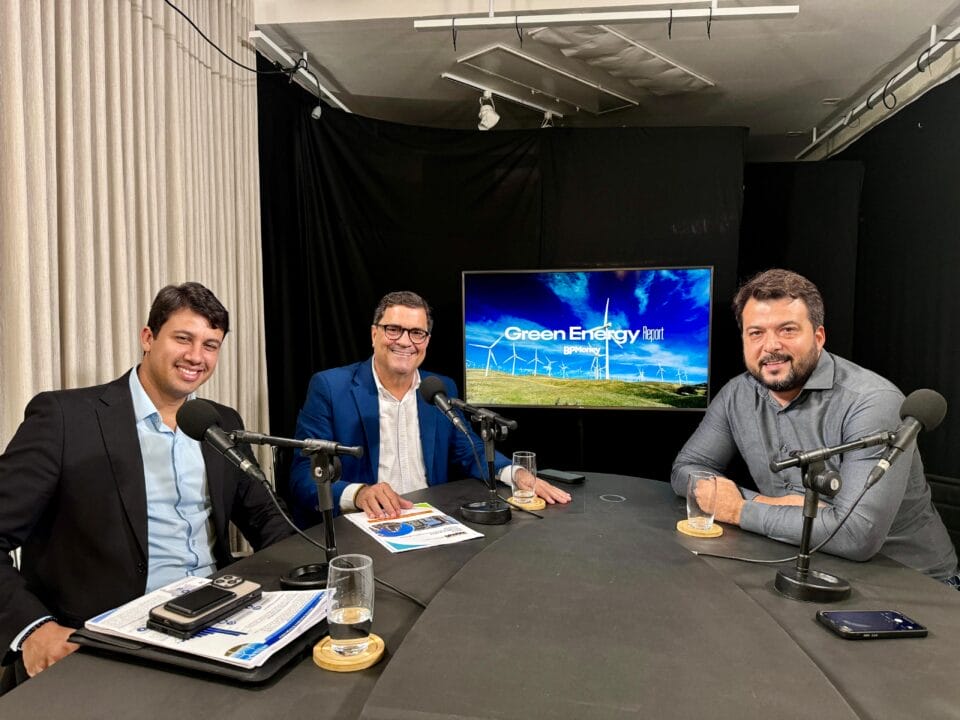
The Manager Said on the Green Energy Report Podcast That the State-Owned Company Needs to Engage More in the Hydrogen Agenda
European countries do not have the winds that we have. They do not have the solar radiation that is a hallmark of almost all northeastern states; yet, they are much more advanced in developing the fuel of the future: green hydrogen. Concerned about this reality and the possibility that Brazil – particularly the northeastern states – may miss this enormous window of opportunity, the Secretary of Economic Development of Bahia, Ângelo Almeida, proposes the participation of Petrobras, as a state arm, to drive this development and boost investments. But not only that: Almeida proposes that the state-owned company create a subsidiary focused entirely on the development of renewable energy.
The manager stated that he sees the current state of national production with great concern, as he does not see an environment of converging actions, which, in his view, could imply a loss of opportunities generated by the very geographical conditions of the country. Almeida noted that despite Brazil’s conditions to advance, European nations, with fewer natural resources, are ahead.
“They do not have the winds that we have, they will never have. They do not have the solar radiation that we have – Northeast and Bahia – they will never have. They do not have the conditions that Bahia and the Northeast have, especially Bahia, to create that environment that is ideal for us to have the first green refinery,” declared Ângelo Almeida in an interview with journalist Gusmão Neto on the Green Energy Report podcast, from the BP Money portal.
-
Renewable energy advances over protected areas in Brazil, and a survey by the Energy Transition Observatory reveals silent impacts that challenge environmental conservation and pressure sensitive traditional territories.

-
Rio Grande do Sul accelerates energy transition: State invests in renewable technologies and consolidates decarbonization strategies and pathways to attract billions in new industrial investments.

-
With 160,000 m² of collectors, an area larger than 20 football fields, Silkeborg, in Denmark, hosts a solar thermal plant that heats 19,500 homes and could become the largest solar heating plant in the world.

-
A study reveals the expansion of renewable energy procurement in Brazil and shows how companies are taking advantage of opportunities to reduce expenses, ensure energy efficiency, and strengthen strategic environmental commitments.


“I view the issue of green hydrogen with great concern. I see that there is a lack of coordination. It is necessary to build an environment of harmony and dialogue with convergence: we are not perceiving this at the moment. This is a debate that must be followed by concrete actions, and we will not have concrete actions if we do not have, within this debate, a company, for example, like Petrobras,” pointed out Ângelo Almeida.
The secretary noted that he is not the only voice calling for greater participation of Petrobras in the green hydrogen market. “I have seen and followed, coincidentally, a fellow countryman of ours, Deyvid Bacelar, coordinator-general of Fup [Unique Federation of Oil Workers] who is practically speaking alone and he is calling on society and Petrobras itself to engage and begin to present more effectively projects that, for now, have very little adherence and are very timid,” said Almeida.
Our thesis is that Petrobras should have a disruptive outlook and believe in the power of innovation. Innovating, creating a subsidiary, a new company, an arm of Petrobras that is directed towards fostering and bringing the innovation and incentive policy for the construction of a large park, a large clean energy plant, solar and wind energy, which we have abundantly in Bahia. […] There is no public policy aimed at innovation anywhere in the world that has been made without government participation. The state is there for that: no one will innovate with their own money. Innovation and risk-taking come with government funds. […] This investment must come from the state, and Petrobras is the arm [of the state]; the Brazilian state has the majority [of shares] and it should have this responsibility to make this leap in innovation and improve the quality of life of our people.
Ângelo Almeida, Secretary of Economic Development of Bahia
When discussing the Bahian scenario, he emphasized that the state has “a perfect storm, in the good sense,” a robust ecosystem that can position Bahia in a position to produce this fuel of the future as “the cheapest green hydrogen on the planet, in the world.”

Ângelo Almeida also commented on the need to increase the population’s knowledge about sustainable economics. “People still do not know what a green economy is. The notion is very limited that the green economy will bring to our state and to northeastern Brazil the conditions for sustainability and social development with great strength.”
The secretary compared the differences between Brazilian and European realities. “Any citizen today who goes through these European TV channels will witness a debate, and in almost all of these debates, there is a discussion about climate change, about the need for a just energy transition. Investments are already happening massively, regulations and regulatory frameworks are already being established in Europe, and we here are in the Stone Age,” he exemplified.





Seja o primeiro a reagir!