





 Portuguese
  English
  Spanish
  4 min of reading
  0 comments



Without Oil Exploration In The Equatorial Margin, Brazilian Production Faces Serious Risks Of Sharp Decline, May Reach Only 700 Thousand Barrels Per Day By 2052.
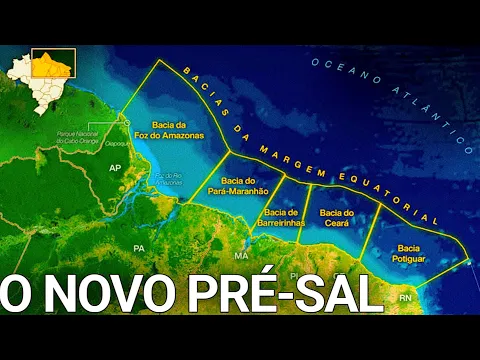
When we talk about oil exploration in Brazil, the pre-salt has always been the main star, being responsible for a large part of the current production. But a new protagonist is emerging on the horizon: the Equatorial Margin, also referred to by many as the “new pre-salt.” This region, which can be crucial for ensuring the country’s energy security in the coming decades, is at the center of a dispute between Petrobras and Ibama.
What Is The Equatorial Margin?
The Equatorial Margin is an area of great interest for oil exploration, located on the northern and northeastern coast of Brazil. Despite its enormous potential, no well has been drilled in the region so far. The main reason is environmental hurdles. The area was auctioned by the ANP (National Agency of Oil, Natural Gas and Biofuels) in 2013, but issues such as licensing and environmental protection have delayed exploration.
Interestingly, this region is often compared to the pre-salt due to its geological characteristics. Petrobras, which leads the development of projects in this area, believes that the Equatorial Margin can be the next major oil exploration hub in the country. However, without the approval of Ibama, everything remains stalled, and the forecasts are concerning.
-
A new Brazilian shopping center worth R$ 400 million will be built in an area equivalent to more than 4 football fields, featuring 90 stores, 5 cinemas, a supermarket, a college, and parking for 1,700 cars, potentially generating 3,000 jobs.

-
Larger than entire cities in Brazil: BYD is building a 4.6 km² complex in Bahia with a capacity for 600,000 vehicles per year, but the discovery of 163 workers in conditions analogous to slavery has shaken the entire project.

-
With an investment of R$ 612 million, a capacity to process 1.2 million liters of milk per day, Piracanjuba inaugurates a mega cheese factory that increases national production, reduces dependence on imports, and repositions Brazil on the global dairy map.

-
Brazilian city gains industrial hub for 85 companies that is equivalent to 55 football fields.



Brazil May Lose R$ 3 Trillion In Revenue And Stall Creation Of 300 Thousand Jobs
According to the Ministry of Mines and Energy, if Brazil does not open new fronts for oil exploration, such as the Equatorial Margin, the country may miss out on nearly R$ 3 trillion in taxes and royalties between 2032 and 2055. This amount would be crucial for the national economy, especially at a time of seeking new sources of revenue and job creation.
What makes the scenario more alarming is that, without new discoveries, oil production in Brazil may enter a sharp decline. Projections indicate that national production, which is expected to peak at 5.3 million barrels per day in 2030, could drop to 2.5 million in 2040 and plummet to just 700 thousand barrels per day by 2052. This places even more pressure on the need to explore regions like the Equatorial Margin.
Additionally, oil exploration in this region has the potential to create up to 300 thousand direct and indirect jobs, mainly in the North and Northeast of Brazil. However, as long as environmental licensing does not progress, these job positions also remain stalled.
Environmental Hurdles And The Role Of Ibama
Although oil exploration in the Equatorial Margin could be the salvation for Brazilian production in the coming decades, the project faces environmental obstacles. The National Institute for the Environment and Renewable Natural Resources (Ibama) is the agency responsible for allowing or blocking exploration in the area. And so far, no decision has been made.
According to Clarice Coppetti, Petrobras’s director of corporate affairs, the company has already fulfilled all outstanding issues pointed out by the agency, including the implementation of a new wildlife protection base in Oiapoque, in the state of Amapá. The expectation is that Ibama will provide a response sometime in 2024.
On the other hand, Magda Chambriard, CEO of Petrobras, expressed frustration with the delay, stating that the company “has lost ten years” of exploration in the Equatorial Margin. According to her, licensing issues that were not resolved during this period are unlikely to have a quick solution.
Government Support For Oil Exploration
Despite the challenges, the Brazilian government, with support from President Lula, strongly advocates for oil exploration in the “new pre-salt.” The president has stated on several occasions that the country cannot forgo this opportunity. He even suggested that the government, Ibama, and Petrobras sit together to make a definitive decision about the future of this exploration.
Petróleo e gás da produção de exploração, Sylvia dos Anjos, reinforced the need to drill more wells to assess the region’s actual oil potential. According to her, the Equatorial Margin system is similar to that of the Campos Basin, where there are already several wells in shallow waters. She also highlighted that nearly 600 wells have already been drilled in the Equatorial Margin, with significant discoveries in Rio Grande do Norte and even at the mouth of the Amazon River.
A New Pre-Salt?
The Equatorial Margin is often referred to as the “new pre-salt” by industry experts. This is due to the fact that the region may have oil reserves comparable to those discovered in the pre-salt off the southeastern coast. If the forecasts are confirmed, exploration in the region could once again place Brazil in a prominent position in the international market, ensuring the country’s energy self-sufficiency.
However, uncertainty regarding environmental licensing and the lack of drilling make it difficult to predict when this production will actually begin. To ensure that the country does not miss this opportunity, Petrobras and the government need to expedite processes and find a solution to the challenges posed by environmental agencies.







Seja o primeiro a reagir!