





 Portuguese
  English
  Spanish
  5 min of reading
  0 comments


Partnership Offers 700 Free Positions in Technical and Apprenticeship Courses in Various Regions of the Country, with a 21-Month Contract, Signed Card, Benefits, and Certification Recognized by the MEC.
The National Service for Industrial Learning has opened 700 free positions for technical training and professional apprenticeship in various regions of the country, in partnership with Petrobras.
The program combines classes and supervised practice, with a 21-month contract, four-hour daily work schedule from Monday to Friday, signed card, and remuneration equivalent to the minimum wage for 20 weekly hours.
Registration is free and occurs from October 6 to 12, 2025.
-
Federal Institute launches free course on Inclusive Education for 100% online training and certificate from IFRO.

-
Federal Institute opens over 700 vacancies in free technical courses in Civil Engineering, Mechanics, Electrotechnics, Computer Science, and Nursing; see how to enroll and study at IFPB.

-
Become a professional in logistics, mechanics, computer science, chemistry, or gastronomy at the Federal Institute: Ifes opens more than 1,000 spots in free technical courses with selection without an exam.

-
Take a 100% online and free course at Itaú: Foundation releases 156 options with certificates, registrations open for all of Brazil, unlimited access, areas such as technology, education, and management, and a flexible schedule without tutoring.

Who Participates and How the Journey Works
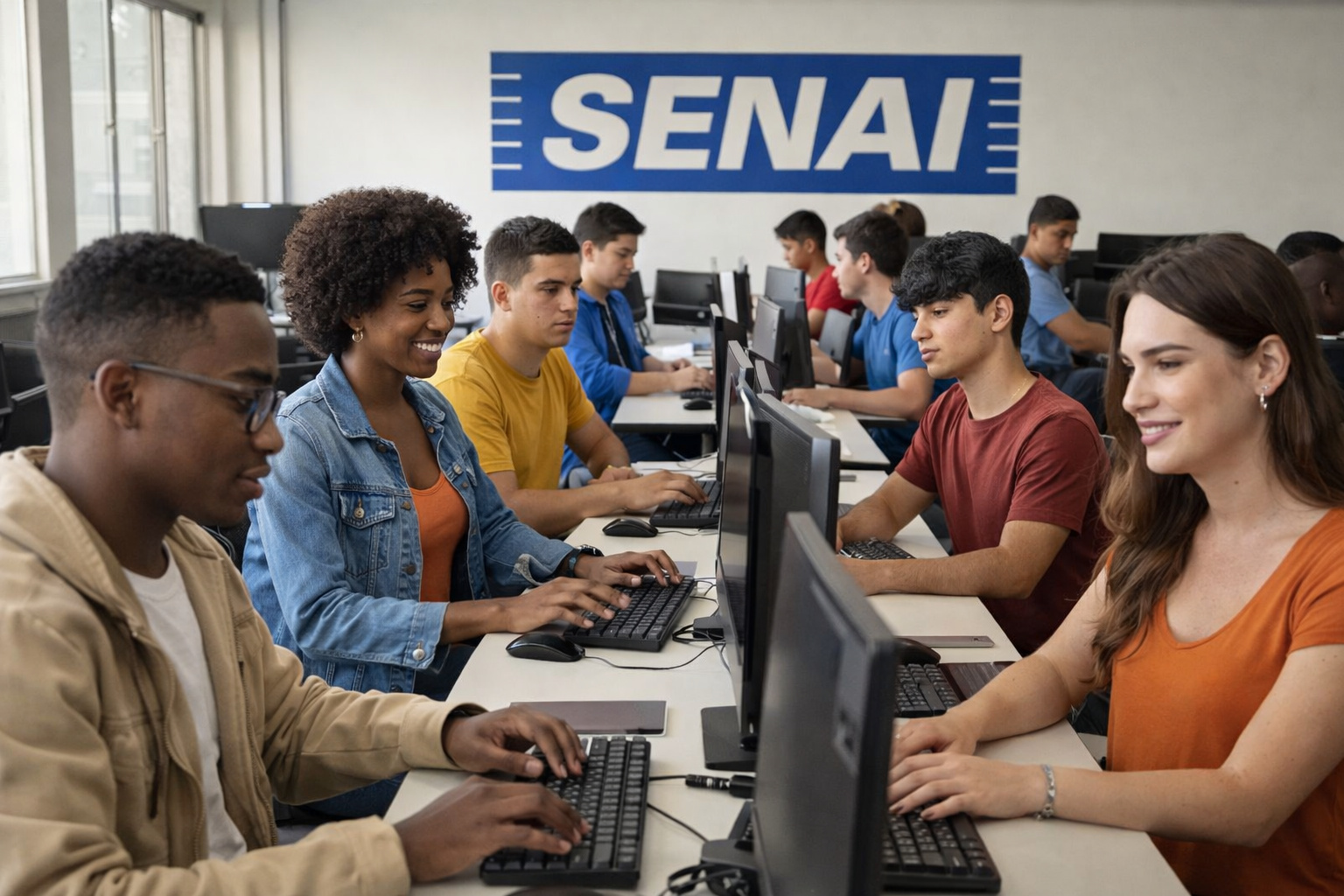
Aimed at young people at the beginning of their careers, the project selects candidates for classes that combine theoretical content and activities in a real work environment.
The bond is formal, with a work card registration, and provides for action in partner units throughout the entire training period.
Meanwhile, students fulfill a reduced workload in the shift defined by the school and the company, balancing studies and practice without exceeding four hours per day.
In addition to monthly remuneration, the program includes proportional vacation and 13th salary according to the Consolidation of Labor Laws.
The extended duration of the contract seeks to ensure sufficient time for mastering the content and developing the technical and behavioral skills required by the covered areas.
Cities with Openings and Training Centers
The opportunities are distributed across capitals and industrial hubs in different regions.
In Espírito Santo, offerings are available in Vitória and Linhares.
Classes are also planned in Manaus (AM), Salvador (BA), Fortaleza (CE), Recife (PE), Curitiba (PR), Natal (RN), Canoas (RS), and Aracaju (SE).
Additionally, Senai units in São Paulo and Rio de Janeiro participate in the initiative with additional classes in strategic cities of both states.
The distribution of openings by municipality and by course follows the installed capacity of each school and the local demand of the productive sector.
In some locations, the opening of classes may occur in phases, depending on the formation of minimum groups and the availability of laboratories.
Training Pathways: Apprenticeship and Technical Courses
The project encompasses two complementary pathways.
In professional apprenticeship, the training is focused on initial market insertion, with an emphasis on operational and support processes.
The technical courses deepen the scientific and technological foundation, preparing the student for more complex activities and operations in knowledge-intensive sectors.
Among the technical courses, itineraries are planned in industrial automation, electrotechnics, mechatronics, chemistry, petrochemistry, system development, and renewable energy systems.
These areas dialogue with highly dynamic production chains and require constant updates, which justifies the emphasis on laboratory practices and the use of industrial equipment.
In professional apprenticeship, the options include training for maintenance mechanic, logistics assistant, welder, building electrician, administrative assistant, and technical support in IT.
These are occupations with recurring employability in industrial and service operations, covering maintenance, production, supply, customer service, and support routines.
Remuneration and Benefits Offered
During the training period, students receive remuneration equivalent to the minimum wage for a workload of 20 weekly hours, with monthly payments.
The formal relationship ensures vacation, 13th salary, and FGTS, in addition to transport vouchers according to legislation.
There is also a possibility of joining private pension plans and access to programs that promote physical activity offered by Petrobras.
The benefits structure seeks to reduce retention barriers, allowing students to maintain study routines without compromising basic commuting expenses.
Meanwhile, pedagogical monitoring and tutoring in the training units help develop competencies, workplace safety, and professional posture.
Certification Recognized by the MEC
At the end of the program, all participants complete with certification recognized by the MEC, which can be a technical diploma or a certificate of learning, depending on the course modality.
This national validation facilitates the continuation of studies and recognition by employers, valuing curricular contents aligned with technical standards, quality benchmarks, and safety requirements.
The certification adds to the practical experience gained throughout the contract, an element often considered in selection processes and career plans of industrial and service companies.
Strategic Areas of the Partnership
The cooperation between Senai and Petrobras directs efforts to productive chains with a strong demand for qualification, such as automation, electrotechnics, maintenance, and logistics.
In sectors with continuous processes, practical training guided by operational and safety standards is crucial.
In this context, the curricular design prioritizes the fundamentals of science and technology, reading and interpreting projects, instrumentation, applied computing, and quality concepts.
By bringing together school and industry, the proposal aligns the curriculum with the real demands of the factory floor and technical offices, emphasizing problem-solving, logical reasoning, and teamwork.
However, participation does not guarantee employment at the end; certification and practical experience enhance the competitiveness of graduates in future selections.
General Requirements and Selection Process
The participation criteria follow the usual rules of apprenticeship and technical education, focusing on young people interested in starting a professional journey in industrial and technology areas.
The distribution of vacancies considers the availability of classes and the candidate’s adherence to the profile of the chosen course.
The selection may involve stages such as analysis of registration information and, when planned, assessments applied by Senai units, respecting the program’s guidelines.
Specific information about documents, internal deadlines of each school, and possible additional phases must be consulted at the time of registration, before the definitive submission of the form.
How to Register
Registration is free and occurs from October 6 to 12, 2025, exclusively through the Petrobras Young Apprentice Program.
During this period, the candidate must choose the desired city and modality, check the prerequisites for each course, and fill out the registration carefully with attention to personal data, contacts, and academic history.
It is recommended to review the information before finalizing the submission and to monitor the provided email for communications about any subsequent stages.








-

-

-

-

-

-

128 pessoas reagiram a isso.