





 Portuguese
  English
  Spanish
  2 min of reading
  0 comments


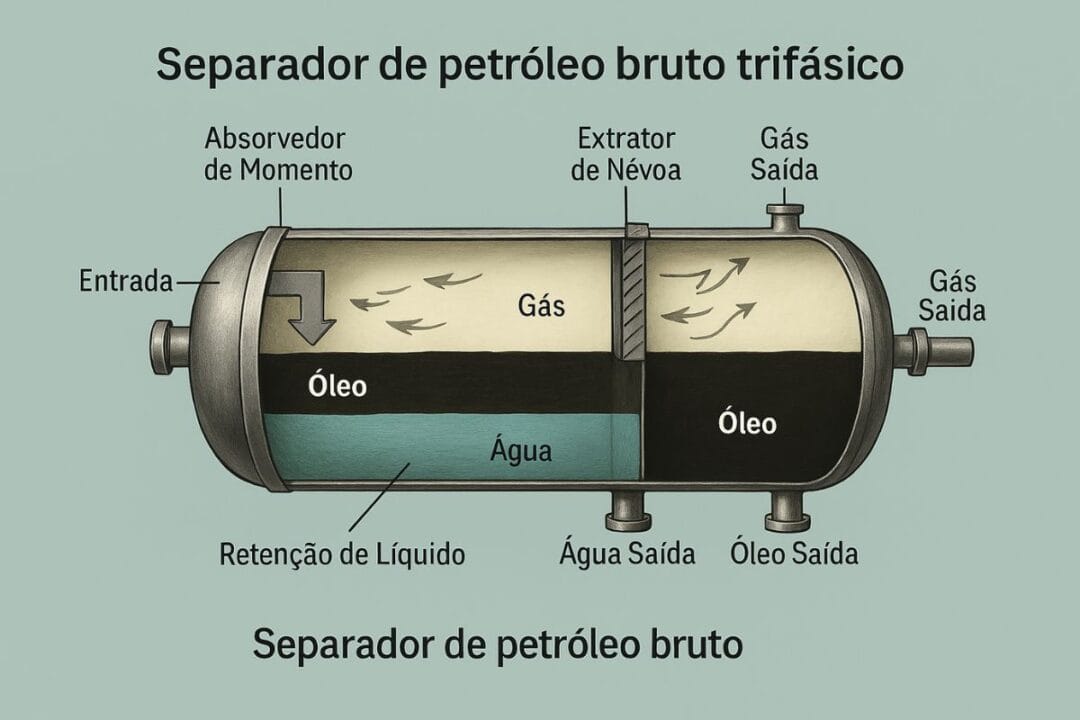
Essential Equipment in the Early Stages of Production, the Crude Oil Separator Reduces Impurities and Protects Industrial Systems
The crude oil separator is a key technology in oil and gas production. It acts immediately after extraction, automatically separating the three main components of the fluid: oil, natural gas, and water. This process occurs before any refining and ensures greater efficiency in the production chain.
The separation is done based on density differences. Gas rises, water descends, and oil remains in the middle. This way, it is possible to treat each fluid specifically, reducing operational risks and increasing the quality of the oil delivered for refining.
How the Crude Oil Separator Works
The fluid enters under pressure inside the equipment. Since gas is lighter, it quickly rises to the top. The crude oil separator contains a mist extractor that prevents liquid droplets from escaping with the gas.
-
Offshore industrial demand in Macaé skyrockets with the recovery of oil and gas and could grow by up to 396% by 2026 in the Campos Basin.
-
Offshore industrial demand in Macaé surges with the recovery of oil and gas and could grow by up to 396% by 2026 in the Campos Basin.
-
Brazilian giant expands borders in the Southeast: Petrobras confirms new oil discovery in ultra-deep waters in the pre-salt of the Campos Basin.

-
Alert in the global energy market: Severe tropical cyclone hits the coast and disrupts gas production at major plants in Australia, threatening global supply.


The oil, with intermediate density, is collected at a specific point, while the water is directed to the bottom. Valves controlled by sensors adjust the internal levels, ensuring that each fluid exits through the correct path without undesirable mixing.
In addition, a pressure control system maintains the balance of the separator, avoiding fluctuations that could compromise the efficiency of the process.
Types of Crude Oil Separators Used in the Industry
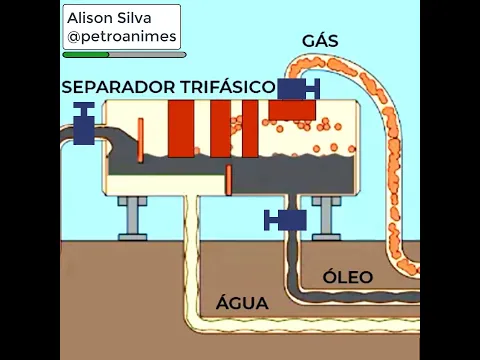

There are three main models of crude oil separators, each adapted to different production profiles. The horizontal type is ideal for wells with high gas volume, offering a larger area for separation. The vertical model is more suitable for fluids with high water content, commonly found in offshore platforms where space is limited.
The spherical separator, more compact, is used in operations with stable flow. Despite its lower separation capacity, its reduced structure facilitates installation in areas with limited space.
Technical Advantages of Using the Triphase Separator
The use of the crude oil separator improves plant efficiency, reduces the water content in oil, separates gas for reuse or sale, and protects subsequent equipment. By removing contaminants early in the production chain, the separator prevents corrosion, mechanical failures, and operational losses.
This equipment is particularly useful in Early Production Facilities (EPF) and wellheads, where oil arrives with a high load of impurities.









Seja o primeiro a reagir!