





 Portuguese
  English
  Spanish
  6 min of reading
  0 comments


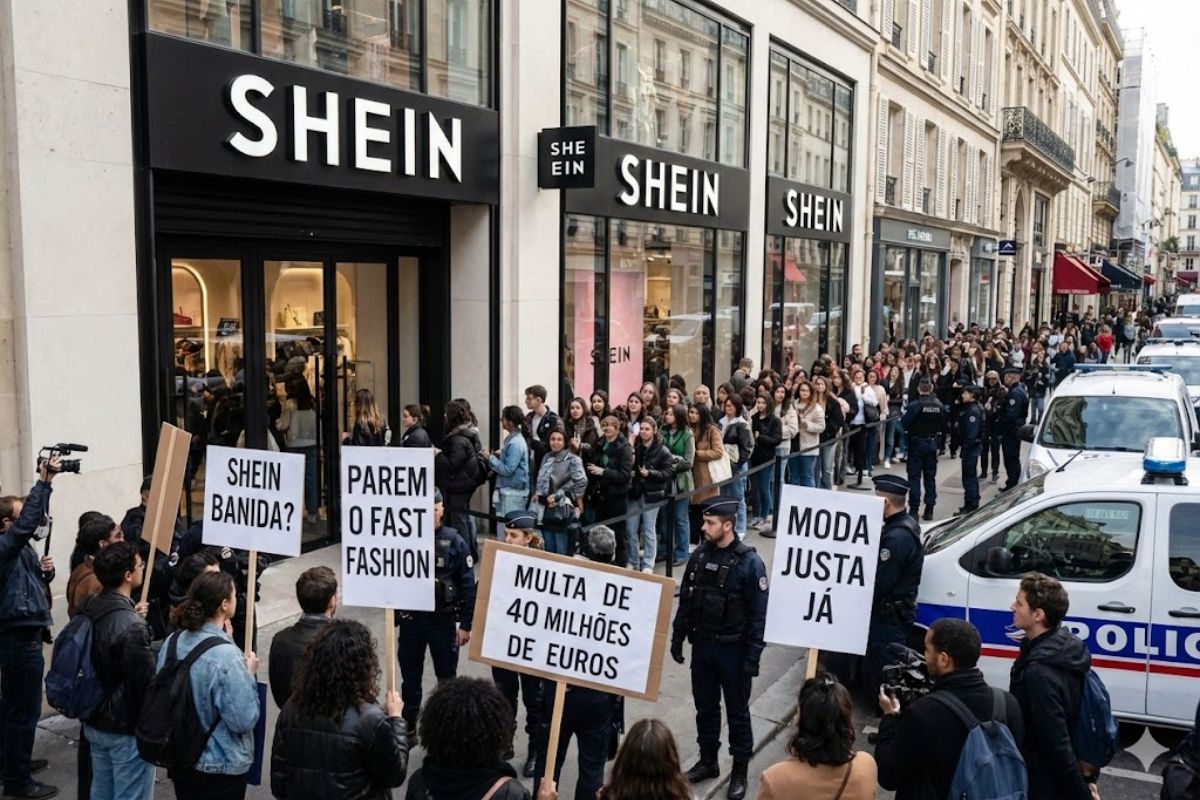
Shein Opens Physical Store at BHV Marais in Paris Amid Protests, €40 Million Fine and Legal Suspension Request, While Europe Discusses Extra €3 Fee Per Package and French Brands Fear Losing Space to Chinese Fast Fashion That Already Dominates Local Digital Sales
On November 5, 2025, Shein opened its first physical store in Paris, at the historic BHV Marais, and became an immediate target for protests, public criticism, and cell phone cameras. The inauguration turned the building into a symbol of a direct clash between Chinese fast fashion and the traditional French fashion industry.
Almost two months later, on the 19th, a Paris court rejected the French government’s request to suspend Shein’s platform. The brand continues to serve consumers while facing formal allegations, a €40 million fine and a growing public debate about its economic, social, and environmental impacts in Europe.
Paris Becomes Global Showcase for Shein
Founded in China and currently based in Singapore, Shein has built a digital empire selling ultra-cheap clothing to the entire world.
-
Brazilian city bets on the business environment to generate jobs and attract investments in the energy sector — secretary reveals strategy at Macaé Energy 2026.

-
50 viaducts, 4 tunnels, 28 bridges, and 40 kilometers of bike paths: BR-262 in Espírito Santo will receive 8.6 billion reais for the largest engineering project in the state’s history, inspired by the Immigrant Highway in São Paulo.

-
Brazil produces too much clean energy and doesn’t know what to do with it: over 20% of solar and wind capacity was wasted in 2025 while investors flee and 509 renewable generation projects were abandoned in the last year.

-
Piauí will produce a new fuel that replaces diesel without needing to change anything in the truck’s engine and reduces pollutant gas emissions by half: truck drivers from all over the Northeast are already celebrating the news that will arrive later this decade.


By choosing Paris, the birthplace of names such as Coco Chanel and Christian Dior, to host its first physical store, the company sought to gain legitimacy in the symbolic heart of European fashion.
The Shein store occupies the upper floor of BHV Marais, just a few minutes from the Notre Dame Cathedral. The space serves as a huge showcase for the brand within an icon of French retail, which annoys part of the local sector.
Ready-to-wear entities claim that the partnership weakens the image of French fashion, traditionally associated with luxury, quality, and pieces that last for years, not weeks.
Even so, the routine inside the store resembles that of any major chain. On ordinary days, only one of the ten cash registers is operating while consumers circulate among polyester dresses and synthetic leather jackets.
Many film videos for social media, and some admit they prefer to try on the pieces there and then buy from Shein online for an even lower price, reinforcing the integration between physical and digital.
Protests, Complaints, and Government’s Legal Defeat

Shein’s arrival in Paris triggered a political and legal offensive. Just before the inauguration, the anti-fraud service of the Ministry of Finance accused the company of selling child-like dolls on its marketplace, as well as the sale of weapons such as machetes and brass knuckles.
Under pressure from French lawmakers and retailers, the government requested a temporary suspension of the platform in the country.
The Paris court, however, deemed the measure disproportionate and rejected the suspension request in a ruling announced on the 19th.
Shein removed the questioned products, halted sales on the outsourced marketplace, and claims to have strengthened controls in partnership with French authorities. The government, in turn, announced it intends to appeal, keeping the open and politicized clash surrounding the company.
Inside the store, protesters occupied the space with posters against slavery and exploitation in the fashion industry, denouncing the social impacts of ultra-cheap production.
Images of the protests, recorded on the same day as the inauguration, circulated on social media alongside lines of customers, summarizing the dilemma: ethical indignation on one side, desire for cheap clothing on the other.
€40 Million Fine and Environmental Pressure
The legal battle is not the only problem. Shein had already been ordered to pay a €40 million fine for business practices deemed misleading by French authorities.
The sanction adds to recurring criticisms regarding environmental impact, textile waste generation, and working conditions at suppliers.
Environmental organizations point out that Shein ranks behind competitors in climate pollution indicators and volume of waste generated.
The strategy of launching thousands of new products every day stimulates immediate consumption, with low-value items that are quickly discarded.
Still, amid high living costs, many French consumers divide their wardrobe between cheap fast fashion and second-hand clothing purchased on digital platforms in an attempt to balance budget and conscience.
Chinese Fast Fashion Gains Ground in Clothing Sales
Even in a market historically dominated by European brands, Chinese e-commerce is already capturing a significant share in France.
Together, platforms such as Shein, Temu, and AliExpress account for a significant portion of clothing sold in the country and are advancing in revenue participation, edging closer to traditional chains like H&M and Zara in consumer recall.
Market research shows that about 10% of French people name Shein among the retailers they buy from most.
The secret lies in the combination of very low prices with an extremely aggressive cost structure.
In a context of tight household budgets, recent inflation, and pressured wages, consumers tend to prioritize lower values, even amidst doubts about social and environmental impacts.
This movement particularly pressures medium French brands. In recent years, a number of local labels have collapsed or closed their doors, unable to compete with the speed, volume, and price of digital platforms of Chinese origin.
Experts claim that this represents a structural change in retail fashion, not just a passing crisis.
Explosion of Packages from China and European Response
The transformation in consumption is also reflected in international order statistics. In 2024, the number of small declared packages entering France surged, totaling nearly 190 million units.
The average value was just over €3 per item, and the overwhelming majority of goods came from China, the source of a large part of Shein’s suppliers.
In light of this scenario, the French government has begun pressuring Brussels for a coordinated response. Among the measures under discussion is the creation of a temporary fee of €3 per small package, starting in July, as an interim step toward a permanent tariff scheduled for 2028.
The reform also aims to eliminate the tax exemption for purchases up to €150, a rule that allowed the explosive growth of companies like Shein in the European retail market.
For economists, the fight against Chinese fast fashion will not be won solely through awareness campaigns or appeals for ‘responsible buying’.
Without common rules on taxation, traceability, and environmental standards, foreign platforms will continue to operate with significant competitive advantages over established brands in Europe.
French Fashion Between Sovereignty, Low Prices, and Industry Future
Fashion and strategy experts see a dual challenge for France.
On one hand, a large part of the local industry has been slow to adapt to the digital age: many brands have not built robust e-commerce platforms or learned to use social media data to anticipate trends, while Shein has made this logic its central business model.
On the other hand, manufacturers insisting on shorter production chains and labels of ‘made in France’ face difficulties in achieving sufficient scale to provide minimally competitive prices compared to Shein.
Without volume, the cost per item remains high, expanding the space for imported fast fashion and undermining the appeal of locally made clothing.
Industry leaders claim that consumers have lost the sense of the real value of an item when they get used to finding t-shirts for €3.
For consultants, the solution involves a combination of tougher public policies requiring minimum environmental and social standards, along with programs for reindustrialization of the textile sector and a slow re-education of consumers about quality, durability, and cost.
At the same time, Shein is trying to reposition itself as a regulatory partner, promising to improve controls while keeping its core strategy intact: selling huge volumes at very low prices to an audience that continues to buy.
In the end, Shein’s first physical store in Paris has become an open-air laboratory: will Europe manage to defend its vision of responsible fashion and economic sovereignty without ignoring millions of people’s desire for cheap and immediate clothing?
Do you think that Shein should be limited by stricter rules in Europe or that the consumer should decide the brand’s future with their own money?








-

-

-

-

-

-

31 pessoas reagiram a isso.