





 Portuguese
  English
  Spanish
  4 min of reading
  0 comments


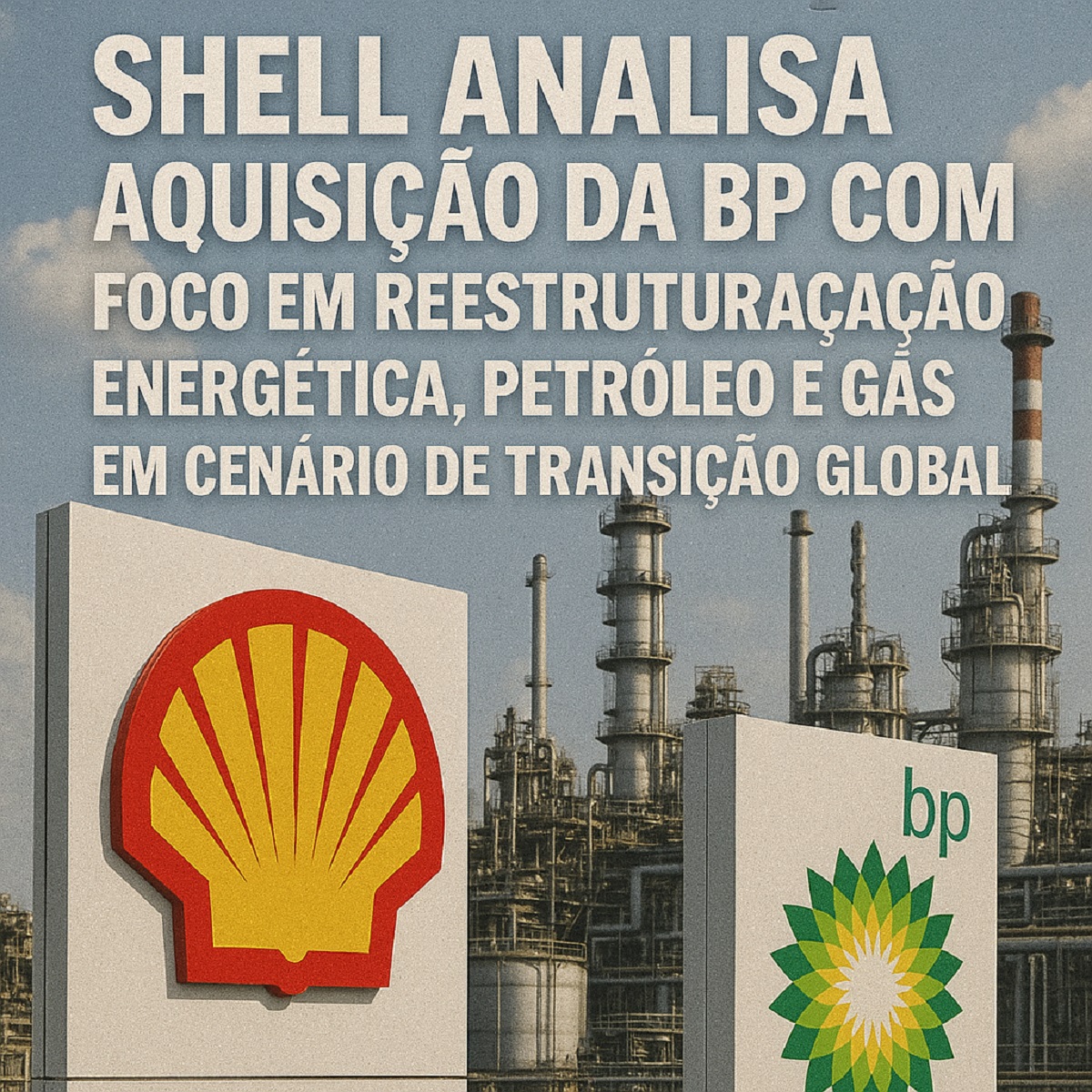
Article Explores Studies Initiated by Shell in April 2025 on Possible Acquisition of BP, Assessing Financial, Regulatory, and Environmental Impacts of the Operation
In April 2025, Shell began a preliminary analysis regarding the potential acquisition of BP, although it has yet to present an official proposal. The newspaper The Times reported the information, and Bloomberg News confirmed it shortly thereafter, based on sources close to the company. Consequently, company executives have been discussing this potential transaction as part of restructuring efforts in light of the transformations in the global energy sector. For this reason, the analysis team seeks to understand the possible financial, regulatory, and environmental impacts, without drawing hasty conclusions.
Market Context and Shell’s Internal Assessment
Since March 2025, BP’s shares have dropped over 12%, according to the London Stock Exchange, reflecting concerns about debt and returns. Meanwhile, Shell ended 2024 with a profit of US$ 28 billion, as stated in a financial report released in February 2025. Analysts believe that the asset merger could improve efficiency and enhance global presence, although there is still no official confirmation.
BP closed 2024 with US$ 45 billion in debts, according to an audited balance sheet. On the other hand, Shell maintained stable liquidity and cash generation, even with fluctuations in oil prices.
Despite this, the analysis does not indicate, at this time, a concrete acquisition decision.
Environmental Pressures and Adaptation to the New Energy Landscape
The global energy transition and climate goals influence strategic decisions in the sector. Since 2022, there has been an increased demand for investments in renewable sources and commitments to the Paris Agreement. In January 2025, the International Energy Agency reiterated the urgency of reducing emissions and expanding sustainable sources. BP maintains the “Net Zero 2050” program, announced in 2020, with investments in clean energy. Shell, for its part, revised its environmental goals in September 2024, lowering long-term ambitions, which drew criticism from environmental groups. The potential union between the companies does not currently have a direct relationship with climate policies. Any integration should consider existing regulatory obligations and ESG commitments. Experts emphasize that the merger could unite complementary strengths in energy innovation.
-
The rise in oil prices could ensure an extra revenue of R$ 100 billion for the Federal Government, indicates a recent economic study.

-
Naturgy begins an investment of R$ 1.6 million to expand the gas network in Niterói and benefit thousands of new residences and businesses.

-
A major turn in the Justice system suspends tax increases and directly impacts oil and gas companies in Brazil by affecting costs, contracts, and financial planning, leaving uncertain what could happen to the sector if these costs had increased.

-
Brava Energia begins drilling in Papa-Terra and Atlanta and could change the game by reducing costs in oil while increasing production and strengthening competitiveness in the offshore market.


Potential Impacts and Regulatory Limits of the Operation
The possible merger between Shell and BP is still under evaluation and depends on multiple legal and economic factors. If realized, it would represent one of the largest restructurings in the sector since 1999, when Exxon and Mobil merged. According to data from Statista, Shell and BP produced approximately 6.2 million barrels per day in 2024. This volume, combined with the global presence of the companies, would expand their operational capacity. However, the proposal may face restrictions from antitrust authorities in the European Union and the United Kingdom, especially in the context of market concentration. The impact on prices and competition will be analyzed by specialized regulatory bodies. The combined presence in over 70 countries requires careful assessment. Approval would depend on commitments to maintaining fair competition.
Legal, Environmental, and Governance Issues Under Discussion
The operation, if it advances, must comply with local and international environmental and legal requirements. Since 2023, Shell has faced environmental lawsuits in the United Kingdom and the Netherlands. On the other hand, BP has been increasing investments in solar and wind energy since 2021. These operational differences may be a point of analysis in potential negotiations. The operation is not confirmed and may be reevaluated at any moment. Transparency regarding the conduct of studies has been reinforced in an internal note from Shell, according to Bloomberg. Investors are awaiting formal updates before assessing practical consequences.
Industry Analyses and Timeline for Decision
Experts from The Guardian and Financial Times, between April and May 2025, indicated that Shell may follow alternative paths to the merger, such as strategic partnerships. According to an article published on May 6, 2025, by Nils Pratley (The Guardian), Shell may gain advantages even without a complete acquisition. Sources connected to Shell informed Bloomberg on May 3 that the analysis process is expected to be completed by the fourth quarter of 2025. The decision will be based on technical, financial, and regulatory criteria. Feasibility studies are underway, with no expectation of announcements in the coming months. Shell emphasizes that any decision will follow ethical standards and compliance.










Seja o primeiro a reagir!