





 English
  Francês
  Alemão
  Italiano
  Japonês
  Norueguês
  Portuguese
  Spanish
  5 min of reading


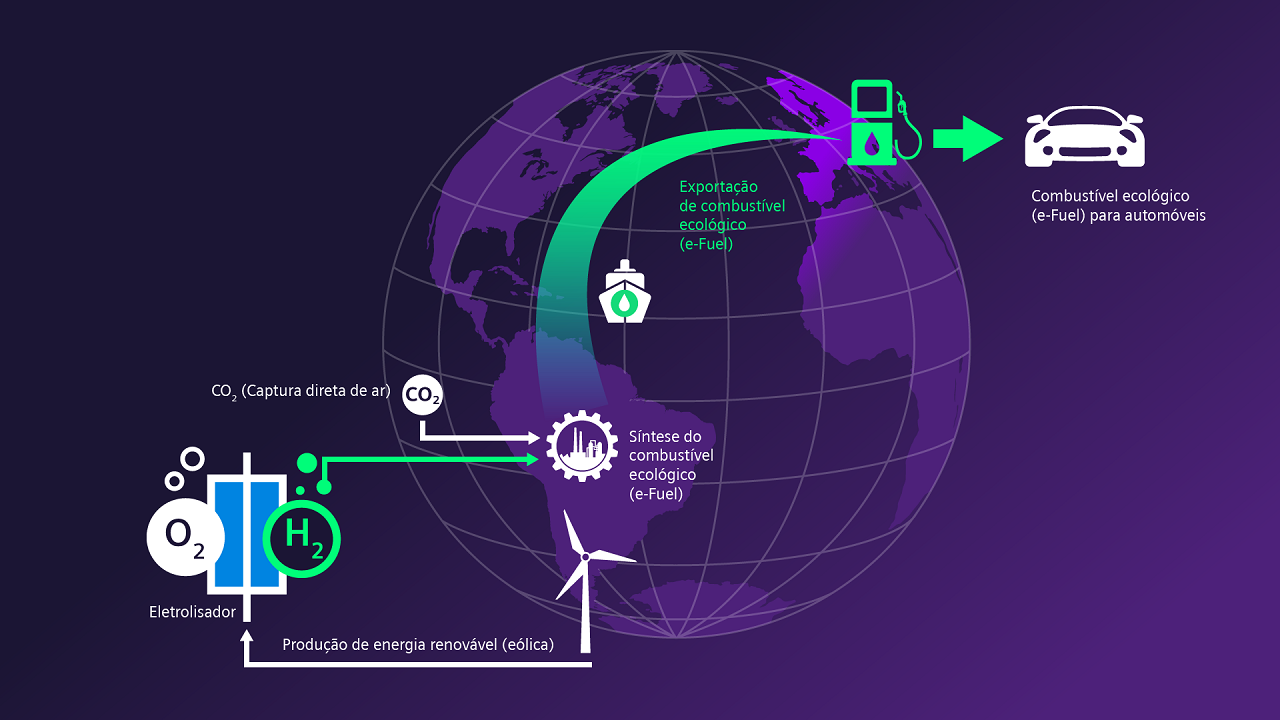
Siemens Energy, along with the sports car manufacturer Porsche and a number of international companies, is developing and implementing a pilot project in Chile to produce the world’s first integrated commercial plant on an industrial scale for the production of climate-neutral synthetic fuels (e-fuels). In the pilot phase, about 130,000 liters of e-fuels will be produced by early 2022. In two additional phases, capacity will be increased to around 55 million liters of eco-friendly fuels per year by 2024, and around 550 million liters of e-fuels by 2026. Porsche will be the main customer for the green fuel.
The other partners in the project are the energy company AME and the Chilean oil company ENAP, along with the Italian energy company Enel.
The pilot project “Haru Oni” in the province of Magallanes leverages the excellent wind conditions in southern Chile to produce climate-neutral fuel through green wind energy. As part of Germany’s national hydrogen strategy, Siemens Energy will receive a grant of around € 8 million from the Federal Ministry for Economic Affairs and Energy to support the project, as announced by the Ministry today.
-
Renewable energy advances over protected areas in Brazil, and a survey by the Energy Transition Observatory reveals silent impacts that challenge environmental conservation and pressure sensitive traditional territories.

-
Rio Grande do Sul accelerates energy transition: State invests in renewable technologies and consolidates decarbonization strategies and pathways to attract billions in new industrial investments.

-
With 160,000 m² of collectors, an area larger than 20 football fields, Silkeborg, in Denmark, hosts a solar thermal plant that heats 19,500 homes and could become the largest solar heating plant in the world.

-
A study reveals the expansion of renewable energy procurement in Brazil and shows how companies are taking advantage of opportunities to reduce expenses, ensure energy efficiency, and strengthen strategic environmental commitments.


Christian Bruch, CEO of Siemens Energy, states: “Establishing a sustainable energy-based economy will require us to rethink the matter. Renewable energy will not be produced only where it is needed, but also where natural resources, such as wind and sunlight, are available on a large scale. Therefore, new supply chains will emerge around the world to transport renewable energy from one region to another. This is especially important for Germany which, ultimately, needs to import energy if it wants to meet its domestic demand. Hydrogen will play an increasingly important role in storing and transporting energy. That is why the support from the German government for the project is an important signal.”
Oliver Blume, CEO of Porsche: “Electromobility is one of Porsche’s main priorities. E-fuels for cars are a valuable complement to this – especially if produced in parts of the world where a surplus of sustainable energy is available. This type of fuel is an additional element in the journey towards decarbonization. Its advantages lie in the ease of application: e-fuels can be used in both combustion engines and hybrid plug-ins, as well as for utilizing the existing network of filling stations. By using them, we can contribute even more to climate protection. As a manufacturer of efficient and high-performance engines, we have extensive technical expertise. We know exactly what fuel characteristics our engines need to operate with minimal climate impact. Our involvement in the world’s first integrated commercial e-fuels plant supports the development of the alternative fuels of the future.”
The Federal Minister for Economic Affairs of Germany, Peter Altmaier, states: “Hydrogen is a key component in successfully achieving the energy transition across all sectors. That is why, with the National Hydrogen Strategy, we aim to tap into the opportunities that hydrogen offers for the climate, energy, and economic policy. We know that we will not be able to meet our local demand solely with national production and will need international partnerships. Thus, I am very pleased to see that Siemens Energy and Porsche are developing their production capacities in other countries, along with import structures, for green hydrogen and its derived products. Thanks to German know-how, for the first time in the world, innovation coming from the lab will now be applied in an integrated commercial plant.”
Siemens Energy is co-developing the “Haru Oni” project (also known as the HIF project) and acts as a systems integrator to meet the entire value chain, from energy generation using Siemens Gamesa wind turbines to the production of green hydrogen and its conversion into synthetic fuel. The flexible PEM (PEM = Proton Exchange Membrane) electrolyzer system is ideal for utilizing volatile wind energy.
As the main customer of the fuel, Porsche plans to initially use the eco-friendly fuels from Chile in pilot projects. This includes the use of e-fuel in vehicles for Porsche’s motorsport activities, at Porsche Experience Centers, and possibly also in production sports cars. The sports car manufacturer will start with an initial investment of around € 20 million.
AME is the main developer and owner of the HIF (Highly Innovative Fuels) project company. Enel is a co-founder of the plant, focusing on wind energy and electrolysis. ENAP will support the project with an operations, maintenance, and logistics team.
Chile, with its excellent climatic conditions for wind energy and the associated low cost of electricity, has very high international potential for the production, export, and local use of green hydrogen. To generate green hydrogen, wind energy is used to dissociate water into its two basic components: oxygen and hydrogen. In a second step, the project requires filtering CO2 from the air to then combine it with green hydrogen to form synthetic methanol. The result is renewable methanol, which can be converted into climate-friendly fuel using MTG (Methanol to Gasoline) technology to be licensed and supported by ExxonMobil.
Siemens Energy is one of the world’s leading companies in energy technology. The company works with its customers and partners on energy systems for the future, thus supporting the transition to a more sustainable world. With its portfolio of products, solutions, and services, Siemens Energy covers nearly the entire energy value chain – from power generation and transmission to storage. The portfolio includes conventional and renewable energy technology, such as gas and steam turbines, hybrid plants powered by hydrogen, generators, and transformers. More than 50 percent of the portfolio has already been decarbonized. A majority stake in the listed company Siemens Gamesa Renewable Energy (SGRE) makes Siemens Energy a global leader in the renewable energy market. It is estimated that one-sixth of the electricity generated worldwide is based on Siemens Energy technologies. Siemens Energy employs 91,000 people worldwide in over 90 countries and generated revenue of about € 29 billion in the fiscal year 2019. www.siemens-energy.com.






Seja o primeiro a reagir!