





 English
  Francês
  Alemão
  Italiano
  Japonês
  Norueguês
  Portuguese
  Spanish
  5 min of reading
  0 comments


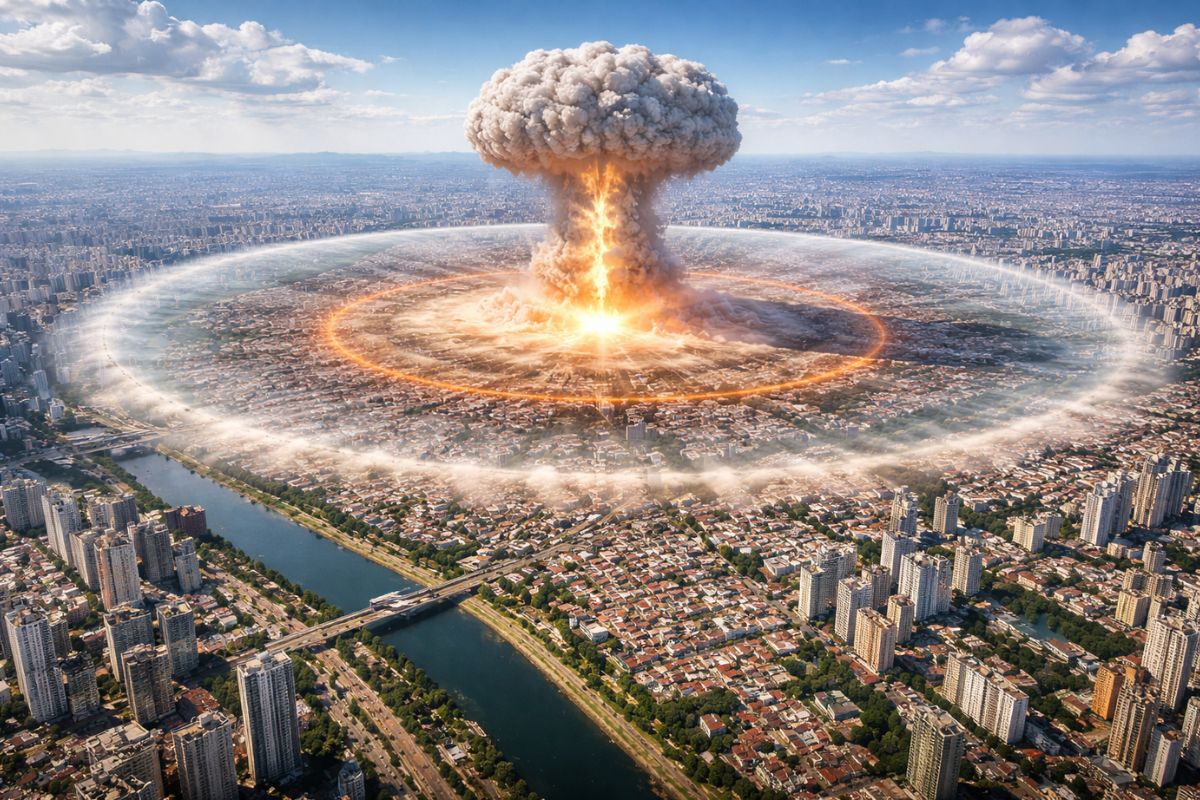
The simulated nuclear bomb over São Paulo projects extreme heat, a devastating shockwave, chain fires, intense radiation, and damage that can spread up to 20 kilometers in a hypothetical scenario of absolute impact.
The idea of a nuclear bomb hitting the largest city in the country is frightening because the effect is not limited to an isolated explosion. The scenario shows a sequence of almost simultaneous destructions, with an instant fireball, violent winds, mass burns, structural collapse, and enormous difficulty in response.
The strength of this type of simulation lies in showing that a nuclear bomb does not only hit the point of detonation. It transforms the surroundings into a chain of overlapping damages, where heat, radiation, fire, and physical impact accumulate in seconds and push the city into an extreme situation.
More than a visual exercise, this type of projection helps to gauge the real scale of the threat. What seems exaggerated at first glance gains concrete shape when observing the extent of the destruction, the potential for millions of victims, and the immediate collapse of urban infrastructure.
-
350-year mystery may have been solved: remains of a soldier who inspired the hero of The Three Musketeers found beneath a church in the Netherlands.

-
NASA photographed a nearly perfect square with 3 km sides on Mars, 13 times larger than the Great Pyramid of Giza, but the official explanation is natural erosion; still, no one has explained why the four sides have almost identical lengths.

-
Starlink breaks the barrier of 10,000 satellites in orbit and takes its expansion to an unprecedented level, with a direct impact on global internet, technological competition, and the race for space.

-
Japan finds an alternative to oil amid rising prices by transforming ocean balance into electricity with a new technology that maintains efficiency even when the sea changes.

Nuclear bomb triggers chain destruction
In the projected scenario, the nuclear bomb releases a gigantic amount of energy in a very short interval. From there, the effects spread almost simultaneously, hitting the air, buildings, people’s skin, and the entire logic of the city’s functioning.
This is the central point of the impact. There is no single primary damage, but a succession of catastrophic effects that make the destruction much broader than the common idea of a large explosion.
Fireball and extreme heat appear in the first seconds
One of the first effects of the nuclear bomb is the formation of a huge fireball over the affected area. Within a radius of about 1.3 kilometers, the extreme heat would turn the central region into an immediate combustion zone.
The thermal effect, however, would go much further. In much more distant areas, the energy released would still be enough to cause severe burns and ignite flammable materials. This expands the disaster far beyond ground zero, spreading severe damage across entire neighborhoods.
Shockwave knocks down structures and devastates the surroundings
Another decisive effect of the nuclear bomb would be the shockwave produced by the brutal expansion of superheated air. This pressure could destroy or severely compromise buildings within a radius of about 10 kilometers.
The physical impact would not be restricted to the center. Trees, poles, glass, facades, and urban structures would be violently thrown or broken. The city would simultaneously suffer from structural crushing, shrapnel, and mass displacement, dramatically increasing the number of victims.
Damage would extend over long distances
Even far from the central area, the nuclear bomb would still produce severe effects. The simulation considers that regions more than 20 kilometers away could also register significant damage, both in structures and in people exposed to heat and pressure.
This reinforces the metropolitan scale of the event. It would not be a disaster localized to a few blocks, but an urban impact of gigantic proportions, with repercussions on mobility, hospitals, energy, communications, and public response.
Mass fires would aggravate the collapse
With so much heat and so many scattered hotspots, the nuclear bomb would give rise to chain fires. The fire would not only arise at the point of the explosion but in various parts of the city almost simultaneously, driven by thermal radiation and the winds from the very detonation.
This scenario would make the disaster even harder to contain. When the entire urban environment begins to burn in sequence, the emergency system loses its capacity to react, and destruction continues to grow even after the initial impact.
Radiation would keep the risk active after the explosion
The nuclear bomb would also leave a lasting effect through radiation. Soil, concrete, dust, and structures could become contaminated, making staying and moving extremely dangerous in various areas.
Moreover, the cloud generated by the explosion could spread radioactive particles and cause this material to return to the ground later. The problem would not end with the explosion, as contamination would continue to threaten survivors, rescuers, and the urban environment.
Rescue would be compromised by failure and contamination
In such a scenario, the nuclear bomb would not only hit people and buildings. Electronic equipment, communication systems, and part of the technical infrastructure could also fail, hindering rescue coordination.
At the same time, radioactive contamination would limit the entry of teams into critical areas. The result would be a double blockage: many people needing help and little safe capacity to reach it, which would further aggravate the human toll of the disaster.
São Paulo appears as a symbol of the scale of the impact
Using São Paulo as a reference makes the scenario even more disturbing. Due to urban density, the size of the population, and the concentration of essential services, a nuclear bomb over the capital would represent a human and structural impact of extreme proportions.
The simulation makes this evident by projecting a collapse that is not limited to the area of the explosion. The entire city would enter rapid disorganization, with repercussions on transportation, medical care, supply, and public coordination.
The scenario serves as a warning about the real risk
In the end, the exercise with the nuclear bomb serves less to impress and more to gauge the real danger of these weapons.
By transforming numbers and physical concepts into a concrete urban scenario, it helps to understand why the debate on control and non-proliferation remains so important.
The main message is clear. The destructive capacity of nuclear weapons exceeds any conventional logic of war, and precisely for this reason, this type of weapon continues to be treated as a threat of civilizational scale.
Do you think simulations like this help the population better understand the real size of the risk of a nuclear bomb?






Seja o primeiro a reagir!