





 Portuguese
  English
  Spanish
  6 min of reading
  0 comments


Experts Reveal The Devastating Effects Of Radiation On The Human Body After Intense Exposure; Understand The Signs, Danger Levels, And How To Act To Survive
Would you feel the effects of radiation in minutes? Understand how the body reacts to different levels of nuclear exposure and what the most lethal symptoms are in the short and long term. The world has witnessed the horrors of radiation with Hiroshima, Chernobyl, Goiânia and, more recently, with nuclear threats involving Iran and Israel. But would you recognize the first signs of radiation contamination in your own body? This article, based on sources such as the Mayo Clinic, details the symptoms that appear minutes after exposure and how they evolve to death, as well as the chances of survival with or without treatment.
The term “Acute Radiation Syndrome” (ARS) may seem distant, but it is not exclusive to historical disasters. Industrial accidents, dirty bombs, military attacks with nuclear weapons, and even hidden radiological devices are current risks. With this in mind, this detailed guide can make all the difference between life and death in the event that you or someone close to you is exposed to high levels of radiation.
ARTICLE CONTINUES BELOWSee also
Friends have been building a small “town” for 30 years to grow old together, with compact houses, a common area, nature surrounding it, and a collective life project designed for friendship, coexistence, and simplicity.

This small town in Germany created its own currency 24 years ago, today it circulates millions per year, is accepted in over 300 stores, and the German government allowed all of this to happen under one condition.

Curitiba is shrinking and is expected to lose 97,000 residents by 2050, while inland cities in Paraná such as Sarandi, Araucária, and Toledo are experiencing accelerated growth that is changing the entire state’s map.

Tourists were poisoned on Everest in a million-dollar fraud scheme involving helicopters that diverted over $19 million and shocked international authorities.

The First Signs: When Your Body Begins To Collapse From Within
Radiation contamination causes changes in the body at different speeds, depending on the dose absorbed. The first reactions can appear within minutes, such as nausea, vomiting, headache, and dizziness. These initial symptoms do not indicate improvement if they cease after a few hours – on the contrary – they herald the beginning of the so-called latency period, a deceptive calm before the brutal worsening of the condition.

The faster these symptoms manifest, the more lethal the absorbed dose was. For example, vomiting within less than an hour after exposure indicates a dose greater than 2 Gy, which puts the patient at serious risk of death without intensive treatment. The intensity of the initial signs, combined with the timing of their appearance, is used by doctors to estimate the severity of the case.
During the latency period, which can last from hours to weeks, the patient may appear stable. But inside, the blood cells, digestive system, and brain cells are already degrading, in an irreversible process if there is no specialized medical intervention.
It is in this phase that many victims, without immediate access to help, end up neglecting the signs, believing they are out of danger. Unfortunately, spontaneous recovery is extremely rare in severe exposures.
In addition to physical symptoms, mental confusion, apathy, and disorientation arise, especially at doses above 10 Gy, where neurological functions are affected. This type of exposure almost always results in death within 24 to 72 hours, even with treatment.
The Three Radiation Syndromes: What Each Type Does To Your Body
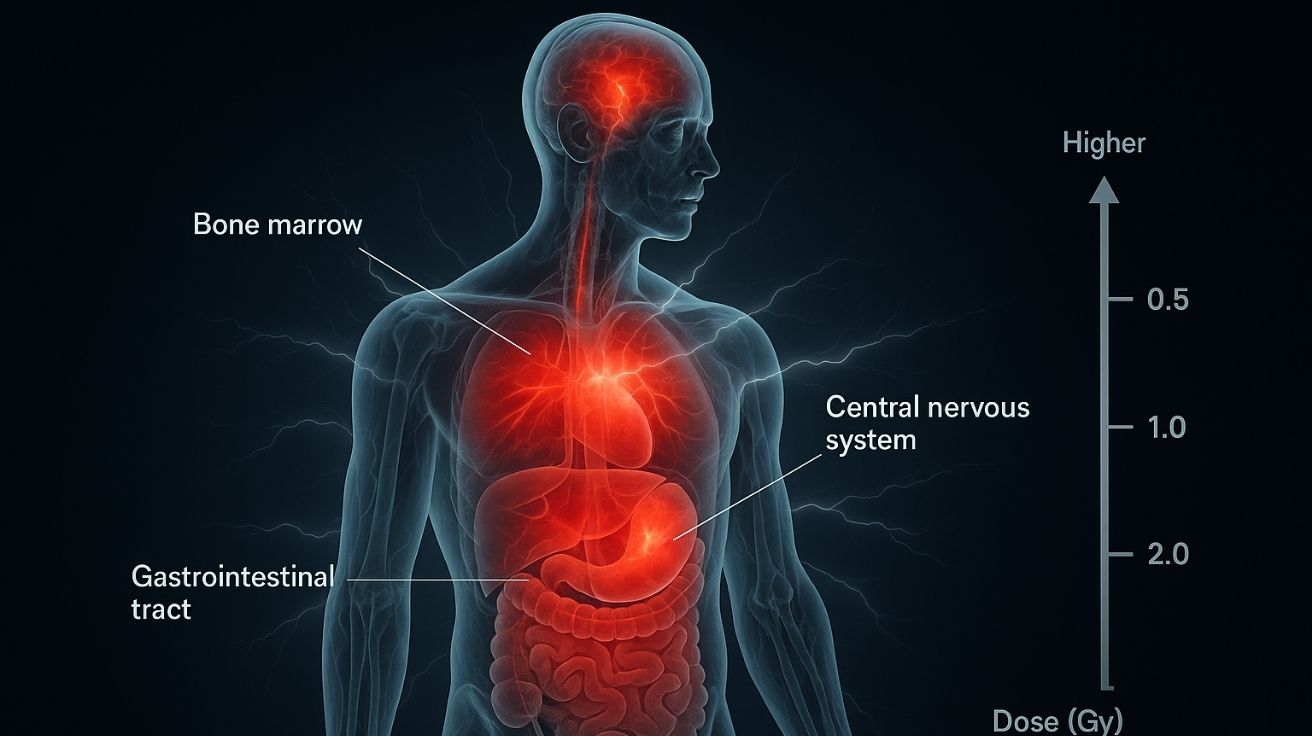
The hematopoietic syndrome appears with exposures above 0.7 Gy and destroys the bone marrow, causing decline of leukocytes, hemorrhages, and severe infections. Contamination is not visible to the naked eye but manifests as extreme fatigue, recurring fevers, and unexplained bruises.
With doses between 6 and 30 Gy, the gastrointestinal syndrome comes into play, one of the most aggressive. Radiation directly affects the digestive system, causing severe diarrhea, uncontrollable vomiting, internal bleeding, and severe dehydration. Without a bone marrow transplant or intensive support, death generally occurs between 7 and 14 days.
For exposures above 30 Gy, the body enters neurovascular collapse. The symptoms are devastating: tremors, seizures, loss of consciousness, and respiratory failure. Most affected individuals die in less than 48 hours, even with medical support.
Notable cases, such as Hisashi Ouchi in Japan, who survived 83 days after receiving 17 Gy, reveal the limits of modern treatment. He lost all of his skin, his organs collapsed, and even under intensive care, there was no viable cellular recovery.
The damage to the bone marrow stem cells and intestinal lining is what, in most cases, causes death from infection or multiple organ failure. These tissues are the most vulnerable as they are in constant regeneration.
Fractionated radiotherapy for cancers can use even higher total doses, but the difference is in the approach: treatments are divided over weeks, allowing the body to recover between sessions. On the other hand, exposure in accidents or attacks is massive and sudden, with no chance for adaptation.
Diagnosis, Prognosis, And Survival Rate
The diagnosis of radiation contamination is based on symptoms and tests such as absolute lymphocyte count in the blood. Abrupt reductions indicate significant exposure. The time between exposure and the onset of vomiting also serves as a marker.
The prognosis depends on the total dose and the duration of exposure. With less than 2 Gy, the survival rate is high. From 2 to 6 Gy, with specialized treatment, the rate drops to 50%. Above 8 Gy, survival chances are almost null.
Common complications even after recovery include cancer, infertility, cataracts, cognitive damage, and autoimmune diseases. The linear no-threshold model (LNT), still used by international agencies, states that any dose of radiation increases the long-term risk of cancer.
Psycho-social rehabilitation is also necessary. Victims develop post-traumatic disorders, fear of recurrence, social phobia, and depression, especially in scenarios of nuclear attacks or collective accidents.
In the cases of Goiânia (1987) and Chernobyl (1986), survivors have reported to this day devastating emotional effects, as well as social impacts such as stigma, abandonment, and job difficulties.
Therefore, medical follow-up must be multidisciplinary, including hematologists, infectious disease specialists, psychologists, and social workers for comprehensive support for the victims.
How To Protect Yourself And What To Do In Case Of A Nuclear Accident Or Attack
Prevention of radioactive exposure follows three principles: time, distance, and shielding. The less time exposed, the lower the dose received. Moving away from the source and protecting oneself behind dense barriers like concrete, soil, or lead are priority actions.
During emergencies, following the authorities’ guidelines is essential. If instructed to stay indoors, close windows and doors, turn off ventilation systems, and shelter in the most interior room possible, preferably one without windows.
If evacuation is necessary, take only the essentials: water, canned food, flashlight, radio, medications, extra clothing, and documents. Avoid bringing pets if heading to public shelters – they are generally not allowed.
The use of potassium iodide (KI) may help protect the thyroid gland in case of exposure to radioactive iodine, but it does not protect other organs or against other isotopes.
Personal protective equipment such as masks, gloves, and special clothing is useful in contaminated areas. However, they do not block penetrating gamma radiation, requiring additional shelter.
New technologies like the 360 Gamma Belt attempt to protect sensitive areas such as the pelvis, where a significant portion of the bone marrow is concentrated. These devices increase the chances of survival by allowing cell repopulation after the crisis.
Historical Cases And The Lessons Left For The Future
Throughout history, episodes such as those of Harry Daghlian (1945), Louis Slotin (1946), Goiânia (1987), and the Tokaimura accident (1999) have provided valuable lessons on the devastating effects of radiation exposure.
Harry Daghlian died 25 days after receiving 3.1 Gy, while Hisashi Ouchi died 83 days after receiving 17 Gy, losing all his skin and suffering from multiple organ failure. These records document the progression of ARS and the ineffectiveness of palliative measures at high doses.
The Hiroshima and Nagasaki explosions also provided important data. People within less than 1 km of the hypocenter absorbed up to 9 Gy, suffering rapid death or severe illness in the days following.
Chernobyl exposed firefighters and engineers to over 15 Gy, leading to death in less than two weeks. Survivors continue to face chronic health problems, infertility, and secondary cancers.
In Brazil, the case of Goiânia demonstrated the danger of orphan sources, abandoned or misplaced radiological equipment. Four individuals died after handling a cesium-137 capsule removed from a decommissioned hospital.
These events show that the risk of radiation did not disappear with the Cold War. On the contrary, with the growing threat of nuclear terrorism, industrial accidents, and regional conflicts, knowledge of the signs of contamination and protective measures is more vital than ever.










-

Uma pessoa reagiu a isso.