





 Portuguese
  English
  Spanish
  5 min of reading
  0 comments


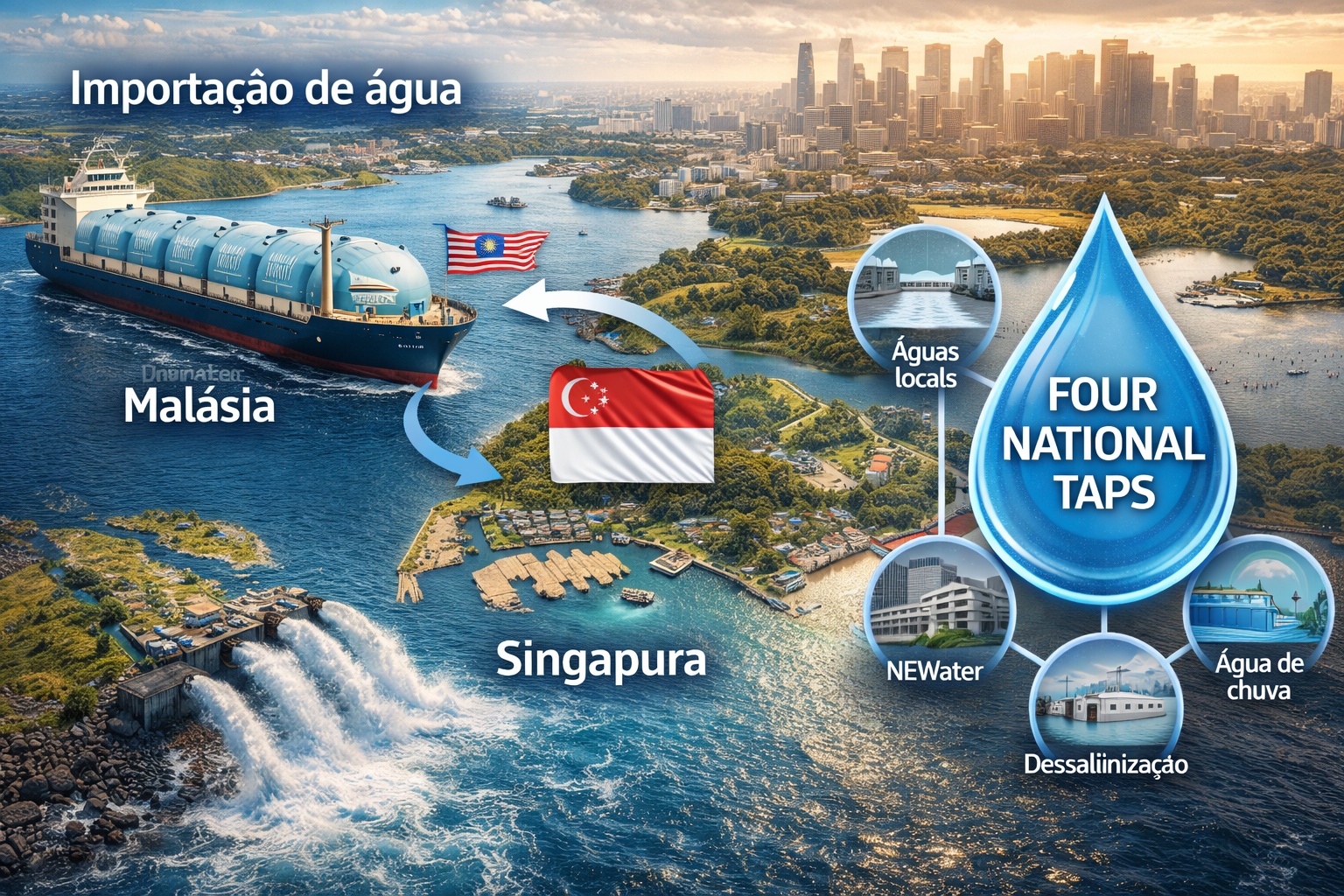
Singapore Recycles Wastewater to Drinkable Standards with NEWater, Which Already Supplies Up to 40% of the Country’s Water, Reducing Dependence on Malaysia and Becoming a Global Reference in Water Reuse.
Singapore, a city-state located in Southeast Asia, has built one of the most advanced water security strategies on the planet by transforming treated wastewater into high-purity water. The NEWater system, developed and operated by the national water agency Public Utilities Board (PUB), has become central to the national supply and today is responsible for up to 40% of the country’s total water demand, according to official data from the agency and international reports.
The project was born out of a historical vulnerability: the structural scarcity of freshwater natural resources and dependence on imports from Malaysia, as stipulated in bilateral agreements that remain in effect until 2061. Faced with population growth, accelerated industrialization, and geopolitical risks, Singapore decided to invest in advanced reuse technology as a strategy for economic and environmental survival.
Water Security in a Country Without Extensive Rivers or Relevant Aquifers
Singapore has no large rivers or extensive underground aquifers. Its limited and highly urbanized territory drastically reduces the availability of natural catchment. Historically, the country relied heavily on the importation of raw water from Malaysia, especially from the state of Johor.
-
Motorola launched the Signature with a gold seal from DxOMark, tying with the iPhone 17 Pro in camera performance, Snapdragon 8 Gen 5 that surpassed 3 million in benchmarks, and a zoom that impresses even at night.

-
Satellites reveal beneath the Sahara a giant river buried for thousands of kilometers: study shows that the largest hot desert on the planet was once traversed by a river system comparable to the largest on Earth.

-
Scientists have captured something never seen in space: newly born stars are creating gigantic rings of light a thousand times larger than the distance between the Earth and the Sun, and this changes everything we knew about stellar birth.

-
Geologists find traces of a continent that disappeared 155 million years ago after separating from Australia and reveal that it did not sink, but broke into fragments scattered across Southeast Asia.

To reduce this dependence, the government structured its water policy around four sources known as “Four National Taps”:
- Locally captured rainwater
- Water imported from Malaysia
- High-purity recycled water (NEWater)
- Desalination of seawater

Within this model, NEWater has evolved from an experimental project to a structural component of the national supply.
What is NEWater and How Does it Work Technically
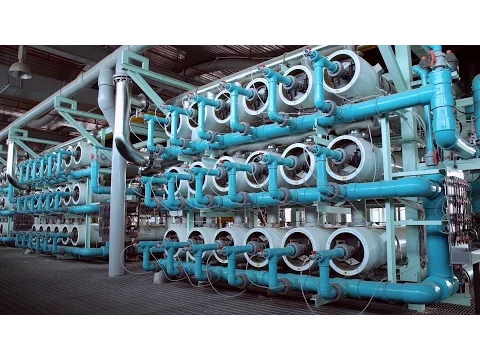

NEWater is produced from urban wastewater that has already undergone conventional treatment. This water is then subjected to a multi-barrier purification system, consisting of three main stages:
Microfiltration and Ultrafiltration
In the first stage, microfiltration membranes remove suspended particles, bacteria, and some viruses. The process uses controlled pressure to force water through filters with microscopic pores.
Reverse Osmosis
In the next stage, the water passes through reverse osmosis membranes that remove dissolved salts, heavy metals, organic compounds, and nearly all molecular impurities. This process is similar to that used in the pharmaceutical and electronics industries to produce ultrapure water.
Ultraviolet Disinfection
Finally, the water undergoes treatment with ultraviolet radiation as an additional barrier against any remaining microbiological agents.
According to the PUB, the result is water with a purity standard that exceeds international drinking water requirements established by organizations such as WHO.
Actual Supply Percentage and Future Goals
Official data indicates that NEWater currently accounts for up to 40% of the total water demand in Singapore.
The majority of this volume is used industrially, especially in the semiconductor industry and high-precision manufacturing, which requires water of exceptionally high purity.
The national plan envisions that by 2060, NEWater could supply about 55% of the country’s demand, further reducing the need for external imports and increasing resilience against climate change.
Reports from the World Bank categorize Singapore’s model as one of the most effective urban water management strategies in the world.
Reduction of Dependence on Malaysia
Imported water from Malaysia has always been a sensitive factor in bilateral relations. The supply agreements, signed in 1961 and 1962, guarantee supply until 2061 but have historically been subject to political debate.
The expansion of NEWater and desalination has allowed Singapore to gradually reduce its strategic vulnerability. Today, the dependence on imported water is considerably lower than in previous decades.
This movement is seen as a strategic step towards national water autonomy.
Desalination and Reuse: Energy Comparison
Although desalination is also an important part of Singapore’s water system, NEWater presents relative energy advantages.
Desalination requires significant energy consumption to remove salt from seawater. In contrast, the reuse of wastewater starts from a previously treated stage, which can reduce part of the energy cost per cubic meter produced.
The balance between these two technologies ensures operational redundancy in the system.
Public Acceptance and Communication Strategy
One of the initial challenges of NEWater was cultural. The idea of consuming recycled water faced public resistance in the early years.
To overcome this barrier, the government launched educational campaigns, public visits to treatment plants, and distributed NEWater bottles at national events. Technical transparency was a central part of the acceptance strategy.

Surveys conducted after implementation indicated a high degree of trust among the population in the system.
The industrial sector is the main consumer of NEWater. Semiconductor, electronics, and pharmaceutical industries require ultrapure water for their production processes.
By ensuring stable, high-quality supply, NEWater has also become a tool for economic competitiveness, strengthening Singapore’s position as a regional tech hub.
Climate Change and Urban Resilience
Global water stress has increased due to extreme events, precipitation variations, and rising temperatures.
Singapore, by not relying exclusively on rainwater, has created a system that is less vulnerable to climate variability. The continuous reuse of wastewater allows predictable supply generation, regardless of rainfall patterns.
This characteristic is often cited in international studies as an example of resilient water planning.
How Many NEWater Plants Are There?
Currently, Singapore operates multiple NEWater production plants strategically distributed across its territory. The combined capacity is designed to keep pace with population and industrial growth.
The plants are integrated into a continuous monitoring system that tracks physical, chemical, and microbiological parameters in real-time.
Quality and International Standards
Periodic laboratory tests are conducted by independent laboratories and audited by international entities. The quality of the produced water is comparable to that used in sensitive industrial processes and meets international drinking water standards.
Technical reports indicate extremely low levels of total dissolved solids and the absence of detectable pathogens.
Replicable Model?
Various countries are studying Singapore’s model, especially regions with chronic water scarcity such as parts of the Middle East, Australia, and the United States.
However, experts point out that success depends on institutional planning, investment in technology, public education, and a robust regulatory framework.
Singapore has built one of the most advanced water reuse systems in the world by transforming treated sewage into a national strategic resource. NEWater, responsible for up to 40% of the country’s supply, has reduced external dependence, strengthened water security, and established the country as a global reference in sustainable water management.
In a global scenario marked by increasing water scarcity, the Singaporean model demonstrates that technology, long-term planning, and integrated public policies can redefine the relationship between densely populated cities and their natural resources.








-

-

-

4 pessoas reagiram a isso.