





 Portuguese
  English
  Spanish
  3 min of reading


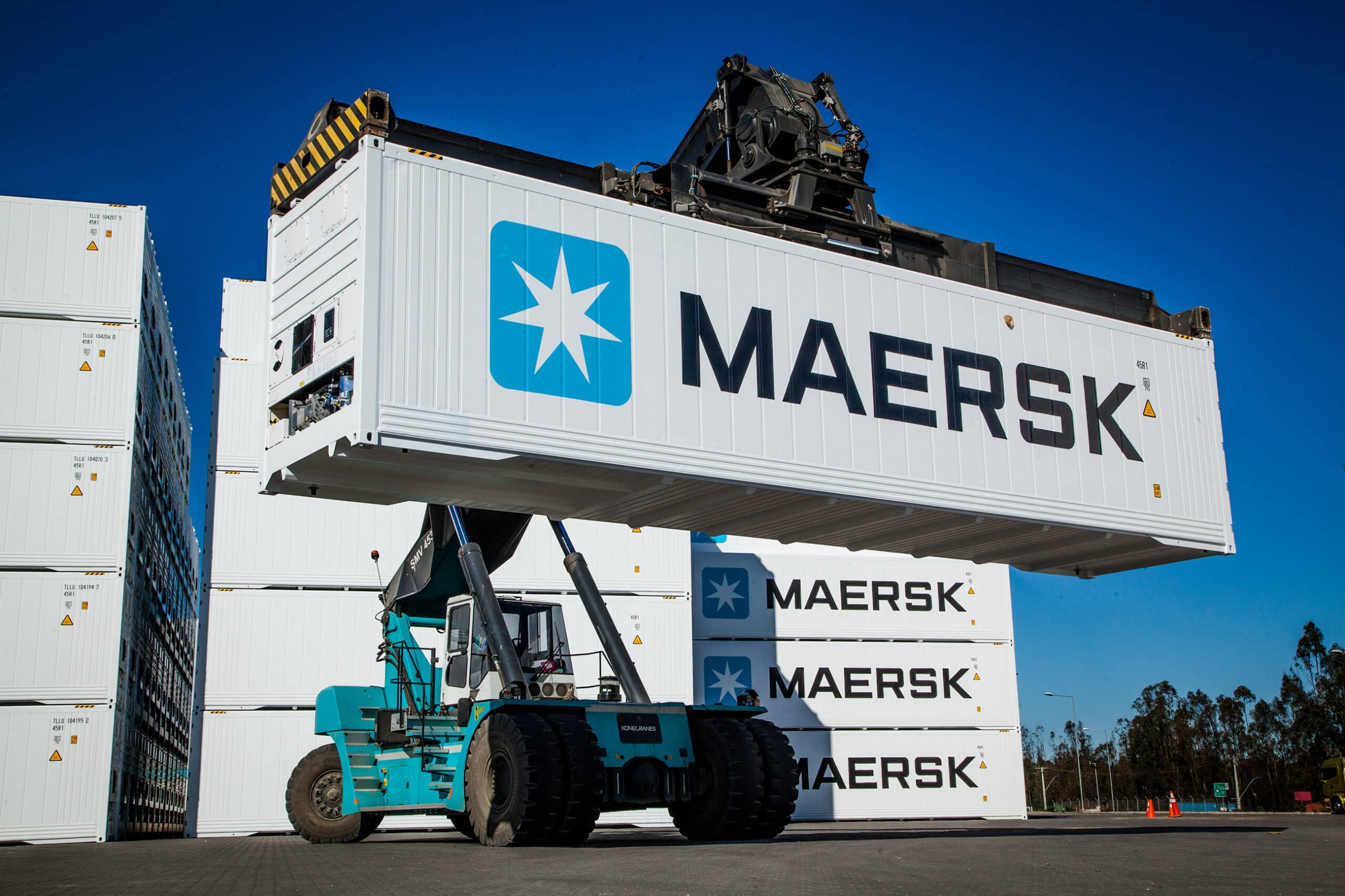
Remote Container Management Lets Customers of the Danish Company Monitor the Condition of Perishable Cargo in Real Time
A.P.Moller – Maersk, the largest Danish shipping company in the world, has a monitoring system for refrigerated cargo. The so-called Remote Container Management (RMC) allows customers to monitor the condition of perishable goods in real time. Thus, the quality of products is assessed continuously, generating a high level of efficiency and satisfaction among the more than 3,600 customers in the cold chain.
The Danes operate in the refrigerated container segment alongside Hamburg Sud. Maersk’s digital monitoring system (RCM) is installed in more than 380,000 refrigerated containers, providing information on temperature, humidity, CO2 emissions, and GPS location of the cargo, and notifies the customer if something needs attention.
“With Captain Peter (as the monitoring platform, which looks like a regular smartphone app, is called), we are significantly enhancing the customer experience of working with data and building the foundation to provide even more advanced features around it,” explains Maersk’s Digital Reefer Development Manager, Ken West.
-
The government requests the Federal Revenue Service for a new system to automate the income tax declaration, reducing errors, time, and bureaucracy for millions of Brazilians.

-
Pix in installments, international Pix, and contactless payment without internet: the Central Bank revealed the new features coming to the tool that is already used by almost every adult in Brazil.

-
Mercado Livre has just started selling medications with delivery in up to three hours to your door, and this move could completely change the way Brazilians buy medicines on a daily basis.

-
In Dubai, rising tensions from the war in the Middle East are causing super-rich individuals to leave the Gulf and direct their fortunes to a new financial refuge in Asia.


The main Brazilian ports from which refrigerated products are exported to the world are: Santos (SP), Itajaí (SC), Paranaguá (PR), Itapoá (SC), and Rio Grande (RS). The main destination for refrigerated cargo is China, followed by the Middle East, West Africa, and South Africa.
Numbers and Challenges of Refrigerated Cargo
Frozen poultry, cattle, and pork are the main products exported from Brazil in refrigerated containers, followed by concentrated juices and fresh fruits.
This year, the country exported beef to 132 countries. China alone purchased over US$ 3.6 billion of the meat, which represents an 86% increase compared to the same period last year (US$ 1.96 billion).
Regarding Brazilian chicken meat exports, more than 2.8 million tons were totaled this year. This figure is 6% higher than the total shipped in the same period of 2021 (2.6 million), resulting in US$ 5.620 billion.
Meanwhile, pork exports totaled 4,600 tons in 2022, which represents an average decline of 8.2% compared to the same period in 2021 (453,900 tons).
For many years, products transported in refrigerated cargo leaving Brazil spoiled in large quantities due to improper temperature or challenges with shipments.
Additionally, many refrigerated export companies are located in inland cities, where containers with perishable products are transported by train or truck, making it difficult to monitor all shipments with the level of complexity that such a large global operation implies. Therefore, the Remote Container Management implemented by Maersk is also expected to contribute in this regard.
Refrigerated Cargo Transportation: How Does It Work?
Refrigerated cargo transportation is known as reefer. Companies operating in this sector must comply with specific legislation. The regulations and laws require special practices regarding food temperature care, primarily.
In case of non-compliance, the cargo may be confiscated, leading to fines and other penalties depending on the severity of the case. Failure to ensure suitable packaging during transportation and storage of these foods can render them unsellable or pose serious health risks.
The reefer is a 20 or 40-foot container with a refrigeration system made of steel or aluminum. The equipment must have 10 centimeters of polyurethane thermal insulation and an internal finish in stainless steel. The refrigeration system includes a compressor, condenser, air intake, external controller, expansion device, and internal evaporator.









Seja o primeiro a reagir!