





 Portuguese
  English
  Spanish
  3 min of reading
  0 comments


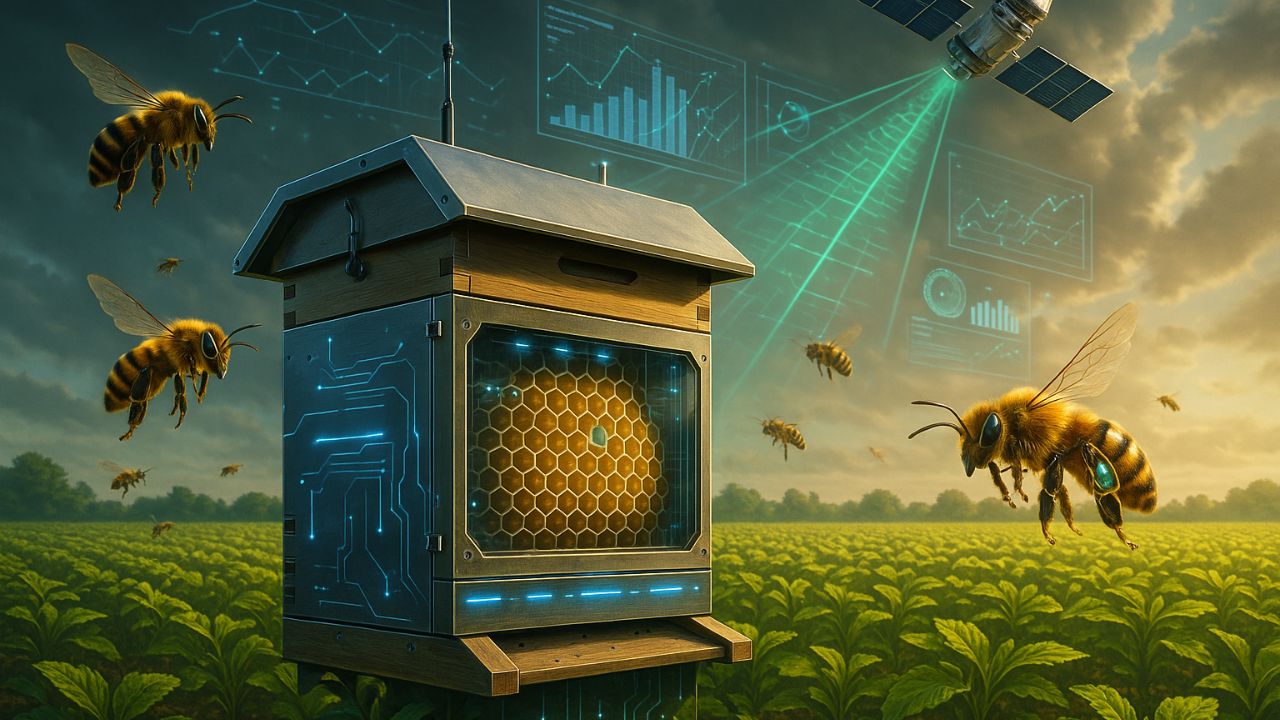
Advanced Technology With Satellite Monitoring Emerges as a Solution to Protect Pollinators and Ensure Crop Productivity on a Continental Scale.
The accelerated decline of bee populations poses a direct threat to food security and the global economy. To combat this crisis, a silent revolution is taking place in the field: smart beehives, monitored by sensors and connected via satellite, promise to transform beekeeping and secure the future of agricultural pollination.
The Billion-Dollar Impact of Bee Decline
The health of bees is directly linked to the stability of our food system. The global economic value of pollination is estimated at an impressive $500 billion annually. About 75% of the world’s food crops depend on these pollinators. The loss of these animals means, therefore, fewer fruits, vegetables, and seeds.
The problem is urgent. The annual loss rate of bee colonies has already surpassed 35%, an alarming number compared to the 3% from four decades ago. In Brazil, the situation is critical: in just five months, 500 million bees were found dead in four states. One of the major culprits is the improper use of pesticides, which, even in low doses, compromise the health and immune system of the colonies.
-
One of the most important lakes in the United States for birds, the balance of nature, and the climate has dried to historic levels, leaving boats stranded, revealing salt flats, and showing how the lack of water can transform an entire landscape.

-
It’s not Cristiano Ronaldo or Messi: the richest football player in the world is only 27 years old, has a fortune of 100 billion reais, and is the nephew of a sultan from an Asian country that few people know about.

-
At 77, the king of one of the most famous and powerful crowns on the planet is said to be under pressure to leave the throne, while behind the scenes there are already talks of a new coronation that could cost R$ 260 million.

-
Chinese researchers have created bamboo drones that fly with the same precision as conventional models and have released the flight control software for free to the entire world in a technology that could revolutionize sustainable aviation.


How the Smart Beehive Works Via Satellite
The technological response to this crisis is Precision Beekeeping. Instead of invasive and stressful manual inspections for the animals, management becomes remote and data-driven. The smart beehive functions as a “digital twin” of the colony, utilizing a set of technologies.
Internal sensors measure real-time temperature, humidity, and weight of the hive, vital indicators of health and productivity. Microphones capture buzzing sounds and, with the help of Artificial Intelligence (AI), identify stress or the absence of the queen. Cameras at the entrance monitor the flow of bees and can identify pests. Finally, an integrated GPS ensures the safety and location of the apiary. All this data is sent to the cloud, where algorithms analyze and generate alerts for the beekeeper.
Satellite Connectivity: The Key to Continental Expansion
The major barrier to smart beekeeping has always been the lack of internet in rural and remote areas where apiaries are located. The solution to this gap is satellite connectivity. Companies like the Spanish Sateliot are launching constellations of nanosatellites that provide 5G NB-IoT (Narrowband Internet of Things) connectivity from space.
This technology is the missing link. The satellite allows critical data and alerts, such as theft or declining colony health, to be sent from anywhere in the world directly to the beekeeper’s phone. This transforms a local practice into a centrally managed operation, allowing a single operator to oversee apiaries over vast areas. Satellite connectivity enables precision beekeeping on a continental scale.
The Era of “Pollination as a Service”
Technology not only optimizes the beekeeper’s work but also creates a new business model: “Pollination as a Service” (PaaS). Digital platforms, such as the Brazilian AgroBee (nicknamed “the Uber of bees”) and GeoApis, connect farmers who need pollination with beekeepers who have healthy, monitored colonies.
The data from the sensors serve as a verification mechanism. The farmer can remotely confirm the presence and activity of the contracted hives. Additionally, the platforms facilitate communication, allowing farmers to notify about pesticide applications so that beekeepers can protect their bees. A relationship that was once conflictual now becomes a partnership, with aligned incentives for both.
The Path to a Global Network of Pollinators
Despite the potential, large-scale implementation faces barriers. The initial cost of acquiring satellite technology is still high, and many producers have doubts about the return on investment (ROI). Moreover, beekeeping is a traditional activity, and adopting new technologies requires cultural change and training.
To overcome these challenges, strategies focus on low-cost solutions and innovative financial models, such as equipment leasing (Hardware-as-a-Service). Support from governments, through subsidies, and partnerships between the public and private sectors are essential. The vision for the future is to create a global network of smart beehives, functioning as a planetary ecological sensor to monitor the health of pollinators and ensure the sustainability of agriculture for future generations.





-

-

-

-

-

-

29 pessoas reagiram a isso.