





 Portuguese
  English
  Spanish
  6 min of reading
  0 comments


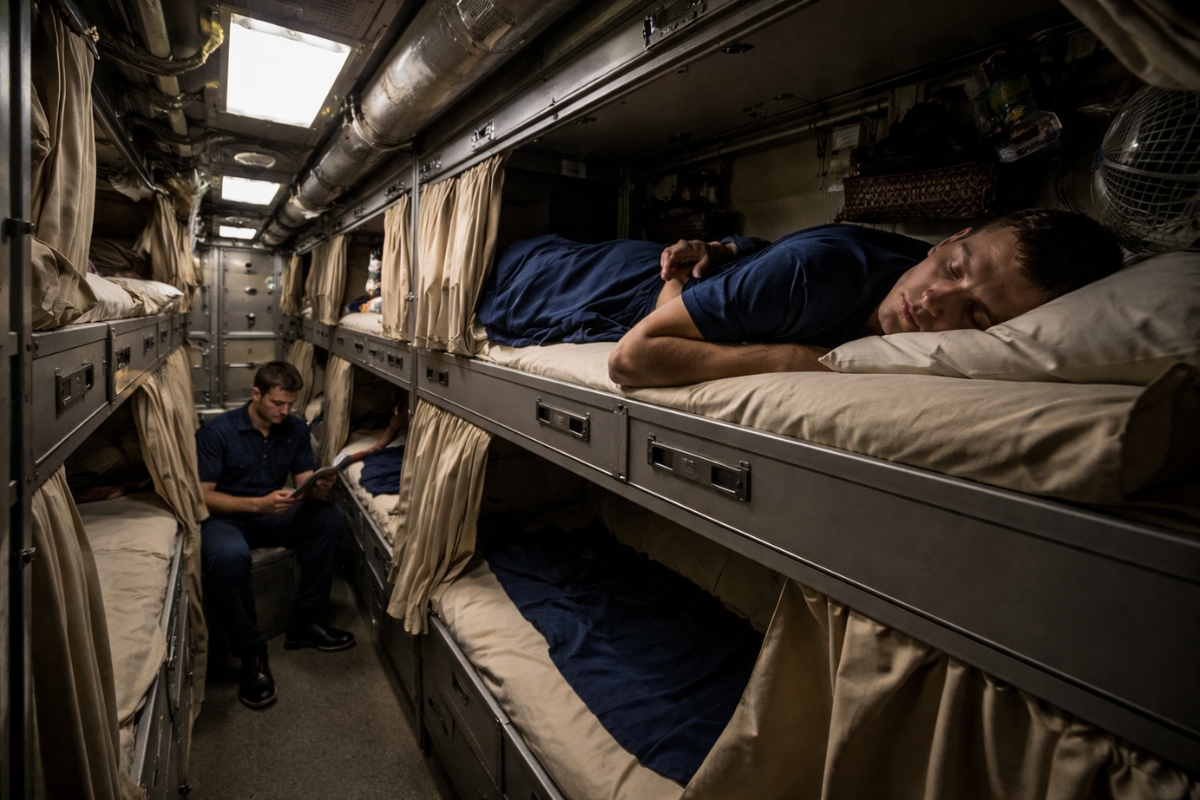
The USS Toledo Operated Under Ice In The Arctic With A Dive To 180 Feet And Showed How 140 Sailors Live In Continuous Shifts, With Minimal Space, Strict Control, And Silence That Becomes A Strategic Advantage
Living inside a nuclear attack submarine on a mission under ice means dealing with limitations at all times. Limitations of space, light, rest, and error. In the case of the USS Toledo, operating in the Arctic adds an even harsher factor: the surface ceases to be an escape route. The ice transforms the environment into a permanent ceiling and changes the decision-making pace, the routine, and the psychological weight of the crew.
Life on board does not revolve around comfort. It revolves around keeping the vessel stable, silent, and ready. The central goal is to sustain the ability to act undetected, as the submarine descends to depths like 180 feet in a theater where communication and emergencies operate differently.
Difficult Entry Already Shows The Control Pattern
Even embarking on the submarine reflects how everything is adjusted by the reality of the ice. Access was not through the traditional hatch because there was water over the hatch and the vessel was not high enough in the ice layer. The entry had to happen from the top of the vessel, descending through a narrow ladder.
-
This small town in Germany created its own currency 24 years ago, today it circulates millions per year, is accepted in over 300 stores, and the German government allowed all of this to happen under one condition.

-
Curitiba is shrinking and is expected to lose 97,000 residents by 2050, while inland cities in Paraná such as Sarandi, Araucária, and Toledo are experiencing accelerated growth that is changing the entire state’s map.

-
Tourists were poisoned on Everest in a million-dollar fraud scheme involving helicopters that diverted over $19 million and shocked international authorities.

-
Hidden beneath the dense forest of the Sierra Nevada, Betoma emerges in a neighbor of Brazil as the greatest archaeological discovery of the century, revealing a colossal ancestral city covering over 18 km², with 8,334 stone structures and the potential to rewrite the history of South American civilizations.

This type of adaptation is not a detail. It signals the first rule of the environment: standard procedures only apply as long as the area permits. In the Arctic, routines must be flexible, but control must be absolute.
Immediately after entering, circulation becomes guided. There are compartments that cannot be visited and routes that exist to preserve sensitive areas. Life aboard the submarine begins with discipline and continues with discipline.
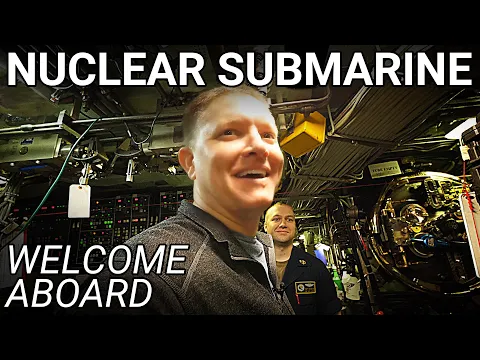

Minimal Space And Organization At Three Levels
The USS Toledo is organized into three levels. The upper level focuses on control and communications. The middle level houses living and dining areas. The lower level gathers engineering and weapon handling sectors, where teams associated with critical systems work.
This division is not only architectural. It defines how people move and how work flows. In a submarine, movement is not free. Every passage requires attention because corridors are narrow, doors are heavy, and equipment occupies what would be empty space on another vessel.
The crew must live and operate in a high-density structure. This makes simple rules, such as keeping areas unobstructed and respecting silence, go from being culture to becoming a condition for survival.
Continuous Shifts And Rest In Stacked Hammocks
One of the hallmarks of life on board is fragmented rest. At one point, it was explained that about one-third of the crew sleeps at any given time of day, while the others maintain the submarine’s operations.
The sleeping quarters reflect the real pattern. Hammocks stacked in rows, closed curtains, and uniforms hung outside. The goal is to reduce light, noise, and unnecessary movement. Privacy is minimal, and rest must be protected as an operational resource.
This model creates its own rhythm. There is no typical day as on land. There is a sequence of shifts and tasks, focused on keeping the vessel ready and able to respond to any changes.

Interaction In The Mess Hall And Routine Without Room For Improvisation
The crew’s mess hall appears as a central point of interaction and passage. It’s not just a place to eat. It’s where sailors cross paths, exchange quick information, and gauge the state of the vessel and the team.
The tone of the routine is pragmatic. Everything is compact, functional, and repeatable. Daily life is a sum of small procedures that avoid larger failures. This mindset supports missions where the crew cannot rely on external support.
In the Arctic, this weighs even more. If an incident occurs, surfacing to ask for help is not a quick decision. The ice eliminates the obvious escape route and requires the submarine to solve issues internally.
Internal Security, Restricted Areas, And Monitoring
Life on board is also marked by restrictions. Areas where access is not permitted were cited, including regions associated with the reactor and deeper sectors linked to the engine. This emphasizes how the submarine is segmented into zones, each with its own rules.
The use of a dosimeter to monitor radiation exposure is part of the protocol. The assessment indicated low levels, and it was explained that the flight to the region could expose more than the time spent on board.
In practice, this indicates a routine of constant technical control. Each risk is measured, documented, and managed. The submarine operates as a platform where safety is not just talk. It is routine.

Silence As A Way Of Life And As A Mission Tool
In an attack submarine, silence is not just a matter of etiquette. It is an advantage. The logic is to reduce signals and minimize patterns. Less noise, less active communication, and less emissions make it harder for adversarial forces to detect presence.
The commander described that specific missions are classified, but mentioned types of tasks for which the crew trains, such as tracking submarines, monitoring surface ships, gathering intelligence, and maintaining offensive capability.
The decisive point is that the submarine operates largely autonomously. On missions, communication is limited to preserve stealth. This shapes even how individuals live, as each person understands that an everyday mistake can lead to strategic exposure.
Depth, Pressure, And The Idea That There Is No Easy Way Out
During the operation, the submarine was taken to a stationary dive to 180 feet. The maneuver involves quick internal calls and sound signals, with depth adjustments that can generate noises from the hull expanding and contracting.
These sounds help illustrate the operational sensation. The environment is pressured from the outside, controlled from within. The crew must rely on procedures and training because there are no windows, no visual references, and no immediate surface.
Under the ice, the absence of the option to surface changes the psychology of the command and the crew. The submarine needs to function as a closed system, able to maintain stability and resolve problems in a chain reaction.
Chain Of Command And Qualification Culture Shape Daily Life
The life inside the submarine is sustained by a clear hierarchy and a culture of constant learning. A triad of leadership was described, consisting of the commander, executive officer, and chief of the vessel, along with a structure where officers manage and enlisted personnel execute specific specialties.
The qualification known as dolphins was introduced as a preparation milestone. The cited rule requires completion within 12 months, with many completing it in six to eight months, while officers may take about a year.
This requirement influences the routine as it necessitates continuous study and mastery of systems. The logic is simple: in an emergency, everyone needs to know how to act, not just in their roles, but for the vessel as a whole.
Human Scale And Discipline As A Strategic Factor
The number cited for the USS Toledo was 140 people on board, including about 13 officers. This demonstrates a large concentration of responsibility in a small space, with little room for individual error.
Life on the submarine during missions under ice is composed of disciplined repetition. Sleeping in stacked hammocks, eating quickly, moving carefully, studying for qualifications, and maintaining silence are not mere details. They are the foundation that supports the capacity to remain invisible.
In the end, daily life becomes strategy. The way the crew lives and operates is what enables the submarine to carry out long missions, maintain autonomy, and exert pressure on the surrounding environment.
It is this compact, silent, and controlled life that transforms presence into influence and changes the strategic reading.







-

2 pessoas reagiram a isso.