





 Portuguese
  English
  Spanish
  4 min of reading
  0 comments


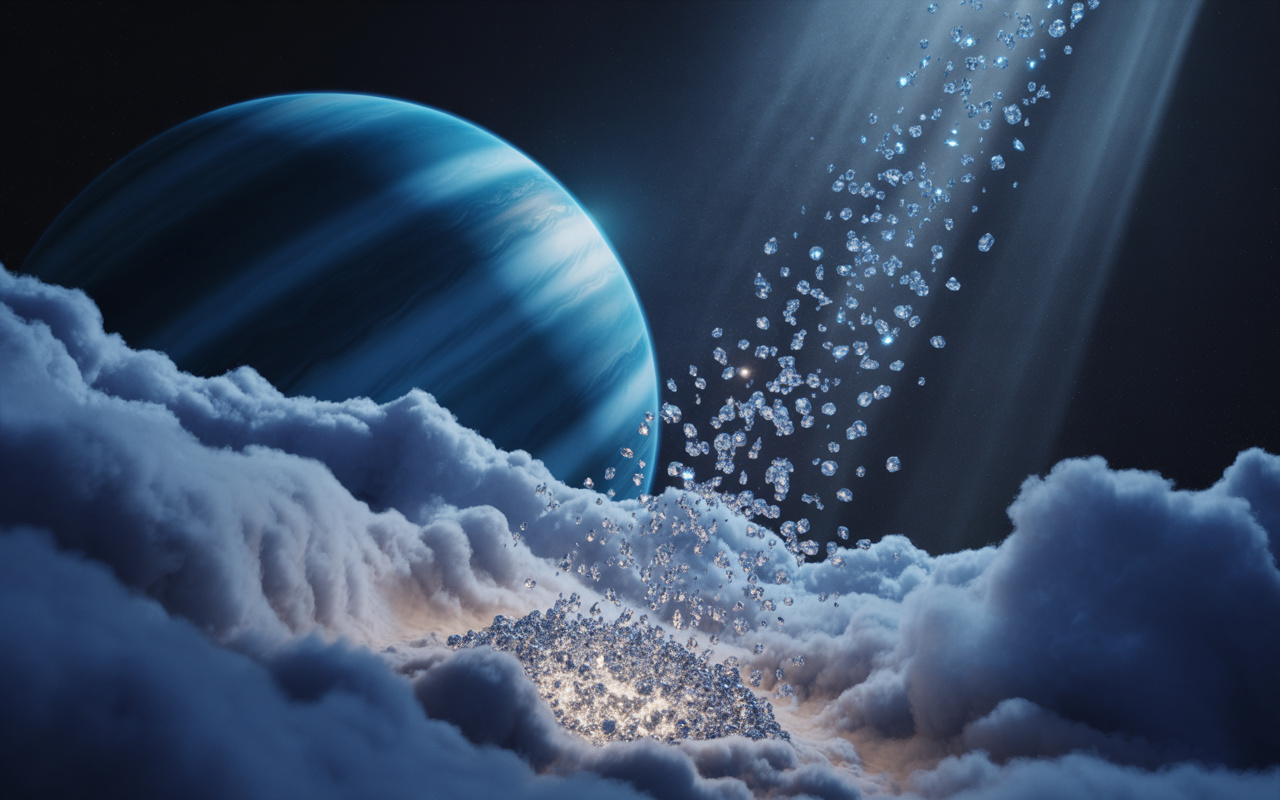
Few Know, But Under Pressures Above 1 Million Atmospheres, Carbon Becomes Diamond on Uranus and Neptune, Creating a “Rain” of Gems Confirmed by Experiments.
The idea seems straight out of science fiction, but it is solid science: on certain giant planets in the Solar System, diamonds literally form and “fall” into the depths. It is not a metaphor. Under extreme pressure and temperature conditions, the carbon present in the inner layers of these worlds undergoes a real physical transformation, crystallizing into diamond. This process occurs today, right now, in environments where everyday physics simply ceases to apply.
The main candidates for this phenomenon are Uranus and Neptune, the so-called ice giants. Unlike Jupiter and Saturn, dominated by hydrogen and helium, Uranus and Neptune have large amounts of carbon, oxygen, and hydrogen in their inner layers, exactly the ingredients necessary for diamond formation under extreme pressure.
Pressures So High They Break Human Intuition
To understand why this happens, one must look at the numbers. Inside Uranus and Neptune, pressures exceed 1 million atmospheres (over 100 gigapascals), and temperatures can reach thousands of degrees Celsius. Under such conditions, organic molecules rich in carbon — similar to methane (CH₄) — disintegrate.
-
Motorola launched the Signature with a gold seal from DxOMark, tying with the iPhone 17 Pro in camera performance, Snapdragon 8 Gen 5 that surpassed 3 million in benchmarks, and a zoom that impresses even at night.

-
Satellites reveal beneath the Sahara a giant river buried for thousands of kilometers: study shows that the largest hot desert on the planet was once traversed by a river system comparable to the largest on Earth.

-
Scientists have captured something never seen in space: newly born stars are creating gigantic rings of light a thousand times larger than the distance between the Earth and the Sun, and this changes everything we knew about stellar birth.

-
Geologists find traces of a continent that disappeared 155 million years ago after separating from Australia and reveal that it did not sink, but broke into fragments scattered across Southeast Asia.
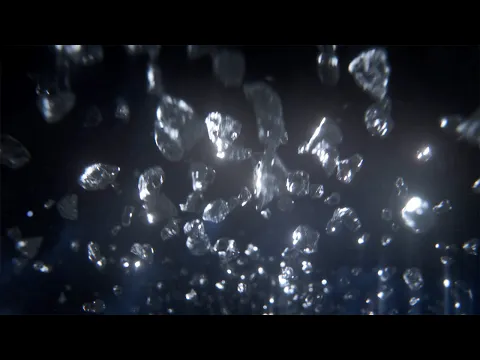

When this occurs, carbon atoms become free and are forced to reorganize. Physics takes care of the rest: the most stable arrangement for carbon under these pressures is the crystalline structure of diamond. The result is the spontaneous formation of tiny crystals that, when they accumulate, become grains and solid blocks.
These diamonds, denser than the surrounding material, sink slowly, creating what scientists describe as a diamond rain — not in the human visual sense, but as a continuous flow of solid crystals moving to deeper layers of the planet.
The Phenomenon Is Not Hypothesis: It Has Been Reproduced in the Laboratory
For decades, this idea existed only as a theoretical model. That changed when laboratory experiments managed to reproduce the internal conditions of Uranus and Neptune on a microscopic scale.
In high-energy physics facilities, researchers subjected carbon-rich plastics to ultra-fast shock waves, using high-powered lasers. These materials — chemically similar to compounds found in the ice giants — were compressed and heated in fractions of a second.
The result was unequivocal: diamonds formed before the sensors. The detection was done using X-ray diffraction, a technique capable of identifying the exact crystalline structure of the produced material. They were not metaphors or approximations: they were real diamonds, created in the laboratory under planetary conditions.
These experiments confirmed that the process is physically plausible and, more than that, inevitable when the correct parameters are met.
Why Uranus and Neptune Are Ideal Worlds for Diamonds
The internal composition of these planets is the key point. Both have mantles rich in:
- superpressurized water,
- ammonia,
- methane,
- and other organic compounds.
When these substances are subjected to extreme pressures, hydrogen separates from carbon. Hydrogen tends to migrate, while carbon compacts and crystallizes.
Planetary models indicate that this rain of diamonds occurs thousands of kilometers below the visible clouds, in regions completely inaccessible to direct observation. Still, the effects of this process may influence:
- the distribution of internal heat,
- the dynamics of the magnetic fields,
- and even the thermal evolution of the planet over billions of years.
Cosmic Diamonds Are Not Rare, They Are a Consequence of Physics
What makes this curiosity even more shocking is realizing that diamonds are not special to the universe. They are just one of the stable forms of carbon under certain conditions. Where there is carbon and sufficient pressure, diamonds emerge.
This means that:
- giant planets outside the Solar System,
- carbon-rich exoplanets,
- and even massive interstellar objects
may harbor similar processes. On a cosmic scale, diamonds may be common, while on Earth they are rare simply because the necessary conditions are exceptional and localized.
Why This Discovery Changes How We See Other Worlds
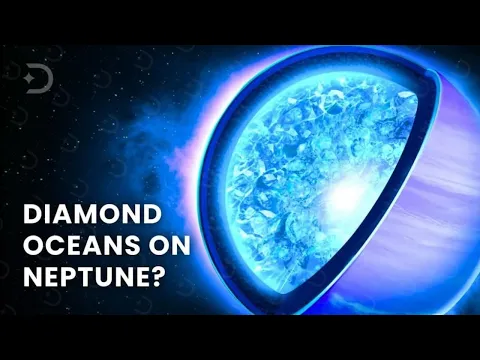
The “diamond rain” is more than an extravagant curiosity. It shows that:
- complex chemical processes happen without life,
- valuable materials for humans are trivial to physics,
- and distant planets are dynamic, active, and violent systems.
This data helps scientists refine planetary formation models and understand why Uranus and Neptune emit more heat than expected, despite being so far from the Sun.
A Sky That Literally Rains Jewels, But We Will Never See
Despite the catchy name, this rain would not be pleasant to observe. It occurs in dark, deep, and crushing regions where no spacecraft would survive.
Still, the mere fact that jewels fall from the sky on other worlds is a powerful reminder of how the universe operates on scales and conditions that defy any human intuition.
Few know, but while we look at the night sky thinking of stars and constellations, somewhere in the Solar System diamonds are forming and sinking right now, silently, under millions of atmospheres of pressure.







-

-

-

-

-

8 pessoas reagiram a isso.